
IM Certified® Blog

When is a number line not a number line?
By William McCallum The number line is a seemingly simple object: a straight line with two points marked 0 and 1. Those two points are the seeds of great complexity, however. Whole numbers are located at positions marked off by iterating the interval. Fractions are...

The Art of Reflection
“In times of stress, the best thing we can do for each other is to listen with our ears and our hearts and to be assured that our questions are just as important as our answers.” —Mr. (Fred) Rogers By Kaneka Turner We are never more “on” than when we are teaching a...

Ratio Tables are not Elementary
By William McCallum In grade 3, as students start to learn about multiplication, they think about products like 6 x 7 in terms of equal groups. 6 x 7 is the number of things when you have 6 groups with 7 things in each group. They might start out calculating that...

Could you—or someone you know—be our newest IM Certified Facilitator? The Critical Role of IM Certified Facilitators.
“What I find distinguishes IM is that IM Certified Facilitators are uniquely supported by the IM authoring team to ensure the integrity of the curriculum remains intact.” By Kiana Porter-Isom I was always interested in mathematics as a student but I only began...
Using Diagrams to Build and Extend Student Understanding
When students notice things, we often ask, ‘Why is that happening?” but it can be challenging to explain why beyond the procedure one followed.
But fifth graders are brilliant.

The 5 Practices: Looking at Differentiation Through a New Lens
By Catherine Castillo Our district had seen a downhill trend in standardized test scores in mathematics. This forced us, as educators, to take an intentional look at our teaching practices. The past few years have been an exciting time in math instruction. Research on...

Learning through Teaching
By William McCallum I was in New Orleans a couple of weeks ago visiting a school using IM 6–8 Math and was inspired by the efforts the school was making to implement problem-based instruction. I saw teachers at different stages on a learning curve with the...
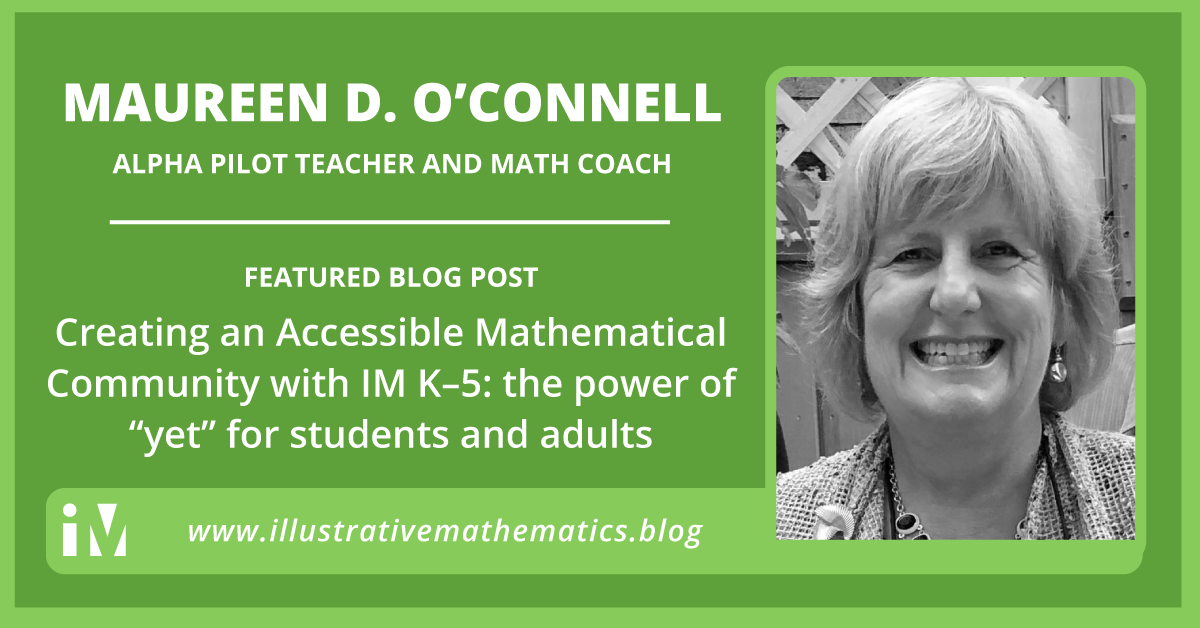
Creating an Accessible Mathematical Community with IM K–5: the power of “yet” for students and adults
Does the perfect elementary math curriculum exist? Armed with a growth mindset and the Alpha IM K–5 curriculum, teachers in Ipswich Public Schools push their thinking to reach all mathematicians. By Maureen D. O’Connell I preach growth mindset daily. When my students...

Using Instructional Routines to Inspire Deep Thinking
We want students to think about math deeply. Creatively. Analytically. Instead, what often happens is that students race towards quick solutions. So what can we do to support this other kind of thinking in class—the slow, deep kind? By Jenna Laib One way is through...

Making Authentic Modeling Possible
The first thing you have to understand is that asking people to model with mathematics makes them mad. Not in all contexts, though! At a social gathering with a generally amiable and curious group of people, you might try floating a question like: I wonder if...