
IM Certified® Blog
Fraction & Decimal Number Lines
By Kristin Gray Recently, our 3rd, 4th, and 5th grade teachers had the opportunity to chat math for 2 hours during a Learning Lab held on a professional development day. It was the first time we had done a vertical lab and it felt like perfect timing as 3rd and 4th...

Respecting the Intellectual Work of the Grade
By Kate Nowak A thing that I think we did really well in Illustrative Mathematics 6–8 Math was attend carefully to really deep, important things that adults that already know math can easily overlook. For example, what does an equation mean? What does it...
Assessment Principles in Illustrative Mathematics 6-8 Math
By Bowen Kerins A wide-ranging team worked together to develop the Illustrative Mathematics Grades 6-8 Math curriculum. As Assessment Lead, it was my responsibility to write and curate the Shared Understandings document about assessments we used throughout...

Reflection & Discussions in Grade 8, Part 1
By Ashli Black Woo, blogging! As I start work on high school curriculum, I thought I would go back and revisit the grade 8 units that I’ve spent the past 18 months working on and share some of my favorite things. This gives me a chance to think about what sorts of...
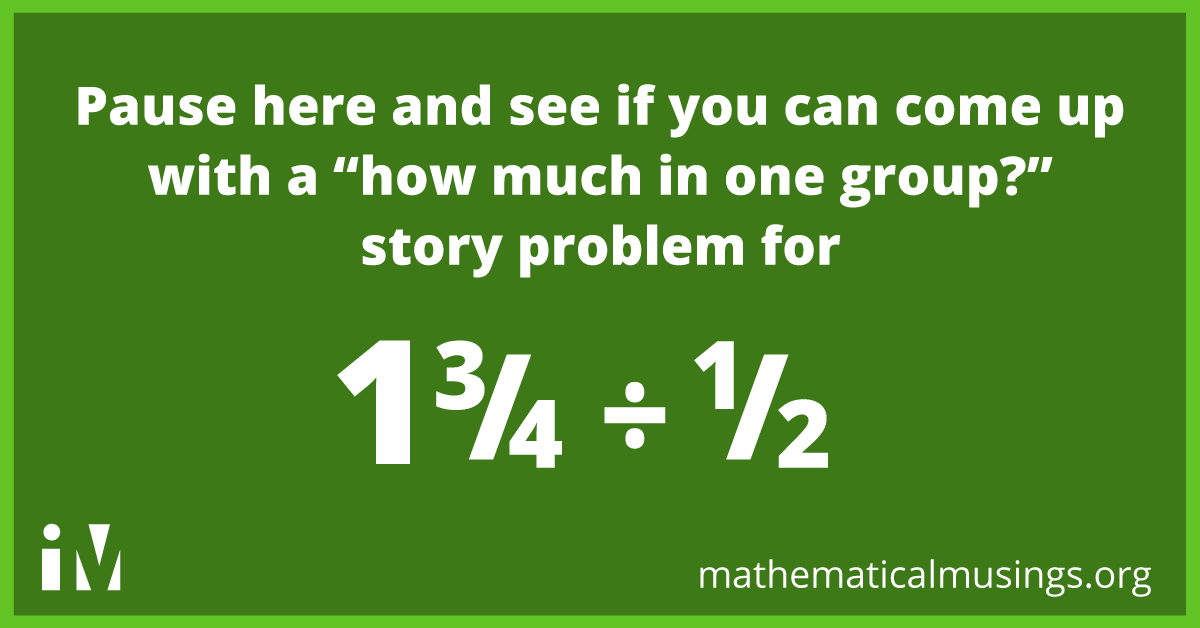
Fraction division part I: How do you know when it is division?
By William McCallum and Kristin Umland In her book Knowing and Teaching Elementary Mathematics, Liping Ma wrote about this question and how teachers responded to it: Write a story problem for $1 ¾ \div ½$. [Pause here and think about the answer yourself.] Many people...
Truth and consequences: talking about solving equations
By William McCallum The language we use when we talk about solving equations can be a bit of a minefield. It seems obvious to talk about an equation such as $3x + 2 = x + 5$ as saying that $3x+2$ is equal to $x + 5$, and that's probably a good place to start. But...
Ways of thinking and ways of doing
By William McCallum Somewhere back in days of Facebook fury about the Common Core there was a post from an outraged parent whose child had been marked wrong for something like this: $$ 6 \times 3 = 6 + 6 + 6 = 18. $$ Apparently the child was supposed to do $$ 6 \times...
Misconceptions about Multiple Methods
By William McCallum You may have noticed that I am back to publishing regular blog posts! My goal for now is a blog post every second Wednesday. I am now also trying to answer forum questions promptly. I want to thank the readers who took up the slack for the last...
The Structure is the Standards
Co-authored by Bill McCallum, Jason Zimba, Phil Daro You have just purchased an expensive Grecian urn and asked the dealer to ship it to your house. He picks up a hammer, shatters it into pieces, and explains that he will send one piece a day in an envelope for the...