By the Illustrative Mathematics team
When districts commit to high-quality instructional materials and the conditions that make strong implementation possible, the impact on student outcomes can be powerful—and measurable.
A new case study from Columbia University’s Center for Public Research and Leadership (CPRL) highlights exactly that kind of story. In New York City’s District 11 in the Bronx, sustained investment in IM® Math, paired with systemwide coherence and continuous improvement, led to significant math gains for students across grade levels and subgroups.
A Clear Starting Point: Math Outcomes Were Too Low
Before District 11 made changes to its math program, student outcomes told a troubling story. Math proficiency was well below city benchmarks, hovering at around 30%. Despite hard work from educators, too many students—especially English learners and students with disabilities—were not getting consistent access to grade-level instruction.
District leaders didn’t respond with short-term fixes. Instead, they asked a harder question: What would it take to build a system where strong math instruction was the norm in every school?
Choosing a Shared, High-Quality Math Curriculum
One of District 11’s first moves was a shift to IM Math as a shared districtwide curriculum. This decision was supported by external partners, including Bank Street College of Education, who helped assess existing materials and instructional practices.
Moving to a single, research-based math curriculum with an emphasis on both conceptual understanding and procedural fluency created immediate coherence:
- Teachers across schools were planning with the same materials.
- Professional learning could focus deeply on instructional practice, rather than on navigating multiple programs.
- Students who transferred schools within the district no longer experienced gaps or unnecessary repetition in math content.
As District Achievement Instructional Specialist Barbara Faughnan noted in the CPRL case study, having all schools use the same math curriculum “allows for so much more collaboration”—something that had been nearly impossible when schools used multiple programs.
Implementation That Went Beyond Materials
District 11’s math gains didn’t come from curriculum adoption alone. Leaders paired IM Math with robust implementation supports, including:
- ongoing instructional coaching specifically aligned to IM Math’s structure and lesson design
- digital grade-level “Playbooks”—instructional guides that were continually updated to capture pacing guidance, adaptations, and effective practices
- daily walkthroughs using shared look-fors tied directly to the curriculum
Most importantly, leaders expected a learning curve. Teachers were encouraged to implement IM with fidelity and to learn over time how to adapt lessons for their classrooms without reducing rigor—especially for students with disabilities and English learners.
Math Gains That Reached All Students
From 2023 to 2025, the impact in District 11 was clear.
Across grades 3–8, math proficiency increased by 10.3 percentage points overall. Gains were even more meaningful for historically underserved students:
- +6.6 percentage points for students with disabilities
- +9.4 percentage points for English language learners
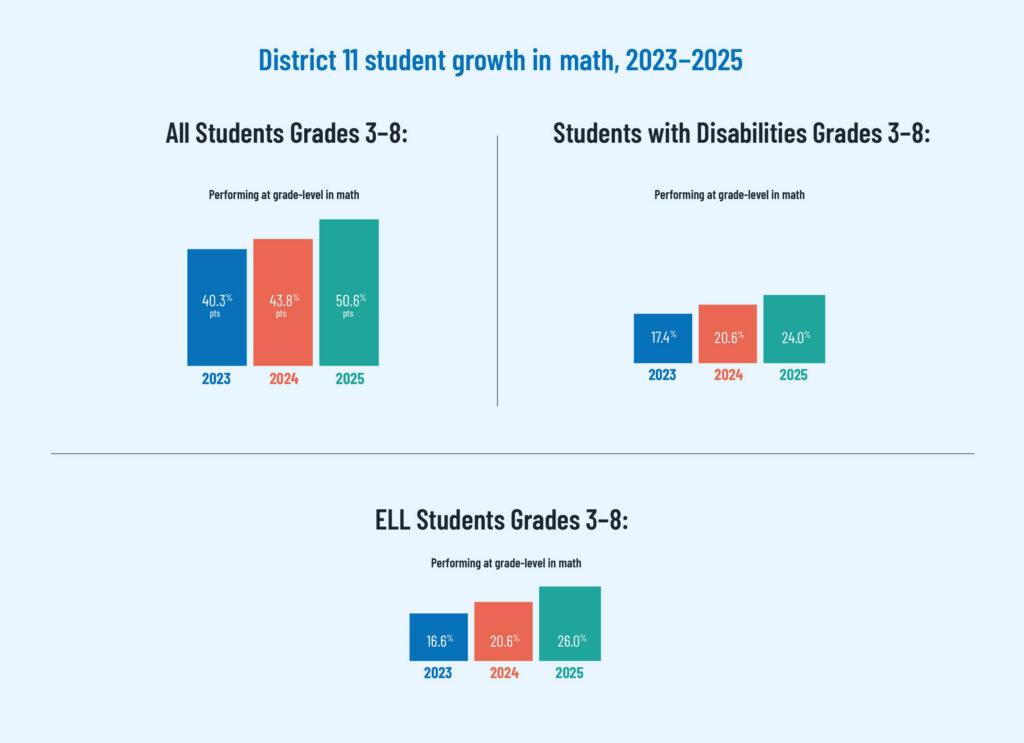
Looking over a longer time span, District 11 surpassed pre-pandemic math proficiency levels, and the number of students performing significantly below grade level reduced by almost 20 percentage points between 2018 and 2025.
These were not isolated gains at the top—they reflected broader access to grade-level math learning.
Conclusion
District 11’s story reinforces a core lesson we see again and again: High-quality math curriculum matters most when it’s implemented as part of a coherent system.
IM Math provided the foundation, but the district’s commitment to shared expectations, professional learning, and continuous improvement made the difference. Teachers grew more confident, students engaged more deeply in mathematical thinking and fluency skills, and leaders used data not as a verdict, but as a guide.
Crucially, District 11 leaders continue to study what’s working by listening to educators and refining tools and processes to strengthen instruction over time.
As districts across the country look to improve math outcomes, District 11 offers a compelling example of what’s possible when everyone is working with the same strong materials and reaching higher together.
Next Steps
Inspired by NYC District 11’s results and curious what strong implementation could look like in your own school or district? A powerful next step is exploring IM K–12 Math through one of our certified curriculum distribution options:
- AccessIM provides completely free digital access to the curriculum.
- Kendall Hunt uses the same free digital platform but reduces the need for printing by allowing schools to purchase ready-made student and teacher books, along with lesson slides.
- Imagine Learning or Kiddom are paid subscription platforms that offer enhanced digital capabilities with rostering and reporting tools, along with access to print materials.
Not sure which path is right for your context? Schedule a call with a member of our Client and Partner Success team or email us at [email protected]. We’re happy to discuss your goals, answer questions, and collaborate on a plan for what strong, sustainable IM Math implementation could look like in your district.
District 11’s story is one of several featured in CPRL’s new All Systems Go project, which examines how shared, high-quality curriculum and professional learning are fueling learning gains across districts. Learn more at itsallsystemsgo.org.