Lesson Planning

Anatomy of an IM® Math Lesson: Why Centers Matter

Anatomy of an IM® Math Lesson: Why Centers Matter

by Lindy Olejniczak, PK–6 Content Specialist In this series of blog posts—The Anatomy of an IM® Math Lesson—we’re taking a closer look at each part of an IM® Math lesson and how it contributes to meaningful student learning. After exploring the launch and warm-up in...

read more
Anatomy of an IM® Math Lesson: Making the Launch Work for You

Anatomy of an IM® Math Lesson: Making the Launch Work for You

By David Petersen, Specialist, 5–12 Content In this series of blog posts—The Anatomy of an IM® Math Lesson—we’ll take a closer look at each part of an IM Math lesson and how it contributes to meaningful student learning. We begin with the launch: the moment that helps...

read more
Pacing with Purpose in IM® Math

Pacing with Purpose in IM® Math

By Sarah Caban, Director, PK–12 Learning Experiences A snow day. An assembly schedule. A class that needs more time to build understanding before moving on.  Suddenly, you’re behind and asking yourself: Should I . . . rush the next lesson? skip activities? cut...

read more
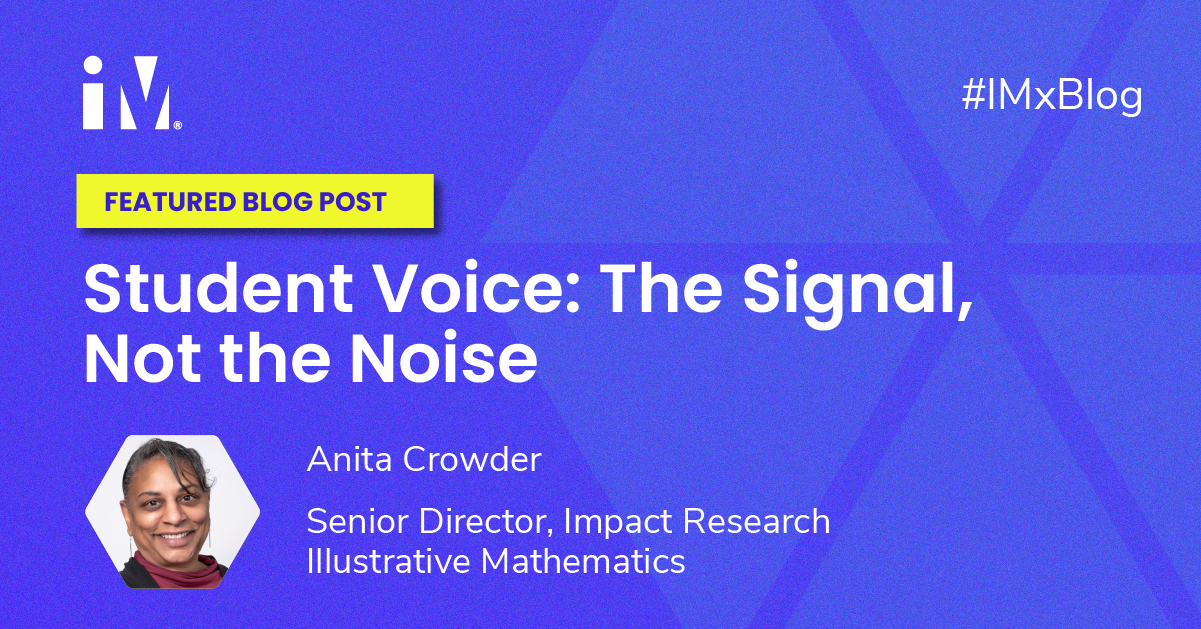
Student Voice: The Signal, Not the Noise

Student Voice: The Signal, Not the Noise

By Anita Crowder, PhD, Senior Director of Impact Research An ideal Illustrative Mathematics (IM) classroom is one where students’ curiosity drives learning, their feedback shapes instruction, and their identities are embedded in every mathematical task. Student voice...

read more
What Is Right About Wrong Answers?

What Is Right About Wrong Answers?

When I first started teaching, at the end of each day, I would open my teacher’s guide, grab my pen, and thumb through the stack of completed worksheets. My eyes would dart quickly from the red answers in the teacher’s guide to the corresponding answers on each...

read more

to the IM Blog and Newsletter

Giveing Tuedsday Heart

Support Free Math Instruction for All Learners

As a nonprofit, we rely on the support of our generous community. Each contribution allows us to reach more classrooms, develop new educational materials, and create opportunities that inspire curiosity and a love for learning.