
By Lindy Olejniczak, PK–6 Content Specialist
This past year, I was playing with my friend’s 2.5-year-old sons. The “game” started with bringing colored balls from a ball pit and tossing them to me. As I caught each one, I began arranging them in different ways. At one point I thought, “I wonder what they would do if I sorted them by color.”
As the kids ran off to collect more balls, I quickly made three piles on the floor: white, light blue, and dark blue. When the boys returned, they paused to assess the new situation. After only a few seconds and without prompting, they placed their balls into the matching color groups and ran off to collect more.
Soon, one of the boys came back holding a white ball. Very carefully, he placed it in the middle of the light blue ball pile. Some of my friends quickly pointed it out, saying, “One is wrong. Can you fix it?” He stopped, looked back at the pile, then picked up the white ball and moved it to the white pile.
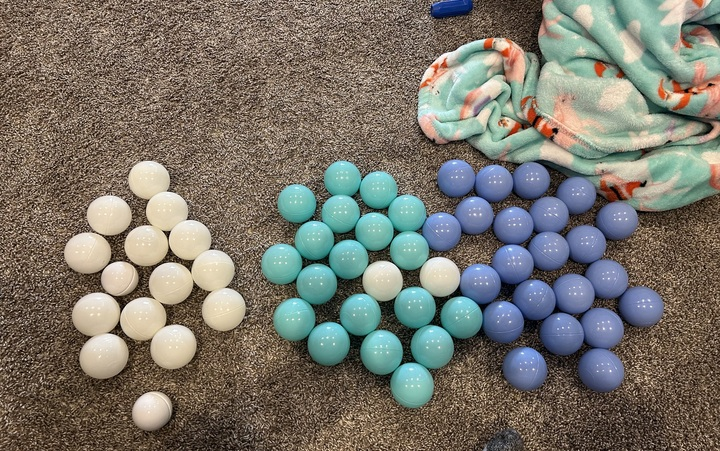
When he came back for another round, however, he did it again. This time, before anyone had the chance to intervene, he proudly said, “Flower.”
That moment stopped me in my tracks.
It reminded me how natural it is to project our own expectations onto young children’s actions—and how much we miss when we don’t pause to truly observe.
The child wasn’t “wrong.” His goal was simply different.
While the adults assumed he was sorting by color, he was actually recreating a structure he had seen me build earlier. Imagine how it must have felt to be told he was wrong when, in his mind, he had successfully created a flower!
And his goal wasn’t just different—it was mathematical. He was remembering a structure, attending to placement, and intentionally recreating a pattern. Yet without his words, we might have completely missed this meaningful thinking.
Seeing Mathematical Thinking in Play
Moments like this are unfolding every day in Pre-Kindergarten (PK) and Transitional Kindergarten (TK) classrooms across the country, and especially in California. As the state continues to expand TK, educators are welcoming more four-year-olds into school communities and navigating how to preserve curiosity while deepening mathematical thinking.
Inquiry Play in IM’s new Transitional Kindergarten curriculum was built for this balance—supporting play-based learning while meeting California’s growing expectations for early mathematics.
In IM® TK Math, Inquiry Play centers invite students to explore objects, ideas, and spaces in open-ended ways. Materials are intentionally selected to encourage sorting, building, arranging, counting, and patterning—not to lead students to a single outcome, but to reveal how they are making sense of the world.
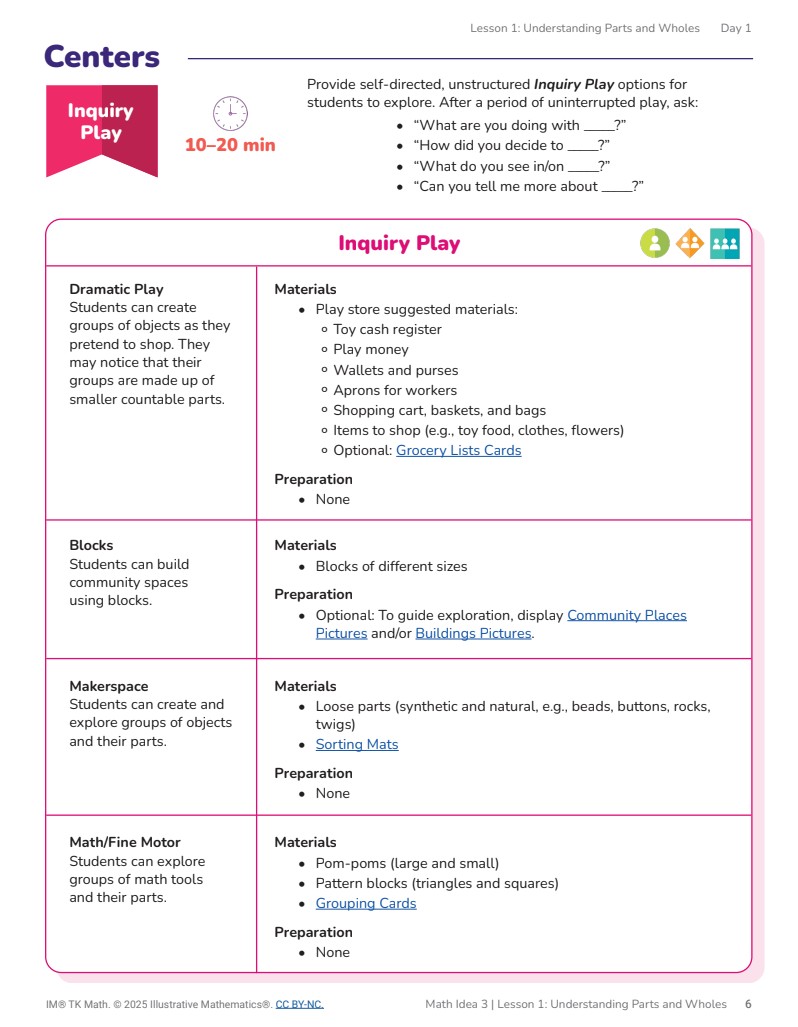
For PK and TK students, mathematical thinking often shows up before formal language or symbols. It appears in how children organize materials, notice similarities and differences, remember structures, and return to ideas again and again. Inquiry play creates the conditions for this thinking to emerge, and for teachers to notice it.
For California TK educators navigating early learning standards and district guidance, this balance matters. Inquiry play supports the development of mathematical thinking—such as noticing structure, making comparisons, and persisting through challenges—without rushing students into formal procedures before they’re ready.
Letting Students Lead—and Teachers Learn
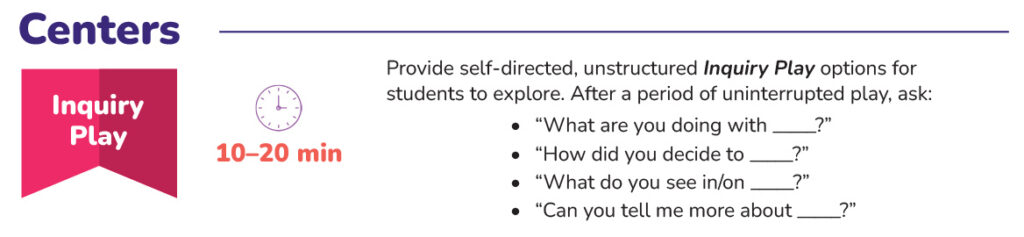
IM TK Math’s Inquiry Play centers are intentionally designed to give students agency while positioning teachers as keen observers and listeners. Teachers are encouraged to allow a period of uninterrupted play before stepping in with suggested questions like “What are you doing with ___?”
 In a state like California, where TK classrooms reflect a wide range of developmental experiences and cultural backgrounds, this kind of observation is essential. When educators slow down and watch carefully, they gain insight into not just what students can do but what they are trying to do—the patterns they notice, the structures they build, and the ideas they return to. That understanding allows instruction to be responsive rather than reactive, and grounded in students’ thinking and ideas rather than adult assumptions.
As teachers observe and reflect on students’ play, they also gather valuable information to shape future instruction: which materials to offer next, which ideas to revisit, and how to build bridges between informal exploration and more explicit mathematical learning.
Conclusion
IM TK Math’s Inquiry Play spaces are designed not only to support mathematical thinking but to honor students as thinkers and leaders of their own learning.
In PK and TK classrooms across the country, we have a powerful opportunity to protect curiosity while nurturing early mathematical understanding. By pausing, observing with intention, and asking open-ended questions like, “Can you tell me more about what you’re doing?” we can create learning environments where students feel seen, heard, and capable.
Next Steps
In our Inquiry Play centers and throughout IM classrooms, we can slow down and truly see our learners. We can pause and observe with intention and wonder. These small shifts invite students to share their thinking, deepen their learning, and feel genuinely heard.
Let’s commit to creating spaces where students lead the way. Stay curious, friends.
For more information on IM’s TK Math curriculum, visit knowim.org/TK.
 Lindy Olejniczak
PK–6 Content Specialist
Lindy Olejniczak is a PK–6 Content Specialist with over a decade of experience as an elementary classroom teacher and mathematics coach. She is passionate about helping all students find joy in mathematics and see themselves as capable, confident learners. As part of Illustrative Mathematics PK-6 writing team, Lindy brings her classroom experience, coaching perspective, and commitment to meaningful math learning to life through engaging, student-centered curriculum materials.