By Rabell Afridi, Math Coach and Lindsey Duff, Gr. 3 SEI Teacher
In our multilingual 3rd grade math classroom one afternoon, students hurried to their desks, eager to get started on a problem. Before they were even seated, they were already debating their ideas.
The prompt asked whether they agreed or disagreed with the argument that the fraction 6/8 could describe a diagram in which 3 out of 4 parts were shaded.
“I respectfully disagree because there are only three parts shaded and four parts in the whole,” said one student. Nearby, another nodded along, until a third widened his eyes, grabbed his pencil, and began adjusting the diagram to show 6/8, eagerly explaining his reasoning to the others.
Moments like this show what’s possible when multilingual learners (MLs) have access to rich mathematical tasks and the language supports needed to engage fully. They are not just participating—they are reasoning, revising, and making their thinking visible.
Why Language Support Matters in a Problem-Based Math Curriculum
That need for intentional support is especially clear in schools like ours, where students speak more than 25 languages. In our 3rd grade Sheltered English Immersion classroom alone, 10 newcomer students represent 10 different home languages.
Many students also arrive with prior experiences centered on procedures and memorization, so the shift to a language-rich, problem-based curriculum like IM® Math may initially feel overwhelming. In those moments, it can be tempting to fall into the trap of simplifying grade-level math rather than increasing access to the language students need to engage with it.
However, through thoughtful planning and intentional scaffolds, we have found a way to help students build independence, strengthen problem-solving skills, and develop the language needed to collaborate with peers. IM Math makes this possible, offering a dynamic structure that gives multilingual learners access to cognitively demanding grade-level content while simultaneously strengthening language development.
How IM Math Creates a Language-Rich Learning Environment
Rich Language in Context
IM Math embeds Tier II and Tier III vocabulary directly into lessons, allowing teachers to introduce and reinforce academic language in context.
In this Grade 5 activity, for example, students encounter academic language repeatedly within problem contexts, helping vocabulary become part of active mathematical reasoning rather than isolated word study.
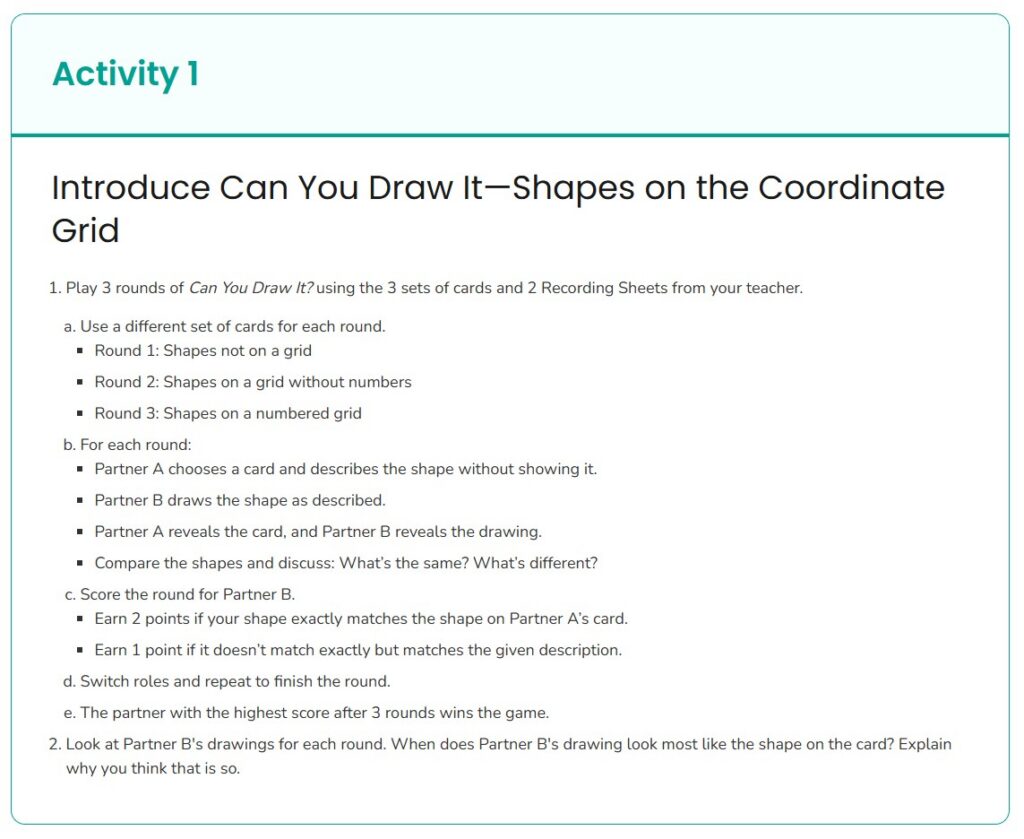
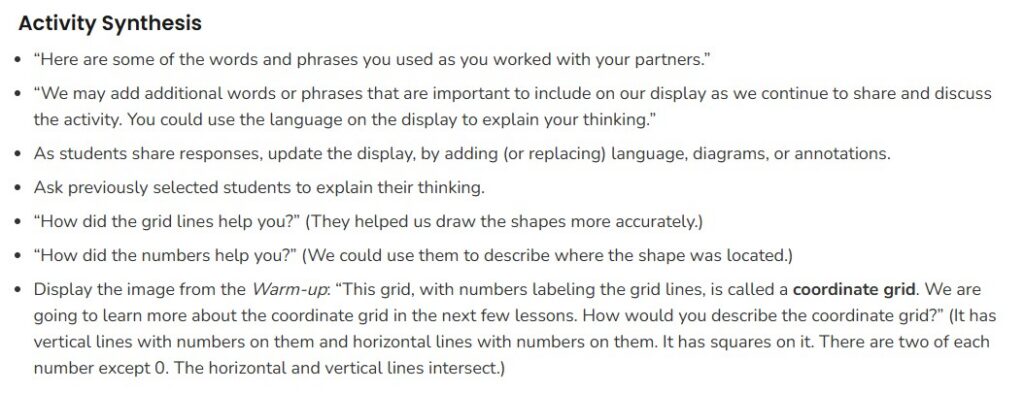
Language development in IM Math goes beyond vocabulary. Students are regularly asked to describe, explain sequences, compare and contrast, justify reasoning, and suggest ideas, as in this Grade 3 activity:
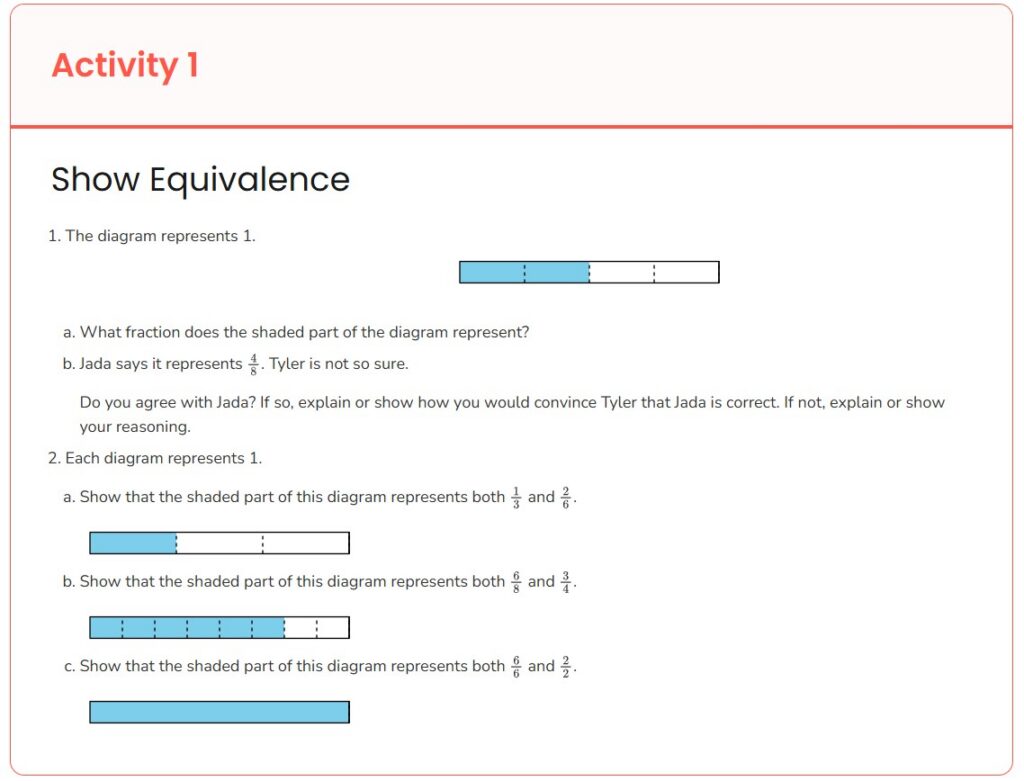
These language functions are not incidental—they are central to completing IM tasks.
Collaboration as Language Practice
IM Math promotes peer-to-peer interaction as a central learning tool. Students work in pairs or small groups in low-stakes settings, allowing them to practice mathematical language without fear of mistakes.
These tasks are designed so students can be “experts,” explaining their reasoning to classmates, responding to questions, and building understanding together. In this Grade 2 activity, students solve together, explain methods aloud, and listen to one another’s approaches before sharing with the class:
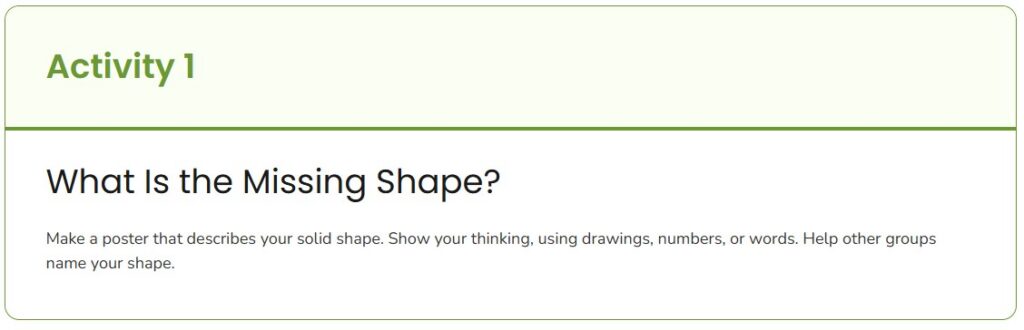
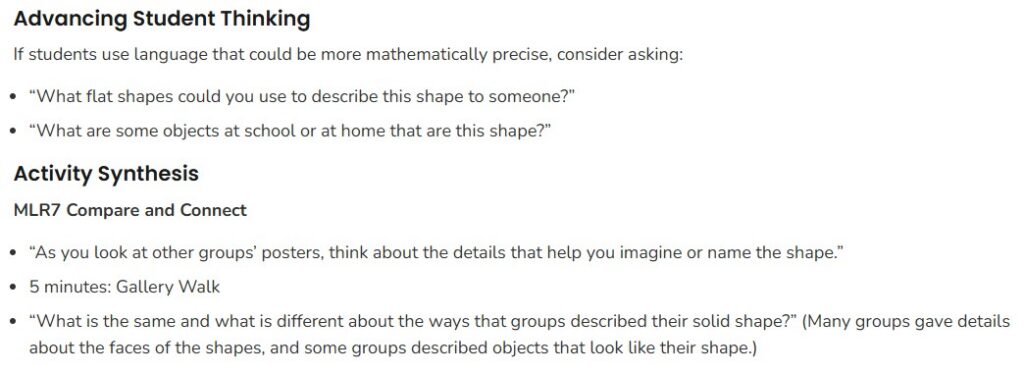
Because students regularly explain, listen, and revise ideas together, collaboration becomes a powerful support for oral language development. This kind of authentic collaboration gives multilingual learners meaningful opportunities to engage in academic discourse while strengthening conceptual understanding.
Predictable Routines That Lower Language Barriers
Routine structures in IM Math help multilingual students predict what comes next and focus on content rather than logistics:
- Think Time: Built-in pauses give students space to process language and plan responses.
- Warm-ups: Repeated formats such as “Which 3 Go Together?” scaffold participation from day one.
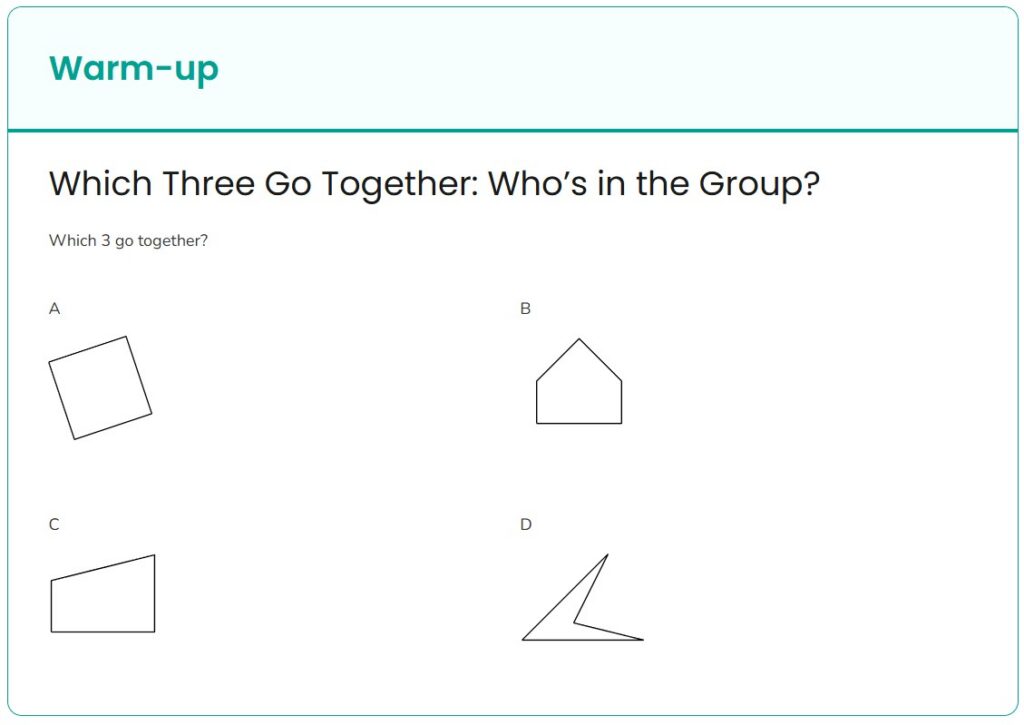
- Syntheses: Structured reflection prompts help students practice using precise academic language in whole-class discussions.
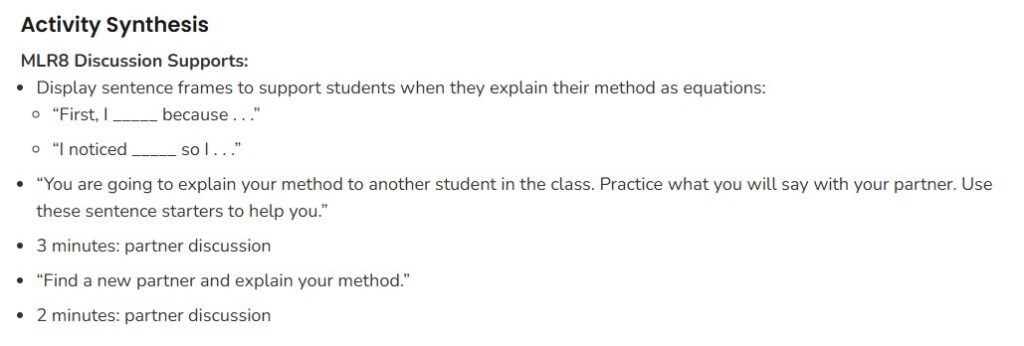
Because routines remain consistent, students can devote more cognitive energy to reasoning and communicating.
Visuals and Tools That Support Meaning-Making
Physical manipulatives, visual models, and the concrete-to-representational-to-abstract progression in IM Math help multilingual learners connect new vocabulary to relevant experiences.
For example, students may move from tile arrays to area models to multiplication expressions, linking concepts to language and symbols at each stage. Visual supports and manipulatives give students a reference point when using unfamiliar terms, reinforcing both conceptual understanding and academic language.
These tools are especially valuable for newcomers, who often benefit from seeing and experiencing mathematical ideas before describing them.
Built-In Supports for Multilingual Learners
IM Math provides specific scaffolds that help students access rigorous tasks while building language.
- Glossaries and sentence frames: Key vocabulary and sentence starters support describing, explaining, and justifying.
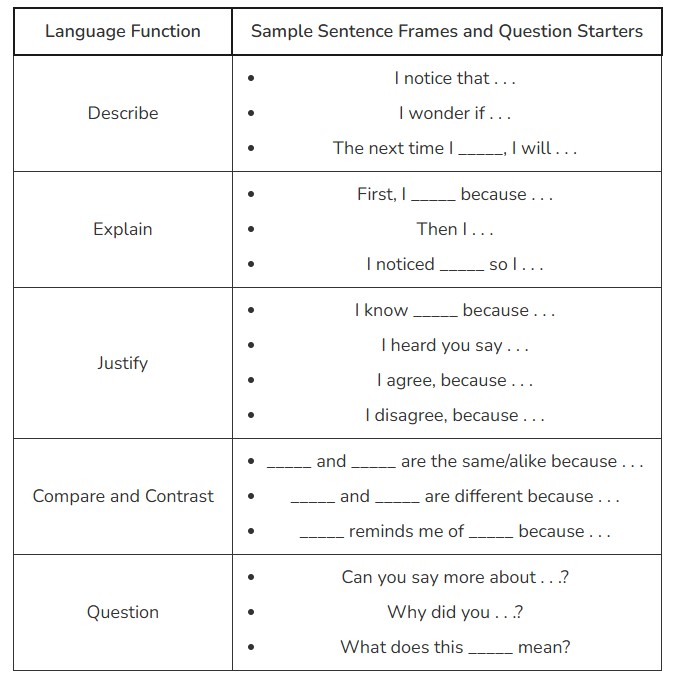
- Consistent contexts: Repeated story contexts reduce unnecessary language load across lessons.
- Culturally relevant examples: Incorporating cultural references, such as Pilolo (a traditional Ghanaian children’s game) or azulejos (decorative Portuguese and Spanish tiles), helps students connect mathematics to their lived experiences.
- Spanish version: In dual-language settings, this resource helps students access concepts while strengthening home-language connections.
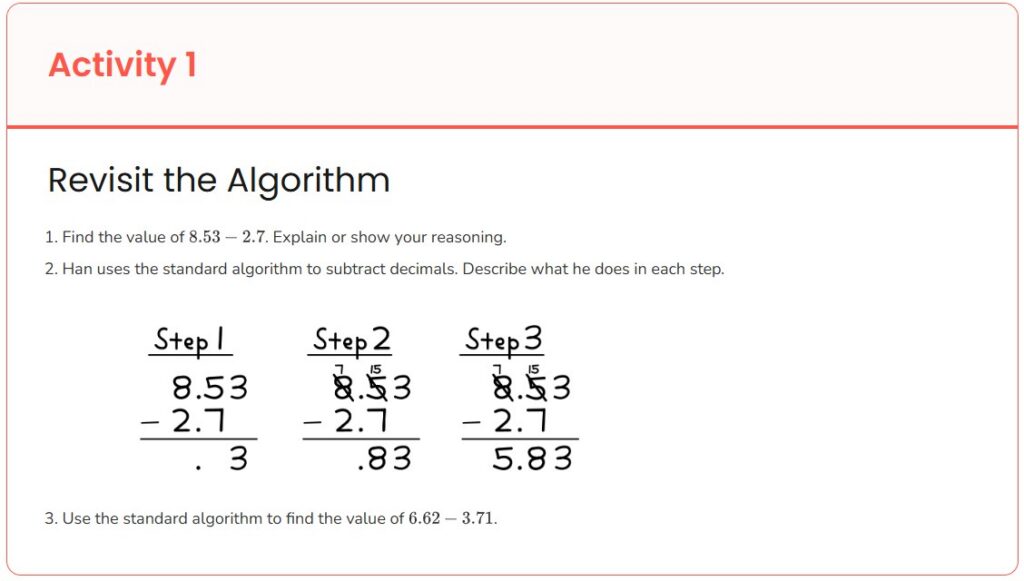
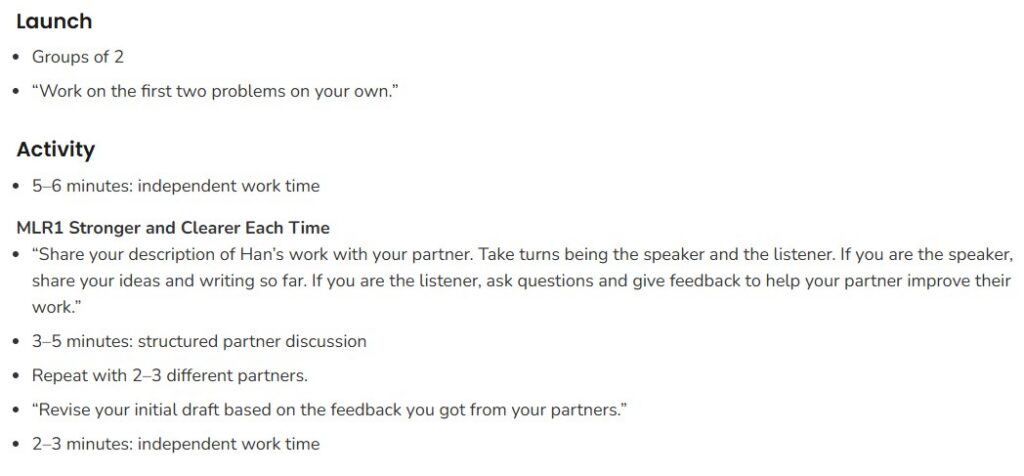
- Math Language Routines: Routines such as Stronger and Clearer Each Time encourage students to communicate their ideas as clearly as they can and give each other feedback. This not only supports discussion but also engages students in Math Practice 3: Construct viable arguments and critique the reasoning of others. For example, in this Grade 5 activity, students revise explanations after hearing a partner’s thinking, strengthening both clarity and mathematical precision:
Additional Supports for Newcomers
For students just beginning to learn English, additional scaffolds can make a significant difference:
- Use vocabulary visuals and photos to introduce context.
- Offer simple sentence frames and numberless story problems.
- Act out tasks in upper grades when possible.
Teachers can also help students draw on home languages to make sense of mathematical ideas and notice how concepts may be expressed differently across languages.
For example, in Japanese, the denominator is spoken before the numerator when naming a fraction. Noticing differences like this helps teachers connect new mathematical language to structures students may already know.
These strategies allow newcomers to access the math while gradually developing confidence in the language.
For California Classrooms, These Supports Matter Even More
In California classrooms, where multilingual learning is a daily reality, these design features align closely with priorities for Sheltered English Immersion (SEI) and dual-language programs.
Educators can strengthen implementation by:
- using sentence frames consistently to support structured mathematical discourse
- providing repeated, scaffolded opportunities for collaborative discussion
- integrating culturally familiar examples that connect math learning to students’ lives outside the classroom
The California edition of IM Math highlights these supports and examples to reflect the state’s diverse student population.
Conclusion
Supporting multilingual learners in a problem-based curriculum begins with protecting the rigor of the mathematics while expanding access to its language.
Effective scaffolding does not lower expectations. Instead, it helps students:
- participate meaningfully in grade-level problem solving
- build mathematical language in context
- collaborate with peers and justify their thinking
Thoughtful use of IM Math’s routines, visuals, manipulatives, and language supports allows multilingual learners to engage deeply with math without reducing cognitive demand, giving every student the opportunity to know, use, and enjoy mathematics.
A Question to Carry Into Your Next Lesson
As you plan upcoming lessons, consider this question:
Am I simplifying the math, or am I increasing access to the language students need to engage with it?
Small instructional shifts can help multilingual learners stay connected to rigorous mathematical thinking while building confidence in mathematical discourse.
Try choosing one familiar IM Math routine this week—such as a warm-up, synthesis, or partner discussion—and consider what language support might help students participate more fully. A simple sentence frame, visual cue, or extra think time can make grade-level mathematics more accessible without changing the mathematical demand.
 Rabell Afridi
Math Coach
Rabell is an instructional coach in Cambridge who is passionate about helping teachers bring math to life for young learners. Originally from California, she spent all of her years in the classroom teaching there before transitioning into coaching. She now partners with Gen Ed and SEI K–5 educators to design meaningful learning experiences that build students’ confidence, curiosity, and problem-solving skills. Rabell is especially committed to cultivating strong math identities for students who have been historically marginalized, recognizing that mathematics often serves as a gatekeeper to future opportunities.
 Lindsey Duff
Gr. 3 SEI Teacher
Lindsey teaches in a Gr. 3 Sheltered English Immersion classroom that serves multilingual newcomers from all over the world. She scaffolds IM Math lessons to make them accessible for students who bring a wide variety of linguistic resources and are at the beginning of their journey to learn English. She loves learning languages and math strategies from her students! She has a master’s degree in elementary education and is completing a master’s degree in applied linguistics.