By the Illustrative Mathematics team
Pittsburgh Public Schools’ (PPS) third-grade proficiency rates nearly doubled just two years into implementing IM® Math through Imagine Learning, one of our IM Certified® curriculum distribution partners. But behind these recent gains is something deeper than strong materials.
The district has committed to building classrooms where all students can engage meaningfully in mathematics—supported by strong Tier 1 instruction, thoughtful use of data, and an intentional classroom culture that values thinking.
Using Data as a Tool for Growth, Not a Label
Alongside state assessments, PPS uses the Pennsylvania Classroom Diagnostic Tool (CDT) to better understand student learning trajectories throughout the year. Early CDT results often show many students in lower performance ranges—particularly at the beginning of the year before grade-level instruction has occurred.
Rather than viewing these results as indicators of student limitations, PPS treats them as system-level signals. The information helps:
- identify instructional priorities
- strengthen Tier 1 core instruction
- guide professional learning and coaching supports
In 2025, mid-year CDT results showed promising movement: From fall to winter, the percentage of third-grade students performing at or above grade level in math more than doubled, with growth seen across all student groups, including Black students, English learners, students with IEPs, and economically disadvantaged students.
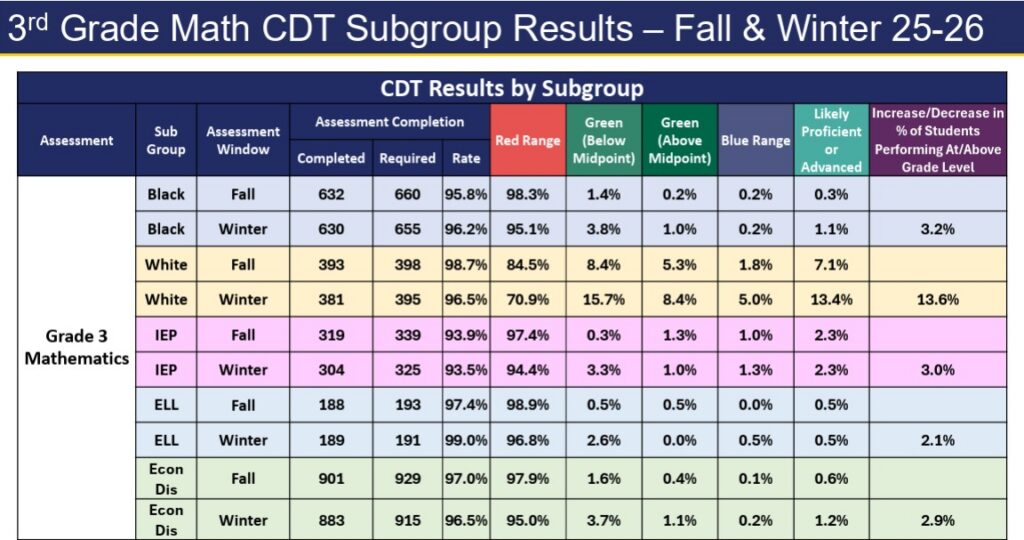
Source: Pittsburgh Public Schools Board Presentation, 2025
These gains reinforce the belief that consistent access to rigorous, grade-level instruction—paired with the right supports—creates the conditions for student success.
Building Strong Mathematical Communities
At the center of PPS’s work is a commitment to creating classrooms where all students can engage meaningfully with mathematics. The district has focused on fostering positive math experiences, establishing shared classroom norms, and embedding practices that support student participation and confidence in daily instruction.
Professional learning has modeled strategies that encourage students to explain their thinking, take academic risks, and learn from one another. These approaches help create classroom environments where students are active contributors to mathematical conversations. As PPS moves forward, this work is no longer treated as a standalone initiative, but as a set of consistent, everyday practices reinforced through coaching and leadership support.
IM Math’s embedded math language routines (MLRs) play a central role in this work, providing students with structured ways to engage with complex problems, communicate reasoning, and access grade-level content—particularly for English learners and students who benefit from additional language supports.
Conclusion
PPS’s experience underscores a powerful truth: Sustained improvement doesn’t come from isolated interventions. It comes from coherent systems, thoughtful use of data, and a shared commitment to student thinking.
By centering instruction, community, and continuous improvement, PPS is building classrooms where all learners can thrive in mathematics.
Next Steps
In case you missed it, read Pittsburgh Public Schools, Part 1: Third-Grade Math Proficiency Nearly Doubles with IM® Math.
Inspired by PPS’s results and curious what strong implementation could look like in your own school or district? A powerful next step is exploring IM K–12 Math through one of our certified curriculum distribution options:
- AccessIM provides completely free digital access to the curriculum.
- Kendall Hunt uses the same free digital platform but reduces the need for printing by allowing schools to purchase ready-made student and teacher books, along with lesson slides.
- Imagine Learning or Kiddom are paid subscription platforms that offer enhanced digital capabilities with rostering and reporting tools, along with access to print materials.
Not sure which path is right for your context? Schedule a call with a member of our Client and Partner Success team, or email us at [email protected]. We’re happy to discuss your goals, answer questions, and collaborate on a plan for what strong, sustainable IM Math implementation could look like in your district.