
by Ashli Black, Director, 5–12 Content
You’re wrapping up the day’s lesson, head filled with all the things you saw on student papers and heard as you visited groups. You already have some ideas about what is going smoothly and what you’ll want to spend some extra time on in upcoming classes. But before you make adjustments to tomorrow’s lesson, you want some evidence to help you decide what comes next.
That’s what IM® Math cool-downs are designed to provide.
What is a Cool-down?
IM Math cool-downs are a type of exit-ticket designed to formatively assess students’ thinking about a math concept from that day’s lesson. They typically take about five minutes and give students an opportunity to independently show what they understand.
IM Math Lesson Structure
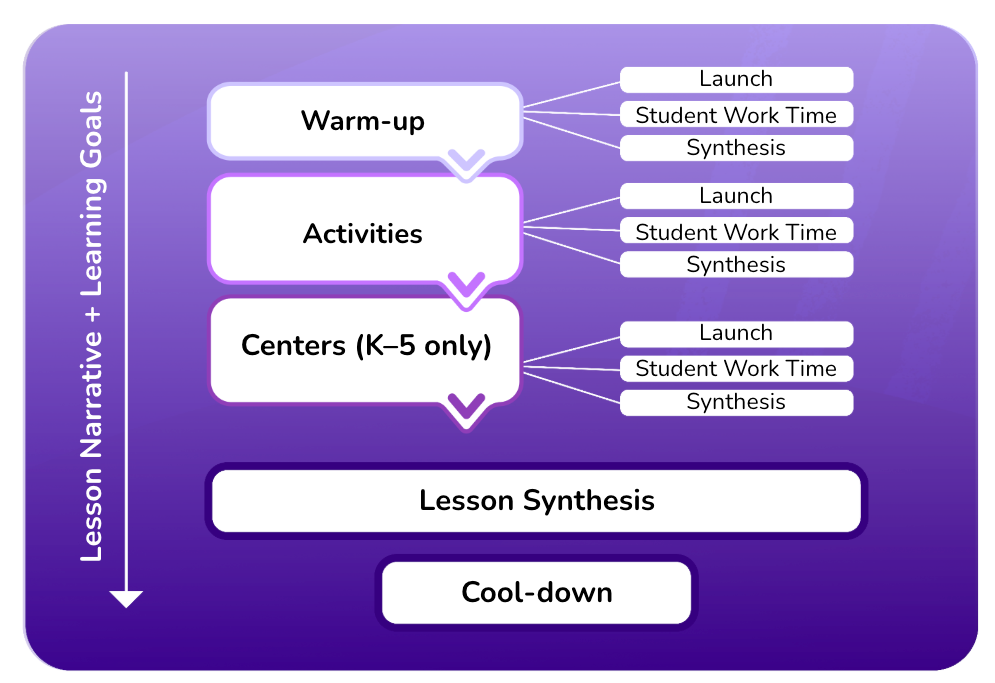
But the cool-down isn’t just about finding out whether students “got it.” It gives teachers evidence they can use to answer a more useful question:
What opportunity do my students need next?
Once the cool-downs are in hand, teachers can review student work and use that evidence to make decisions about upcoming instruction. To support those decisions, each cool-down is accompanied by “Responding to Student Thinking” guidance that suggests possible next steps.
That guidance looks a little different across grade bands, but the purpose is similar: support teachers in continuing grade-level mathematics while providing appropriate, aligned opportunities for students to strengthen their understanding.
In Grades K–5, “Response to Student Thinking” guidance falls into two categories:
- Next-Day Support offers ways to support students as they continue into the next lesson. Depending on the mathematics and anticipated student responses, that might mean providing a more concrete representation or another aligned support.
- Prior-Unit Support points teachers toward earlier work that connects directly to the concepts students are working to understand.
In Grades 6–12, “Responding to Student Thinking” falls into three categories:
- More Chances signals that students will see the content of the cool-down again, so there is no need to alter planned instruction for the class.
- Points to Emphasize suggests small adjustments that can be built into future lessons, such as inviting more students to share strategies in an upcoming activity, reviewing a specific practice problem with the whole class, or altering an activity launch to address a common error.
- Press Pause signals that students may need more time with the content before moving forward. The guidance may suggest adding in specific optional activities or lessons or revisiting content from earlier lessons or sections.
The categories are different, but the instructional decision at the heart of them is the same: What does this evidence of student thinking tell me about what to do next?
From Student Thinking to Instructional Decisions
Let’s take a closer look at how those decisions can play out across a sequence of lessons in IM 6–12 Math. In Section B “Area of a Circle,” of Grade 7, Unit 3, students work toward understanding how to calculate the area of a circle, recognizing that the area of a circle is not proportional to its diameter or radius and solving problems involving the area of a circle.
As students move through this work, their cool-down responses can help teachers decide whether to keep moving, emphasize an idea along the way, or pause to provide additional time.
More Chances: Keep Moving
The first lesson of the section, Lesson 6: Estimating Areas, invites students to estimate the area of an irregular polygon by decomposing it into more familiar shapes.
The “Responding to Student Thinking” for the lesson’s cool-down is tagged More Chances. Students are still early in their work with these ideas. In the lessons that follow, they will continue learning about and practicing how to calculate the area of more complicated shapes.

So even if the cool-down shows that some students have not yet solidified the idea, the teacher does not necessarily need to stop or add additional instruction. More opportunities to make sense of the mathematics are already built into the curriculum.
Points to Emphasize: Make a Small Adjustment
In Lesson 7: Exploring the Area of a Circle, students begin investigating the area of a circle by measuring and then graphing the relationship between the diameter and estimated area of a circle.
The lesson asks students to connect this work with prior work in proportional relationships. Earlier in the unit students established that the radius and circumference of a circle are proportional. Now, students use the graph and table they made during the lesson to recognize that the relationship between the diameter and area of a circle is not proportional. The cool-down for the lesson checks this understanding by asking students to explain their reasoning.
Here, the “Responding to Student Thinking” is tagged Points to Emphasize. Unlike the area of a circle, proportional relationships are not new to students. Students studied ratios and rates in grade 6 and spent the first two units of grade 7 on proportional thinking.
If cool-down responses show that students are having trouble making the connection, teachers have evidence that this familiar idea may need some additional emphasis. But that doesn’t necessarily mean stopping the progression of the unit.
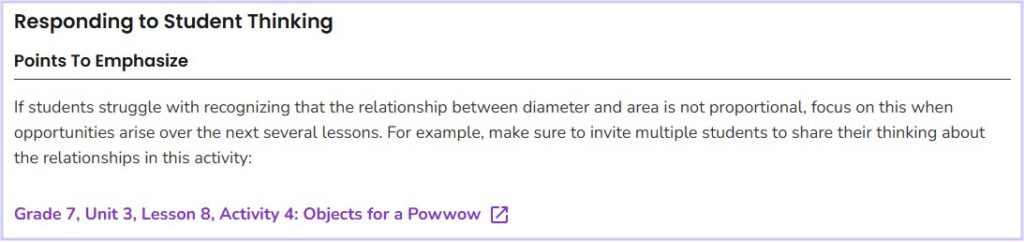
Instead, the guidance points teachers toward an activity in the following lesson in which students calculate the area of circles given a radius or a diameter. During the activity synthesis, students share their reasoning about the area, creating an opportunity for them to make sense of and articulate the difference between a proportional relationship and the relationship between a circle’s radius and its area.
The teacher can keep moving while intentionally making room for an idea that needs more attention.
Press Pause: Create More Time
By Lesson 10: Distinguishing Circumference and Area, students are nearing the end of the unit. Lesson 10 is the final non-optional lesson, and students have had multiple opportunities to develop their understanding of circumference and area. At this point, if cool-down responses show that students are struggling with calculating area and circumference, then it may be time to Press Pause.
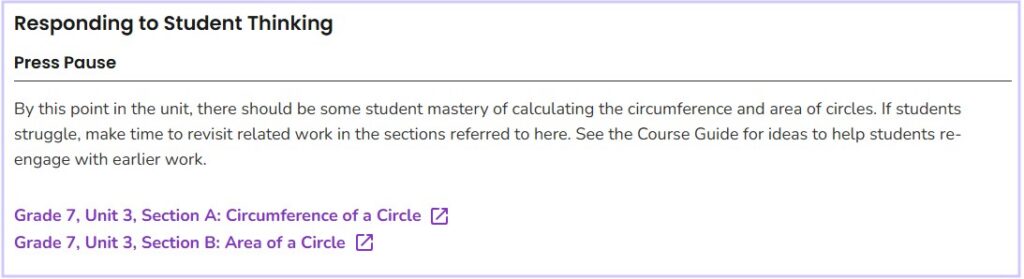
What that pause looks like depends on what an analysis of the cool-downs uncovers. The Course Guide’s Assessment Guidance section on cool-downs offers strategies for re-engaging students who need more time with a key concept or skill.
In Grade 7, Unit 3, for example, optional Lesson 11 invites students to work with a design for a stained glass window and price its components. That experience may provide just the kind of additional practice and sense-making students need to strengthen their understanding of circumference and area of circles before moving on.
Across these three examples, the cool-down isn’t determining what a teacher must do next. It is providing evidence to inform the decision:
More Chances: Keep moving; more opportunities are coming.
Points to Emphasize: Keep moving, but intentionally revisit an idea.
Press Pause: Make more time before moving on.
What If the Cool-down Guidance Isn’t a Match for What My Students Need?
Students and classes are unique. The guidance accompanying a cool-down offers one way to adjust future instruction, but the work students produce may reveal a different need.
If it does, look ahead—and, when useful, look back. Ask yourself:
Where is a good place to invite students to think again about the idea in this cool-down?
The goal isn’t simply to follow the cool-down guidance. It’s to use evidence of student thinking alongside your knowledge of the curriculum and your students to make an informed instructional decision.
Conclusion
At the end of a lesson, teachers already have observations, conversations, and student work swirling in their heads. The cool-down adds one more important piece: a brief, independent snapshot of what students understand.
And that snapshot doesn’t have to lead immediately to “reteach.”
Sometimes students need another opportunity that is already built into the curriculum. Sometimes a small adjustment to an upcoming launch or synthesis can bring an important idea back into view. Sometimes connecting students to earlier work can provide the support they need. And sometimes students need additional time to make sense of the mathematics before moving forward.
Across IM Math cool-downs, the specific guidance may look different, but each cool-down helps teachers answer the same question:
What opportunity do my students need next?
Those few minutes of student thinking at the end of today’s lesson can help a teacher decide what comes tomorrow.
Next Steps
Haven’t had a chance to dig into the cool-downs yet? Head over to AccessIM and pick a unit to start with.
As you plan, check out the unit-at-a-glance materials for a snapshot of the lessons, including lesson goals and cool-downs. You can also find cool-downs throughout the teacher guide or download them from the Unit Downloads page.
Choose a few upcoming cool-downs and ask yourself two questions:
- What will this cool-down help me learn about my students’ thinking?
- How might that evidence shape what I do next?
Ready for More?
Connect with the Illustrative Mathematics team and ask about ask about “Using Cool Downs to Plan Instruction or Learning from Student Thinking.” Schedule a call or email us at [email protected].
Looking for additional implementation support? Our free, self-paced on-demand training modules help teachers prepare lessons, understand instructional routines, build mathematical community, and confidently implement IM K–12 Math.
Explore the Anatomy of an IM® Math Lesson Series
This post is part of our Anatomy of an IM® Math Lesson series, which takes a closer look at the purposeful design of each part of an IM Math lesson, and how those components work together to support students in making sense of mathematics.
Continue exploring the series:
- Making the Launch Work for You
- Setting Up Students for Success with the Warm-up
- Why Centers Matter
- Making Meaning in the Lesson Synthesis

Ashli Black
Director, 5–12 Content
Ashli Black is a former National Board Certified Teacher, Park City Mathematics Institute alumna, and lead writer for IM Math Grade 8 and Algebra 2. In the classroom, she focused on supporting incoming Algebra 1 students and using problem-based teaching and learning. Ashli especially enjoys creating mathematical experiences so that all learners can see and believe in their brilliance and the brilliance of others.