
By Timesha Brooks, Senior Specialist, Professional Learning Design
In Part 1, we named the elephant in the room: math anxiety among teachers and how it shapes classroom instruction.
Now, we turn to the heart of the work—how teachers build confidence, what helps them get there, and the role IM’s curriculum and professional learning play in that transformation.
The Four Stages of Competence: A Tool for Teacher Growth
To understand how this transformation happens, it helps to look at how people build competence over time.
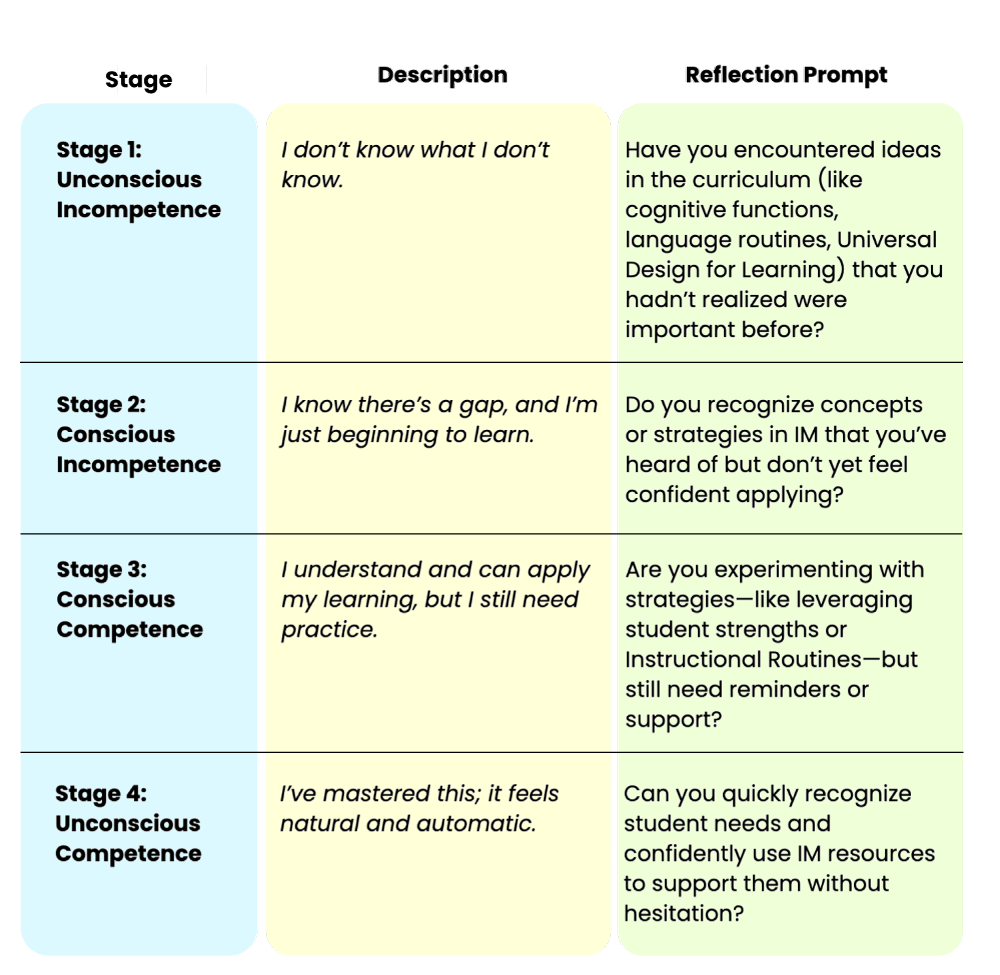
Math anxiety often stems from uncertainty or lack of confidence. Martin Broadwell’s Four Stages of Competence offer a useful way to think about the learning journey teachers experience:
Stage 1: Unconscious Incompetence—We don’t know what we don’t know.
Stage 2: Conscious Incompetence—We realize the gap and start learning.
Stage 3: Conscious Competence—We understand, but still need practice.
Stage 4: Unconscious Competence—We’ve mastered it; it’s second nature.
Now, imagine applying this to some of IM’s resources.
Take cognitive functions, for example—the mental processes essential to learning mathematics. At first, you may not even realize they matter or know what they are (Stage 1). Maybe you’ve heard of them but feel unsure how to apply the concept (Stage 2). With time and practice, you begin identifying student strengths to address areas of need (Stage 3). Eventually, you can spot a struggling student and instinctively know how to leverage their strengths to support their learning (Stage 4).
Self-Assessment: Where Are You on the Journey?
So where does this show up in your own practice?
Think about your relationship with IM’s resources—such as cognitive functions, instructional routines, or problem-based tasks. Where do you see yourself right now?
Wherever you find yourself on this continuum, the next question becomes: What helps teachers move forward?
From Learning the Math to Leading the Math: How IM Builds Teacher Confidence
In April 2020, an IM survey of more than 450 K–12 teachers nationwide found that educators using IM Math reported significant improvements in their teaching practices, along with greater enjoyment and confidence in mathematics. Notably, 68% said they were becoming better mathematicians (Illustrative Mathematics, 2020, November 12).
IM Design
One of the most powerful characteristics of IM Math is that it is designed for teachers to engage as learners first. Tasks, routines, and lesson structures invite teachers to work through the mathematics themselves—strengthening their own understanding, not just preparing them to deliver content.
When teachers experience the math firsthand, they are better able to:
- build confidence in their own reasoning
- shift from “content deliverer” to “skilled facilitator”
- model authentic mathematical thinking for students
IM Course Guide
Resources like the IM Course Guide—organized by grade bands (K–5, 6–8, and 9–12)—help teachers understand the why behind the curriculum. Sections on Universal Design for Learning and Access for Students with Disabilities provide insight into cognitive functions, instructional strategies, and approaches that support all learners.
With these tools, teachers can anticipate student thinking, recognize misconceptions, leverage strengths, and engage in increasingly sophisticated mathematical conversations. These aren’t just lesson supports—they’re confidence-building supports.
IM’s Professional Learning Approach
At the heart of sustained student growth is a long-term investment in teachers. IM’s professional learning is grounded in the belief that teachers learn math best by doing math—the same way students do.
During IM PL sessions, educators:
- work through rich mathematical tasks
- unpack underlying concepts
- analyze student work
- discuss multiple solution paths
Over time, these experiences build the confidence teachers need to guide open-ended discussions and help students make sense of mathematics.
When districts invest in coherent, curriculum-based professional learning, improvements are not short-term gains—they reflect lasting cultural shifts toward deeper learning.
What Research Shows
This approach to teacher learning isn’t unique to IM—it reflects what research shows about how educators grow.
Leading Educators’ Reimagining Professional Learning: What Makes It Work highlights that the strongest teacher growth occurs when professional learning is:
- coherent
- curriculum-based
- sustained over time
Districts like Los Angeles Unified School District (LAUSD) have put these principles into practice at scale.
Over four years of IM implementation, LAUSD has supported teachers in unpacking lessons through the lens of student experience, participating in lesson labs, and engaging in Plan–Do–Study–Act (PDSA) cycles that promote continuous improvement.
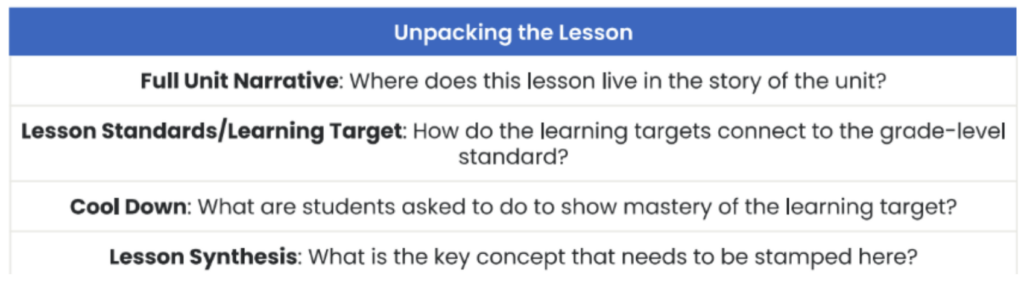
Teachers across LAUSD use IM resources—from lesson plans to embedded teacher moves—to deepen their understanding and refine their practice. And the results are tangible. A 2025 Los Angeles Times article noted that “L.A. Unified has achieved a new high watermark,” with math scores rising across all tested grades for the second consecutive year, surpassing pre-pandemic levels.
Shifting from Fear to Fearless
Over time, this kind of support doesn’t just improve instruction—it changes how teachers experience mathematics.
When teachers engage in math within a supportive, problem-based environment, instruction begins to shift:
- Curiosity replaces anxiety.
- Questions replace answer-giving.
- Students’ ideas drive the conversation.
And something else happens too: Teachers no longer feel pressure to have every answer before class. Instead, they learn alongside students—modeling the very mindset they want students to develop.
Math anxiety doesn’t have to define a teacher’s experience. When educators have space to learn, explore, and grow, they build confidence, and that confidence becomes contagious.
Conclusion
The path from math anxiety to math confidence isn’t about perfection—it’s about exploration, curiosity, and the right supports.
IM’s curriculum and professional learning provide a structure for engaging deeply with mathematics. The tools are already there: thoughtfully sequenced tasks, embedded teacher moves, anticipated responses, and discussion questions that open the door to meaningful mathematical thinking.
Next Steps
Use these resources not just to plan lessons but to build your own mathematical identity. When teachers see themselves as capable mathematicians, students begin to see themselves that way, too.
If you’d like support in using IM’s resources more confidently or want to explore how this approach can strengthen practice in your school or district, our team is here to help. Email us at [email protected] or schedule a call today.
References:
Blume, H. (2025, July 22). L.A. Unified surpasses pandemic setbacks with second year of strong test-score gains. Los Angeles Times.
Illustrative Mathematics. (2020, November 12). Teachers using Illustrative Mathematics K–12 curriculum report positive impact on teaching practices and student knowledge in mathematics.
Leading Educators. (2022, April 26). Reimagining professional learning: What makes it work. https://leadingeducators.org/resource/reimagining-professional-learning-what-makes-it-work/
 Timesha Brooks
Senior Specialist, Professional Learning Design
Timesha Brooks is a professional learning designer who specializes in mathematics pedagogy and teacher development. She designs practical, equity-centered professional learning that translates research into daily classroom moves. Driven by a passion to ensure all students have access to high-quality education, she helps teachers shift from being the math “doer” to being facilitators of learning so all students see themselves as capable, brilliant, and successful in mathematics.