By Neal Tucker, Director of Marketing, with Linelle Brunson, EdD., Senior Specialist in Partnerships
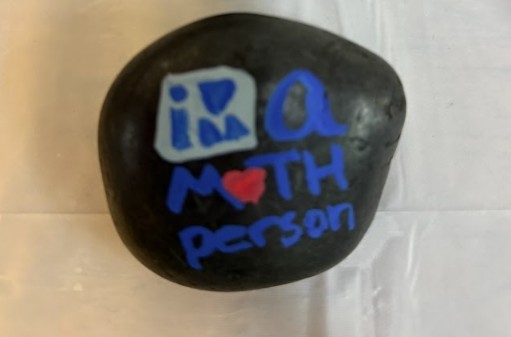
When I got home from the District 7 New York City Public Schools Math Showdown in the Bronx, I brought back a painted rock that says ”I’m a math person.” The IM is the Illustrative Mathematics logo. Or it’s supposed to be, anyway.
I’m the one who painted it. It sits on my desk now. I pick it up throughout the day, during meetings, often not fully aware I’m even doing it. The IM logo I drew on it looks amateur—wobbly lines abound (see below for proof)—but the artistic skill isn’t really the point.
And that is kind of the point.
Nobody at the Math Showdown cared whether their rocks looked “perfect.” What mattered was what students were expressing through them. All day long, in different ways, they painted a similar refrain:
I belong in math.
More Than a Competition
The D7 Math Showdown was part competition, part celebration, part community event. Elementary and middle school students from across the district came together for something that felt less like your typical school day and more like a pep rally for mathematics.
There were “mathlete”-style competitions, hallway activities, creative stations, and conversations—lots of conversations—happening everywhere. Students engaged with math in ways that reflected their own unique personalities and perspectives.
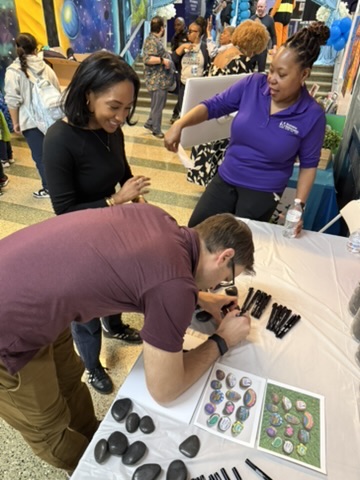
Our table, hosted by Illustrative Mathematics, featured an activity called “Math Rocks.” Pun very much intended.
“I’m a Math Person”
Students used paint markers to decorate rocks however they wanted. They could use words, pictures, squiggly lines, math equations—anything. Some created math-themed designs. Some didn’t. Some just wanted to use the paint markers because, let’s be honest, paint markers are pretty cool. (I didn’t even know they existed until this event. Now I feel like I need my own set!)
What surprised me most was how invested the students were. It didn’t feel like they were painting the rocks because they “had to.” The activity never felt forced. The students were genuinely absorbed in what they were creating, hardly taking a break or even talking to one another as they focused hard on painting their own rock. Of course, after they painted, they wanted to show off their designs to friends, classmates, and anyone nearby willing to admire and talk about them. Which was beautiful and fun every time.
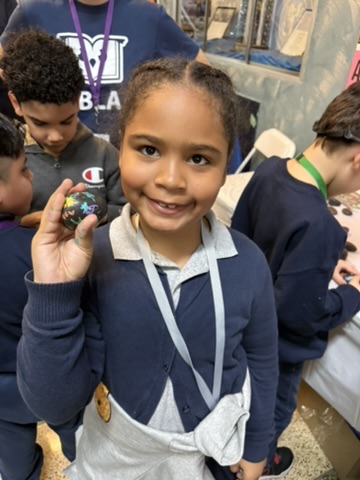
Students crowded our table all day long. They compared colors, swapped ideas, posed their rocks for pictures, and carried them proudly through the hallway. Several kids even came back asking if they could paint another rock. (We were more than happy to oblige!)
The energy throughout the day started high and stayed there.
In a word—it felt joyful.
That’s the word I used afterward when speaking with Wendy Batte, District 7’s Math and Science District Leader. If you spend even five seconds around Wendy, you immediately see the intentionality behind everything she does. On the day of the event, she moved through the building like a superhero—directing students, running the show, making sure people felt welcomed and supported. The event had her spirit and energy from start to finish.
That kind of atmosphere doesn’t happen by accident.
As a former math teacher and coach, Linelle noticed something else unfolding throughout the day too. It did not matter where students fell academically. Every student seemed locked into the experience. They were excited, focused, and genuinely into the math.
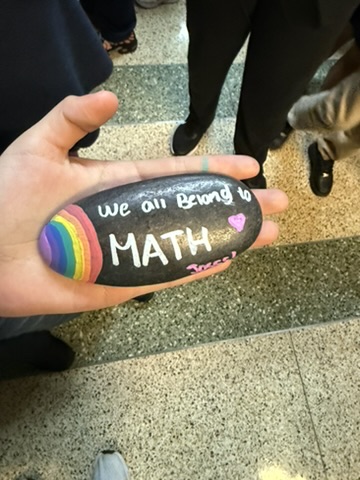
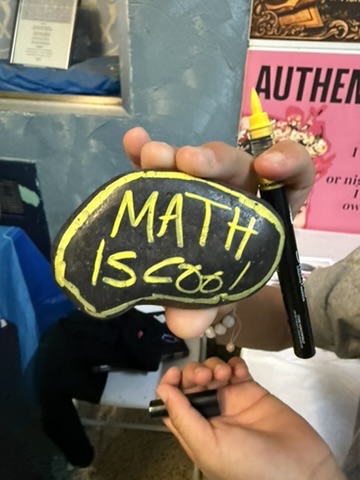
What stood out most to her was how comfortable students felt being there. They trusted their thinking. They took risks. They celebrated when they figured something out. You could almost see their confidence growing in real time. Again and again, they painted phrases like:
“I’m good at math.”
“Math is cool.”
“I’m a math person.”
“We all belong to math.”
Why Math Identity Matters
Those messages have stayed with me long after the event, because so many students grow up hearing the opposite. So do a lot of adults. “I’m just not a math person” has become one of those throwaway lines people say. But math ability isn’t a genetic lottery only a few lucky individuals get to win.
This event showed that. Here, all day, students proudly proclaimed (with paint) something else.
And that really does matter, for the kids’ present education as well as the futures they imagine for themselves. All students need opportunities to develop positive math identities—to see themselves as capable thinkers whose ideas belong in mathematical spaces.
Our table at the event wasn’t necessarily about deep mathematical thinking, at least not in the traditional sense. Students were not solving quadratic equations on their rocks—that wasn’t the goal (though I’d kind of love to see someone try that!).
The goal was engagement, creativity, interaction, perspective. It was an opportunity for students to connect positive feelings to mathematics and to themselves as math learners. Those experiences help students see mathematics as something they can explore, make sense of, and personally connect to.
These positive feelings matter.
Math identity matters.
If students believe they can succeed in math, they participate, and they participate differently. They approach challenges differently. They recover from missteps differently. Linelle said it perfectly: “They stop asking whether they are ‘good at math’ and simply begin doing math.” The value of confidence like that cannot be overstated.
Achievement is wonderful, but often fleeting. Confidence can last a lifetime.
Participation Without Perfection
One of my favorite moments from the day was watching the adults take part too. At one point, a basketball coach from the district stopped by. He lingered for a while before eventually asking if he could paint a rock himself. He did, and he had a blast doing it.
Nobody worried about whether they were “good” at art or whether their rock looked “right.” They simply participated without fear of getting something wrong.
There’s an important lesson in that for math classrooms too. Meaningful math experiences do not have to look like silent seatwork or a perfectly polished solution path on a whiteboard. In fact, at IM, we hope they often don’t!
Sometimes, it looks like a crowded hallway table covered in different colors of paint.
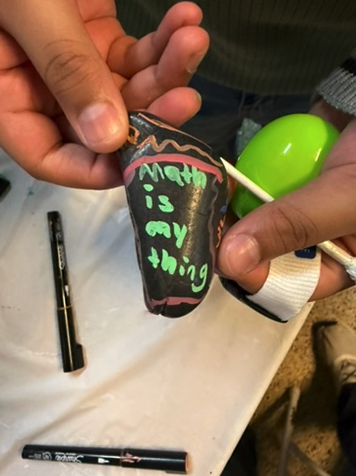
Sometimes, it looks like a kid painting “Math is my thing” onto a rock they’ll take home with them.
Conclusion
District 7’s Math Showdown reminded us that positive math experiences are possible at scale when districts build them with care and intention. The competition brought so much joy and excitement. And the creativity and community surrounding it gave students something just as important: a chance to see themselves as people who belong in math spaces.
That’s a powerful thing to give a student.
Next Steps
Positive math identities do not develop by accident. They grow through meaningful experiences where students feel seen, valued, and capable.
Illustrative Mathematics is proud to support this work across New York City through partnerships including NYC Solves. To learn more about our work with NYC schools and districts, visit knowim.org/nyc.
 Neal Tucker
Director, Marketing
Neal Tucker is the Director of Marketing at Illustrative Mathematics, where he leads strategy across brand, campaigns, and content to expand access to high-quality mathematics curricula. With a background spanning the arts, K–12 tutoring, marketing, leadership, communications, and content production, Neal focuses on connecting educators and districts to resources that support every student in knowing, using, and enjoying mathematics.
 Linelle Brunson, EdD.
Sr Specialist, Partnerships
Linelle Brunson is a Senior Specialist in Partnerships at Illustrative Mathematics with over 25 years of experience in K–12 education, instructional leadership, and professional learning. She has led large-scale educator development initiatives across multiple districts, supporting instructional coaches, facilitators, and school leaders in advancing equitable teaching practices and student achievement. A former teacher, academic coach, and higher education administrator, Linelle specializes in strategic partnership development, curriculum implementation, and adult learning. Her work is grounded in creating meaningful learning experiences that expand access and opportunity for all students, particularly multilingual learners, students with disabilities, and historically underserved communities.