
By David Petersen, Specialist, 5–12 Content
In this series of blog posts—The Anatomy of an IM® Math Lesson—we’ll take a closer look at each part of an IM Math lesson and how it contributes to meaningful student learning. We begin with the launch: the moment that helps students understand the purpose of the activity, prepares them to engage with the mathematics, and sets the tone for the learning ahead.
If you’re new to IM Math or looking for additional implementation support as you read, our free on-demand training modules provide classroom examples and practical guidance that complement the ideas explored throughout this series.
You’ve just wrapped up a strong warm-up and are transitioning to the next activity. Some students jump ahead and begin working. Others sit quietly waiting for instructions. A few want to keep discussing the warm-up.
Then, one student speaks up: “What are we doing next?”
How you respond in that moment can shape everything that follows. This is the launch.
What Is the Launch, and Why Does It Matter?
Like the launching of a boat, this moment can either ease students into the work or leave them drifting without direction. A launch that invites students to immediately begin thinking and discussing sets a different tone than one that relies largely on explanation.
A strong launch helps students approach the mathematics with purpose and confidence. Rather than telling students how to solve the problem, it creates the conditions for them to make sense of the task, collaborate with one another, and begin thinking productively.
IM Math launches often include guidance for
- grouping students
- pacing the activity
- introducing the context
- setting up the task
- activating prior knowledge when appropriate
Each recommendation is designed to help students access the mathematics while leaving the mathematical thinking to them.
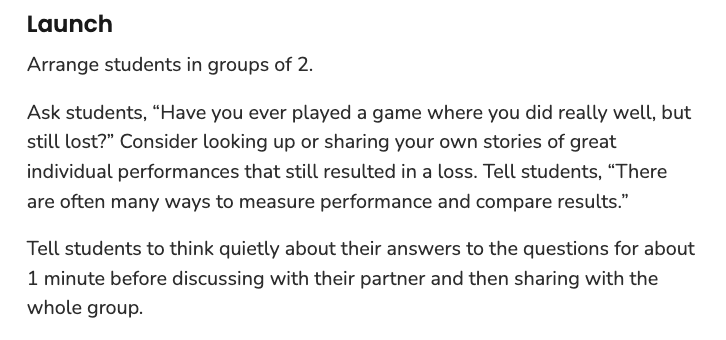 Algebra 1, Unit 1, Lesson 10, Warm-up
How the Launch Fits Into an IM Math Lesson
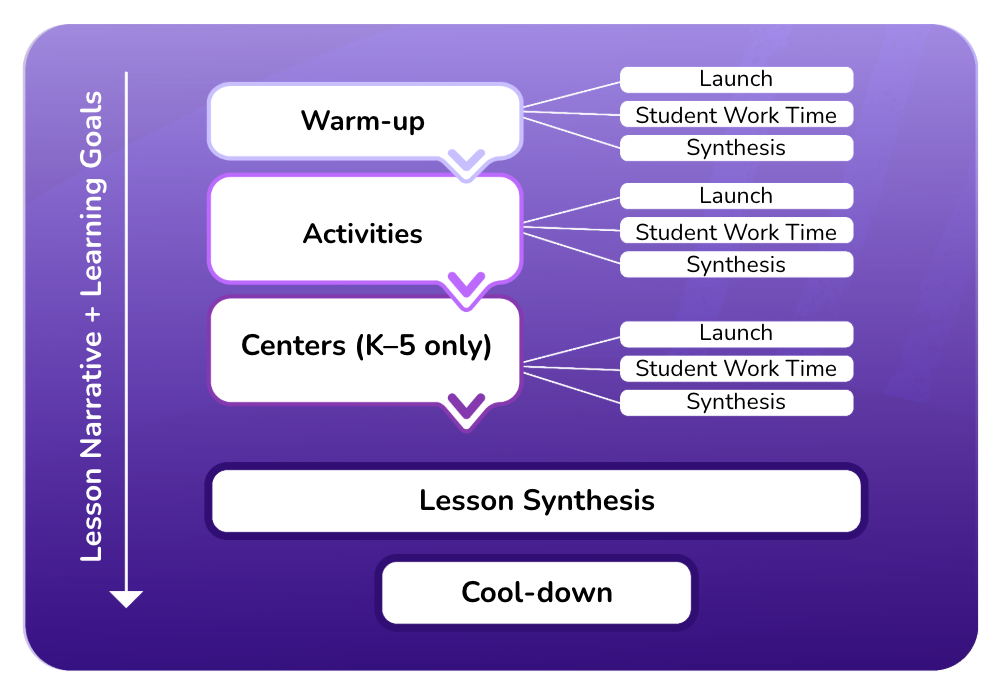
The launch acts as a bridge connecting one activity to the next mathematical experience. Rather than standing alone, it works together with the warm-up, activity, synthesis, and cool-down to create a coherent learning experience.
Key Elements of an Effective Launch
Grouping Students
Many IM Math activities recommend students work in pairs or small groups so that they can learn from one another and build a mathematical community. In some cases, such as Info Gap activities, a particular number of students is needed to do the task. In others, you have more flexibility.
When adjusting groups for your classroom, consider:
- Are there enough students in the group for a range of ideas?
- Are the groups small enough to ensure everyone has a chance to participate meaningfully?
Protecting Time for Mathematical Thinking
Suggested times are often included to give teachers an understanding of how long to plan for the different parts of the activity. Suggested timing isn’t about rushing students through the lesson. It’s about protecting time for every part of the learning experience—including the synthesis, where students connect and consolidate their thinking.
As you adjust pacing, consider:
- Will students have enough time for productive discussions?
- Are you protecting time for all parts of the activity, including the synthesis?
Making the Context Accessible
Contexts help students connect mathematics to the world around them and to people’s experiences. Sometimes students immediately recognize the situation. Other times they may need a bit of background knowledge or clarification before they can focus on the mathematics.
As you introduce the context, consider:
- Do any of your students have a relationship to the situation they might be willing to share?
- What aspects might be unfamiliar to your students and need clarification?
Setting Up the Task
While we want students to develop and share their own ideas about the mathematical content, the structure of a task shouldn’t be a barrier to getting started.
For complex activities, you might:
- Read the instructions aloud together.
- Invite clarifying questions.
- Demonstrate what collaboration might look like while they’re working on the task.
The goal is not to do the thinking for students but to make sure they can access the work.
Activating Prior Knowledge
The launch is also an opportunity to help students recall information or to reintroduce vocabulary that students will find helpful during the activity. Some math concepts will depend on students recalling earlier ideas, and a nudge to help them remember what they’ve learned can help.
When introducing a task that requires background knowledge, consider:
- What previous concepts and language would be helpful for students to recall?
- How can you ask questions to draw those ideas out from students instead of reteaching them?
Conclusion
Every IM Math launch is designed with intention. The guidance included for teachers isn’t meant to be a script. It’s there to support you so you can use what’s most helpful for shaping the experience in ways that best serve your classroom.
As you prepare your next IM Math lesson, spend a few extra minutes with the launch before you begin teaching and consider:
- What guidance is included?
- What will work as written, and what might you need to adapt?
- Where might students need clarity before beginning?
- What prior knowledge could you help students surface to support access?
There’s no single right way to launch an activity. The goal is to create the conditions for students to engage, collaborate, and make sense of the mathematics. By combining the suggestions provided in the curriculum with adjustments that work best for your students, you can set the stage for meaningful learning.
Are You Ready for More?
Connect with the Illustrative Mathematics team and ask about “Leveraging the Problem-Based Lesson Structure.” Schedule a call or email us at [email protected].
- classroom videos
- grade-specific examples
- companion guides
- available for every K–12 grade band
 David Petersen
Specialist, 5–12 Content
After teaching in a variety of secondary schools for ten years, David joined Illustrative Mathematics in 2016. David has helped write much of the 6–12 curriculum for IM and has a specialized focus on the Algebra 1 and Algebra 1 Extra Supports courses as well as the statistics units throughout 5–12. David is passionate about making high-quality, collaborative materials that help teachers and students know, use, and enjoy mathematics.