
By Sarah Caban, Director, PK–12 Learning Experiences
A snow day. An assembly schedule. A class that needs more time to build understanding before moving on.
Suddenly, you’re behind and asking yourself: Should I . . .
- rush the next lesson?
- skip activities?
- cut discussion short next time?
For many teachers, pacing can feel like a constant tension between meaningful learning and staying on schedule.
Pacing Is More than Keeping Up with a Calendar
Pacing is not simply about moving quickly enough to cover content. It is about making instructional decisions that preserve the mathematical goals of the lesson and the coherence of the unit.
When teachers think intentionally about pacing, they are making decisions about:
- where students need more time
- what students already know
- what can be adjusted without disrupting learning
- how to maintain access to meaningful mathematics over time
Thoughtful planning and prioritization means considering students’ current understanding in relation to the lesson learning goal. From there, teachers can determine which activities are essential and where they can condense, combine, or shorten problems while still preserving the curriculum’s overarching design structure, coherence, and integrity.
What Should We Protect?
In IM® Math classrooms, we try to protect the parts of instruction that support deep mathematical understanding and coherence, such as:
- Mathematical discussions—Students need opportunities to explain reasoning, compare strategies, and make connections across representations and ideas.
- Lesson synthesis—The synthesis helps students organize their thinking and connect the work of the lesson to larger mathematical ideas.
- Coherence across lessons and units—Students build understanding over time. Pacing decisions should support those connections rather than interrupt them.
- Access to grade-level mathematics—When students struggle, the goal is not to indefinitely pause grade-level work but to provide support while maintaining forward momentum.
Other lesson elements may allow for greater flexibility, including:
- the number of practice problems completed
- whether every activity happens exactly as written
- the amount of time spent on independent work
- whether a lesson fits neatly into a single day
With those priorities in mind, let’s look at a few practical pacing scenarios teachers commonly encounter.
Scenario 1: “The Discussion Is Taking Longer than Planned”
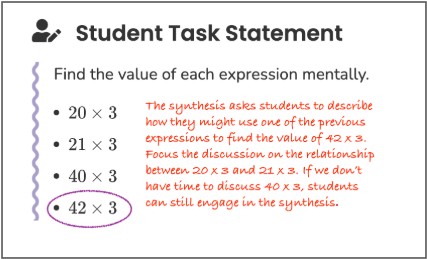
During a warm-up routine, students are discussing multiple strategies for finding the value of an expression. The conversation is productive, but class time is running short. The teacher realizes there will not be enough time to discuss all the expressions.
Common Reaction
Extend the warm-up past ten minutes, then rush through the remaining activities or skip the synthesis in order to finish the lesson on time.
A More Purposeful Pacing Decision
Preserve the discussion and synthesis. Reduce the number of expressions instead. If students are making important mathematical connections through discussion, shortening that moment may weaken the core purpose of the lesson.
Meanwhile, independent practice is often more flexible. Teachers might:
- choose expressions strategically
- move portions of practice outside class time
- repurpose unused expressions during small group or individual support
Key Takeaway
The activity synthesis can help you make decisions about how to consolidate problems in an activity.
Scenario 2: “Students Need More Support than the Pacing Guide Allows”
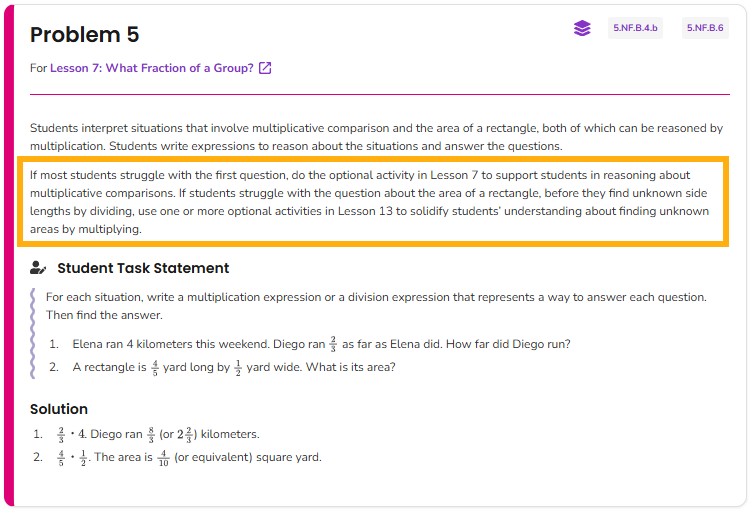
A grade 6 teacher notices many students did not interpret situations that involve multiplicative comparison and the area of a rectangle correctly on the Unit 4 Check Your Readiness assessment.
Common Reaction
“We cannot move forward until students fully master fractions.” Teachers often feel pressure to choose between stopping grade-level instruction entirely or moving on before students are ready.
A More Purposeful Pacing Decision
Use the guidance in the Pre-Unit Practice Problems (K–5) or Check Your Readiness (6–12) teacher instructions:
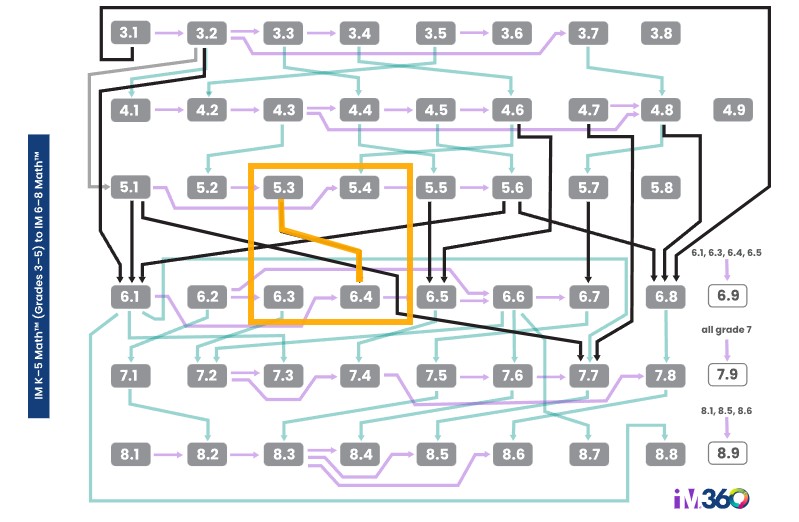
Use the Dependency Diagram below to identify prior grade level connections to the content in this unit.
Provide targeted support that connects content from previous grades to the current grade-level work. This might include:
- strategically chosen warm-ups
- representation supports
- small-group instruction
- connections between new concepts and familiar ideas
For example, the warm-up below is from Grade 5, Unit 3, Lesson 7. It can be used as a prompt during small-group instruction to support students in connecting new concepts to familiar ideas and reminding them of a representation they can use to solve problems involving fraction multiplication.
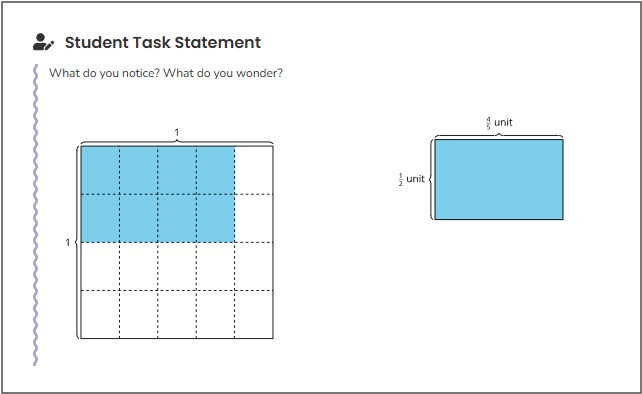
Coherence does not mean waiting for every developing idea to be solidified before engaging with new mathematics. In many cases, grade-level learning can strengthen and extend prior understanding.
Key Takeaway
Pacing decisions should maintain access to meaningful mathematics while responding to student needs.
Scenario 3: “The Schedule Changed”
A shortened week includes testing, assemblies, and interrupted instructional time. The teacher realizes several lessons cannot happen exactly as planned.
Common Reaction
Try to cover every activity exactly as written, even when time no longer allows for it.
A More Purposeful Pacing Decision
Identify the core mathematical goal of each lesson and prioritize the lesson components that support that goal most directly.
Questions teachers might ask:
- Which activities are essential for students to meet the learning goals and demonstrate success on the cool-down?
- Which problems or activities can be consolidated?
- Which practice opportunities can move outside class time?
- Which discussions are essential for students to synthesize learning?
In IM Math lessons, supporting sense making and preserving coherence are essential. Prioritize lesson content that fosters mathematical discussions, surfaces the key ideas in the learning goals, and is consolidated in the lesson synthesis.
Students build understanding over time. Pacing decisions should support those connections rather than interrupt them.
Key Takeaway
When time is limited, prioritizing coherence matters more than trying to preserve every minute of every activity.
Scenario 4: “Some Students Are Ready to Move On, and Some Are Not”
Most students demonstrate understanding after a lesson synthesis, but a smaller group still needs additional support.
Common Reaction
Reteach the entire lesson to the whole class.
A More Purposeful Pacing Decision
Use differentiated supports while maintaining momentum for the broader class. Examples might include:
- small-group instruction
- targeted practice
- additional representations
- strategic partner work
Whole-class pacing should not always be determined by the needs of a small subset of students, especially when other instructional structures can provide support.
Key Takeaway
Maintaining forward momentum and providing targeted support can happen at the same time.
Questions Teachers Can Use When Making Pacing Decisions
These questions can help shift pacing from a reactive process to a more intentional one.
- What is the mathematical goal of this lesson?
- Which parts of the lesson are most important for reaching that goal?
- What do my students already know?
- What understanding will students need later?
- What can be shortened without disrupting coherence?
- What opportunities for discussion and synthesis should be preserved?
- How can supports be embedded while maintaining grade-level learning?
Conclusion
Strong pacing is not about perfectly matching a calendar or finishing every activity exactly as written. It’s about preserving what matters most, responding to students in real time, and helping students build ideas over time.
Pacing with purpose helps students experience mathematics as connected, meaningful, and worth making sense of.
Next Steps
As you reflect on pacing in your own classroom, consider:
- How might you use the learning goals, cool-down, and lesson synthesis to make informed decisions about prioritization?
- Where might greater flexibility create more space for student reasoning and targeted discussion?
- How can pacing decisions help maintain coherence while still responding to students’ needs?
Are you ready for more? Connect with the Illustrative Mathematics team and ask about “Using Learning Goals to Make Instructional Decisions.” Schedule a call or email us at [email protected].
 Sarah Caban
Director, PK–12 Learning Experiences
Sarah Caban leads the creation of timely, relevant learning experiences that empower educators to teach with confidence and curiosity, fostering more equitable and joyful instruction with IM K–12 Math. Sarah was a lead writer for IM K–12 Math and brings over 15 years of experience as a math coach and teacher, including six years teaching in a one-room school on a small island off the coast of Maine.