
By Cristina Roof, Math Specialist, Lexington Public Schools
What are students thinking as they sit on the rug during a whole-class lesson? How much are they learning? How much are they simply just sitting quietly in their own world?
These questions became the focus of school-wide professional development at our K–5 school in Lexington, Massachusetts.
Using the IRT Beyond Mathematics
Experts like Sherry Parrish, author of several books on Number Talks, distinguish between students who are “sitting and getting” and those who are actively learning and applying. As educators, how can we maximize learning opportunities during whole-class discussion so that more students are engaged in meaningful thinking and participation?
We set out to explore this question using the Illustrative Mathematics® IMplementation Reflection Tool (IRT) as our guide. The IRT is a structured observation tool that gives educators a common language for describing what’s happening in a classroom—from how tasks are launched to how student thinking is valued and how much voice students have in their classroom communities.
Although the tool was designed for problem-based math classrooms, we discovered something we didn’t expect: its indicators travel well. The student learning behaviors it identifies show up in literacy discussions, science investigations, and any space where students are expected to think collaboratively.
Building a Shared Understanding of Belonging
One of the most powerful components of the IRT is its progression of student learning behaviors: Receiving, Reacting, Interacting, and Belonging.
We all know the students who feel a sense of belonging. They raise their hands, participate readily, and take active roles in collaboration, discussion, and reflection. Students in the receiving stage, on the other hand, may be hearing information, but their engagement is limited. They often require prompting by the teacher to participate and may make minimal contributions to class discussions.
With a date on the calendar for a school-wide staff meeting, the administrative team, our literacy specialist, and I, the math specialist, sat down to consider how we could introduce this progression of student engagement to classroom teachers and interventionists. How could we create more opportunities for students who were taking a back seat and engaging minimally with the content and with each other? And what overlaps exist between literacy instruction and the whole-class structures we see in an IM classroom?
At the meeting, we revisited the IRT. Teachers worked in groups of three or four and were asked to collaboratively define the following terms on chart paper: belonging, receiving, interacting, and reacting.
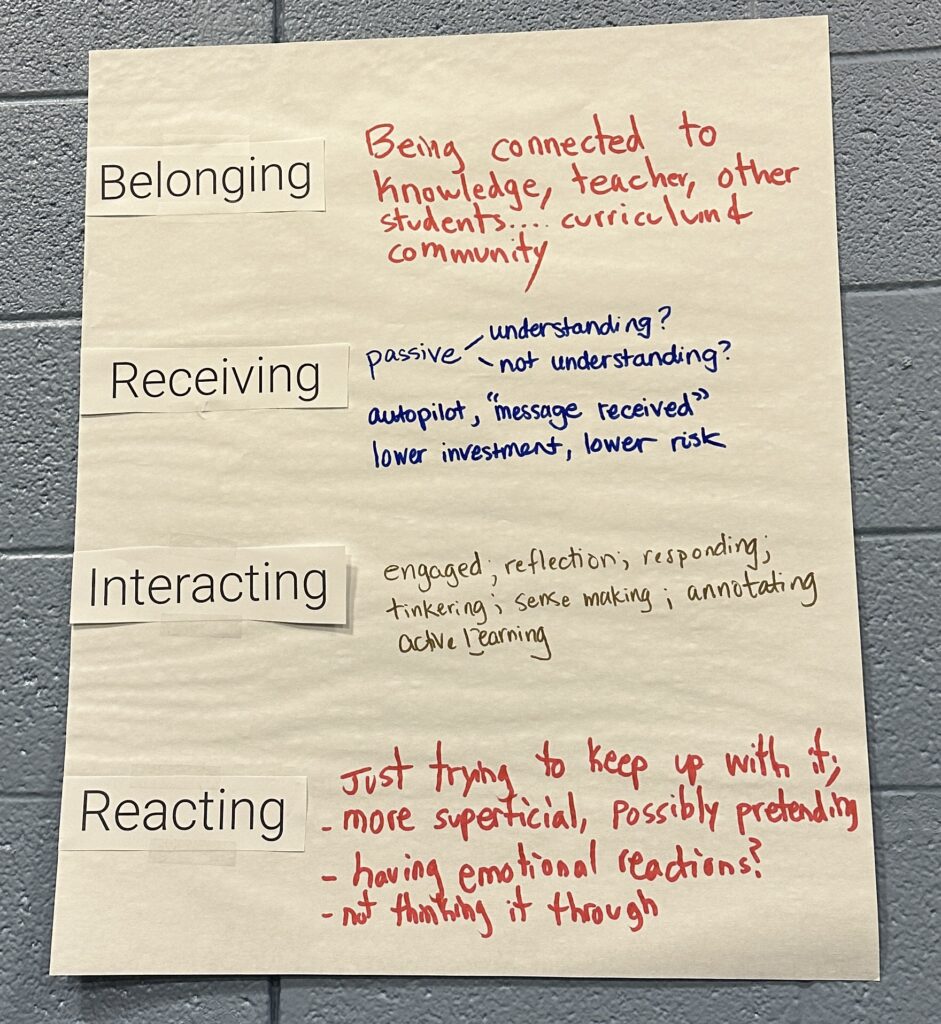
Afterwards, teachers received a copy of the indicators with their definitions. Their next task was to think about their own students. Who came to mind first for each category? Who came to mind last? Were some students in a certain category, like belonging, in one subject but in receiving or reacting in others?
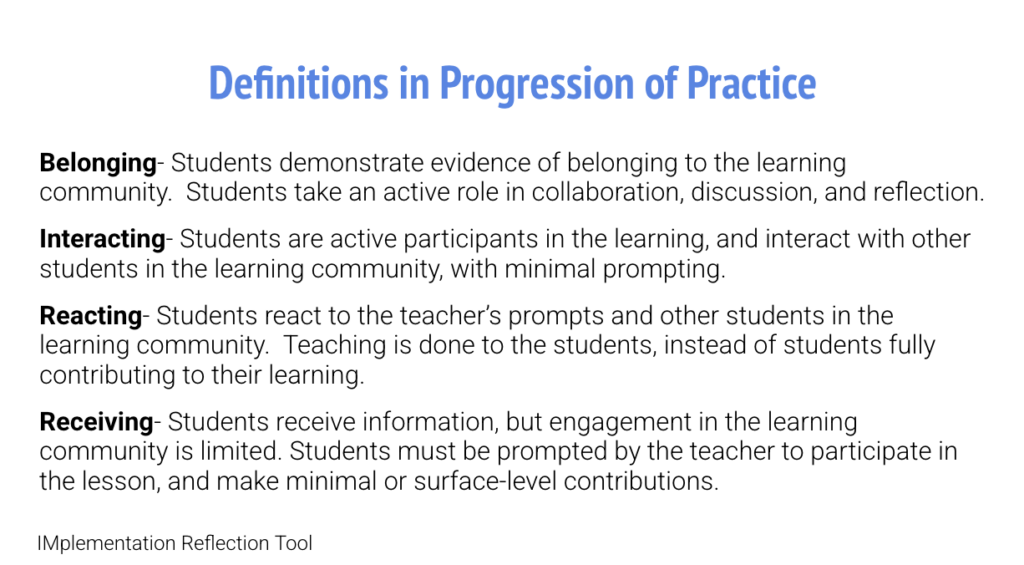
Through this discussion, we developed a shared understanding of the progression toward belonging. More importantly, we established a common language for talking about student engagement and participation. We knew that no student would occupy the same place every day or in every subject. Still, we began asking bigger questions: Could we expand our definition of what it means to belong in math, literacy, and other subjects? Could we increase opportunities for students to step into their learning?
We realized that students who appeared compliant or quiet might be losing access to the curriculum in important ways each day. By the end of the session, teachers were asking how they could create more meaningful access points for all students. That question became our mandate.
If our first meeting gave us a shared language for describing where students were, the second meeting needed to focus on what we could do about it.
Valuing Student Thinking Across Content Areas
Our next staff meeting centered on ways to strengthen students’ sense of belonging. Once again, the IRT served as the backbone for our discussions. We focused on the indicator Valuing Student Thinking and asked teachers to reflect on their current practices around classroom discourse.
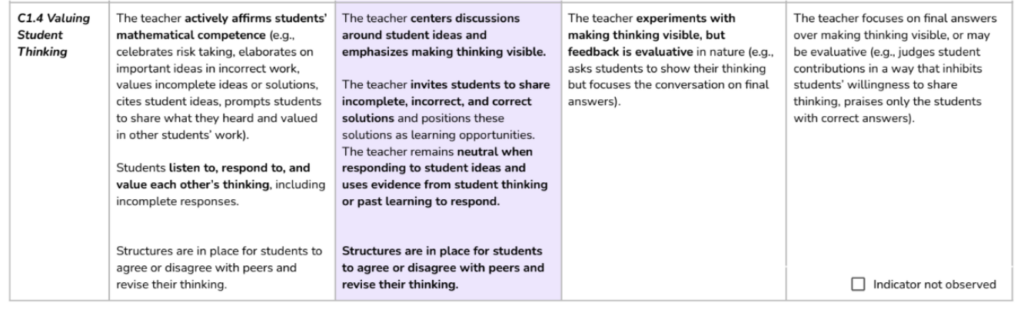
The teachers unpacked each of the levels within that indicator, asking themselves what felt familiar and what seemed new? How are we creating access within our math lesson syntheses? How are we communicating that all thinking has value?
To imagine this in action, we shared examples of teacher moves and asked staff to sort them into the indicator levels. We wrestled with questions such as: What does it look and sound like to value a student’s incorrect answer? How can a student feel that their ideas belonged if those ideas are incorrect or only partially formed?
What C1.4 Valuing Student Thinking Can Look and Sound Like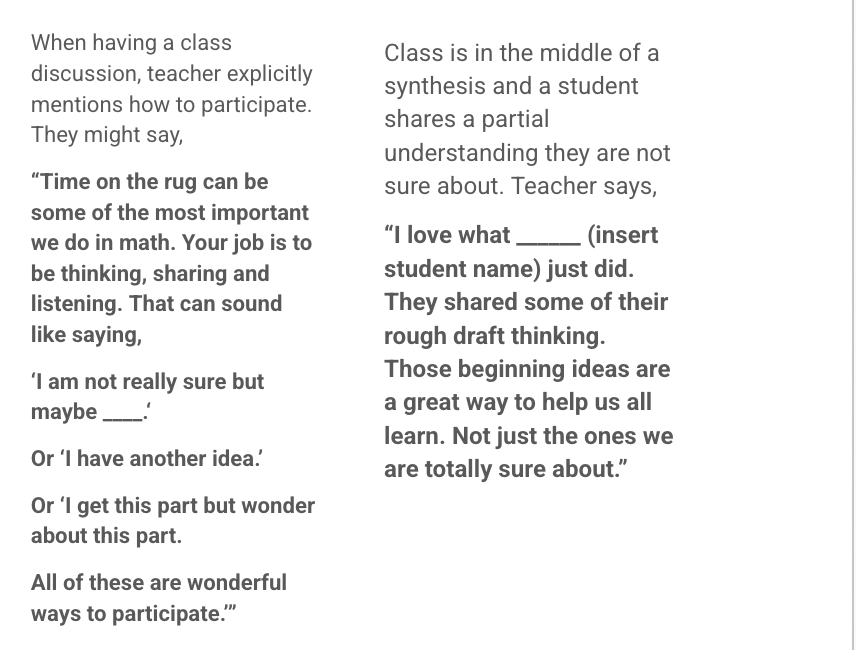
The discussion that followed centered on how some of these moves could be incorporated into the synthesis and classroom discussions no matter what subject or curriculum was being taught. Teachers quickly recognized that these practices were not specific to mathematics. They were tools for building participation, engagement, and belonging in any classroom.
What Changed in Classrooms
As instructional coaches visited classrooms following this work, we began to see teachers experimenting with these moves. The focus shifted from finding the “right answer” to engaging with student thinking as it emerged. In many classrooms, students started taking risks by sharing ideas that were not fully formed or solidified. As other students heard these ideas being validated, they felt more confident adding on to them or sharing their own questions and developing understandings.
Across classrooms, these small but intentional moves created more entry points for students who had previously been hesitant to participate. Participation began to look like partial answers, a wrong answer, the beginning of a strategy, the revoicing of someone else’s ideas.
More students were stepping into the learning—not after their thinking was polished, but while it was still developing. Their beginning ideas belonged, their questions belonged, their developing strategies belonged. And, ultimately, their identities as mathematicians, readers, or learners began to expand.
Conclusion
When students realize that their ideas do not have to be finished to matter, something important shifts. They begin to see themselves as contributors in the learning process, not just receivers of it. What began as a focus on whole-class discussion became a deeper inquiry into access, participation, and voice—and a reminder that the way we respond to student thinking shapes whether students feel they belong in the work of learning at all.
Next Steps
- Start with one indicator from C3: Student Learning Behaviors. Study the progression and use it as shared language for the students you and your colleagues are already thinking about.
- Choose one C1.4 Valuing Student Thinking teacher move to try this week. Whether it’s validating rough-draft thinking, naming multiple ways to participate, or centering an incorrect solution during a synthesis, small intentional moves add up and can have a meaningful impact.
- Partner with a colleague from another subject. The IRT’s language around student behaviors applies beyond mathematics. Invite your literacy specialist, science teacher, or grade-level partner to try the same activity or teacher move. The cross-disciplinary conversations that follow tend to surface what your students need most.
 Cristina Roof
Math Specialist, Lexington Public Schools
Cristina is a long time educator from Arlington, Massachusetts. She has combined her love of classroom teaching and special education into her current role as a math specialist at the Bowman School in Lexington, MA.