By the Illustrative Mathematics team
In the 2024–2025 school year, 40.7% of Pittsburgh Public Schools (PPS) third-grade students scored proficient or advanced in mathematics, surpassing the district’s interim goal of 33.4% and nearly doubling proficiency rates from the 2020–2021 baseline.
For district leaders, this progress represents more than a promising data point. It reflects a focused, sustained effort to strengthen mathematics instruction at a pivotal moment in students’ learning journeys: third grade.
Why Third Grade Matters
Third grade marks a shift in mathematics—from foundational number sense to deeper reasoning with multiplication, division, fractions, and multi-step problem solving. Research consistently shows that students who leave third grade without a strong mathematical foundation are far more likely to struggle as the content becomes more abstract.
Early math proficiency isn’t just about computation; it is a critical predictor of long-term academic success, often even more predictive than early reading achievement. PPS knew that improving math outcomes at this critical juncture would require more than a quick fix. It would take high-quality curriculum, sustained professional learning, and a commitment to continuous improvement.
Clear Growth in Third-Grade Math Proficiency
Now, just two years into implementing IM Math through Imagine Learning, one of our IM Certified® curriculum distribution partners, PPS is beginning to see meaningful, measurable progress.
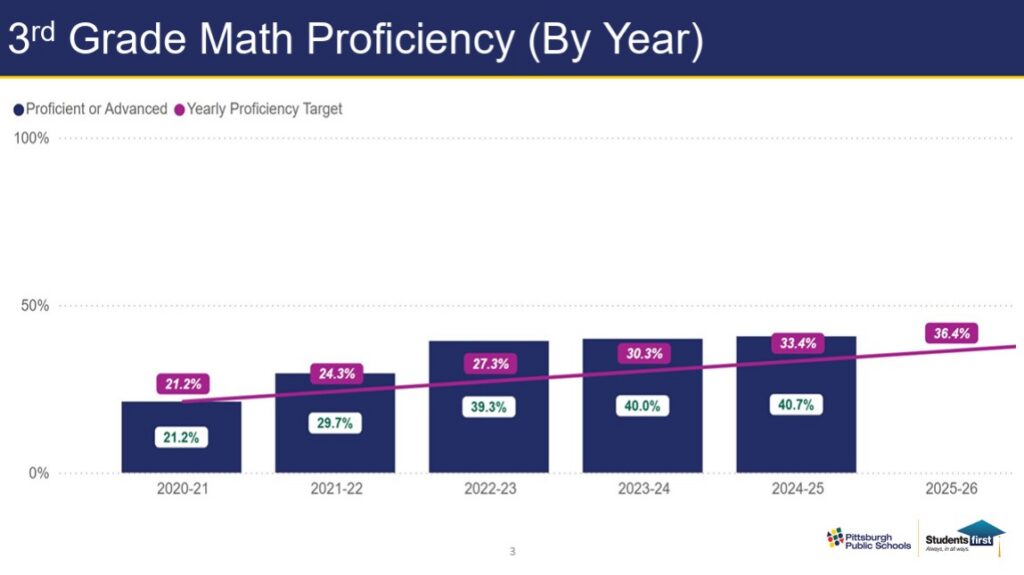
Source: Pittsburgh Public Schools Board Presentation, 2025
These gains reflect a steady upward trend and signal that instructional investments, including strong implementation, are paying off.
As reported by a Pittsburgh NPR news station, schools seeing significant growth with IM Math, such as Roosevelt K-5 in Carrick, are also seeing strong literacy scores: The number of third-graders scoring ‘proficient’ or ‘advanced’ at Roosevelt nearly doubled last year, and scores among Black students, economically disadvantaged students, and students receiving special education services soared.
As PPS Superintendent Wayne Walters explained, “Third grade is where literacy and math come together. It is no longer just one-dimensional.”
Problem-Based Education Meets Professional Learning
The 2025–2026 school year marks PPS’s second year implementing IM Math. While IM’s problem-based curriculum engages students in real-world contexts and emphasizes sense-making, fluency, discourse, and reasoning, district leaders are quick to emphasize that curriculum alone isn’t the whole story. Strong, sustained support for educators is key to turning high-quality materials into meaningful student learning.
PPS has invested in curriculum-based professional learning, math coaching, and real-time monitoring of classroom practice.
- In Year 1, their professional learning focused on understanding the structure of IM Math’s units and lessons.
- In Year 2, the work has shifted toward refining instruction, supporting teachers new to grade levels, and deepening facilitation skills for veteran educators.
The district also implemented “math walks” to track implementation progress in real time and identify where additional support is needed—an approach that allows leaders to respond quickly and strategically.
Conclusion
PPS’s results reinforce a powerful lesson: Meaningful improvement happens when high-quality curriculum is paired with strong implementation.
By focusing on coherence, investing in educators, and maintaining a clear instructional vision, PPS is building momentum in third-grade mathematics—and laying a stronger foundation for what comes next.
Next Steps
Pittsburgh Public Schools’ third-grade gains are just the beginning. Want to see how the district is turning early successes into lasting improvement? Read Pittsburgh Public Schools, Part 2: The Coherence and Data Behind the Gains to learn how PPS uses data, professional learning, and coherent instructional practices to strengthen math outcomes for all students.