
By Cherelle McKnight, Director, PK–6 Content
During a virtual writing retreat, IM’s PK–6 content team gathered on Zoom and . . . played.
My desk was covered with loose parts—small objects meant for building, arranging, and imagining. At one point, we were invited to “free build.” There were no rules, no directions, and no expected outcome.
I reached for a handful of LEGO and began building—testing ideas, pulling pieces apart, changing direction, and following my curiosity wherever it led. When it was time to share, we asked each other questions like, “Can you tell me more about what you made?” and “What were you thinking when you added that piece?” The focus wasn’t on the final product. It was on the thinking behind it.
Next, we were given new parameters. This time, our building was guided by a recent reading or a specific topic of discussion, and we were asked to use particular materials. Even with more structure, the spirit of curiosity remained. Questions, collaboration, and reflection shaped our work.
Later, as we began writing what would become our new Transitional Kindergarten curriculum, IM® TK Math, it struck me: What we had experienced during our retreat was exactly the kind of learning environment we aim to create for early math students—moments of inquiry play alongside moments of teacher-led play.
TK (sometimes referred to as Pre-K or PK) classrooms are designed to bridge preschool and kindergarten, blending joyful exploration with intentional instruction. That balance is exactly what we aim to support in IM® TK Math.
Inquiry Play: Open Exploration
As California continues expanding Transitional Kindergarten, educators across the state are exploring how play-based learning can support young students’ mathematical thinking. In IM TK Math, Inquiry Play is our unique approach to this idea: It emphasizes learning through exploration, conversation, and hands-on experiences, reflecting the priorities of California’s TK classrooms.
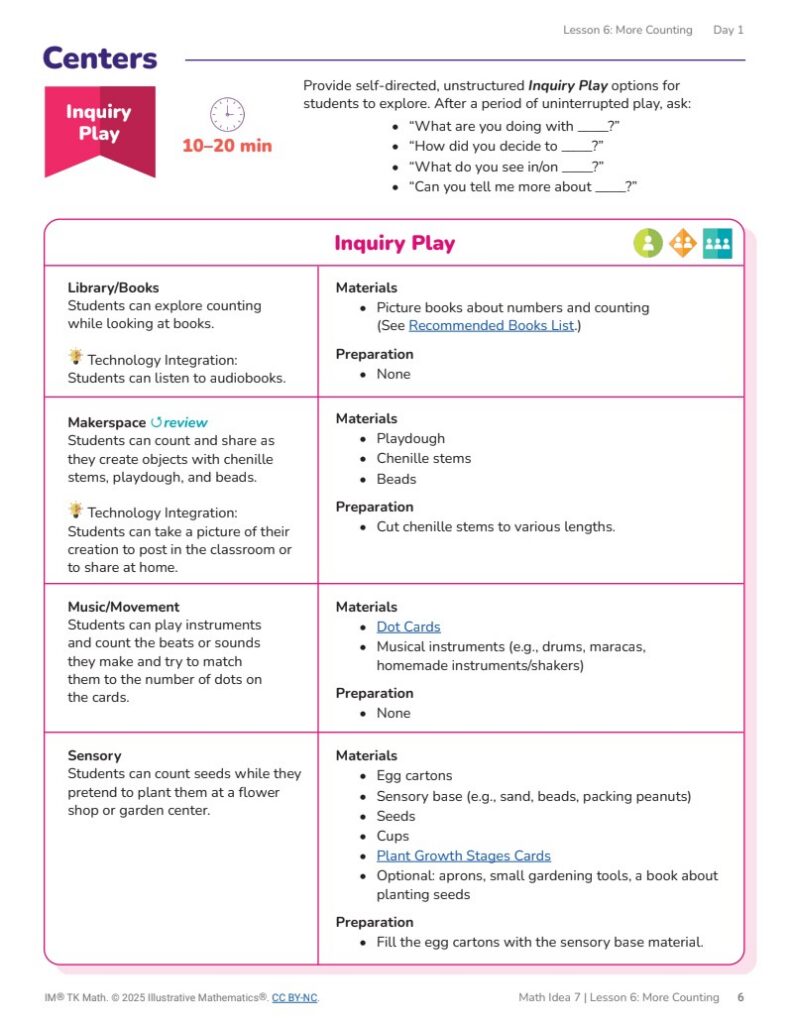
Open exploration is most easily visible in IM TK Math’s Inquiry Play centers. These centers are individual or partner activities that give students time for unstructured, student-guided play. Each activity is intentionally designed to be joyful, exploratory, and mathematically meaningful.
Much like our “free build” during the retreat, Inquiry Play gives students time to explore ideas with materials, test possibilities, and follow their curiosity. Students interact with manipulatives, objects, and spaces. It’s an opportunity for them to practice what they’re learning. They might choose to “free build,” or they may be reminded of a recent math discussion or topic as they work with familiar loose parts and manipulatives.
During Inquiry Play, the teacher’s role shifts. Rather than leading the activity, teachers observe carefully. After a period of uninterrupted play time—or if invited into the play—teachers ask questions like, “Can you tell me more about ___?” or “What are you doing with ___?”
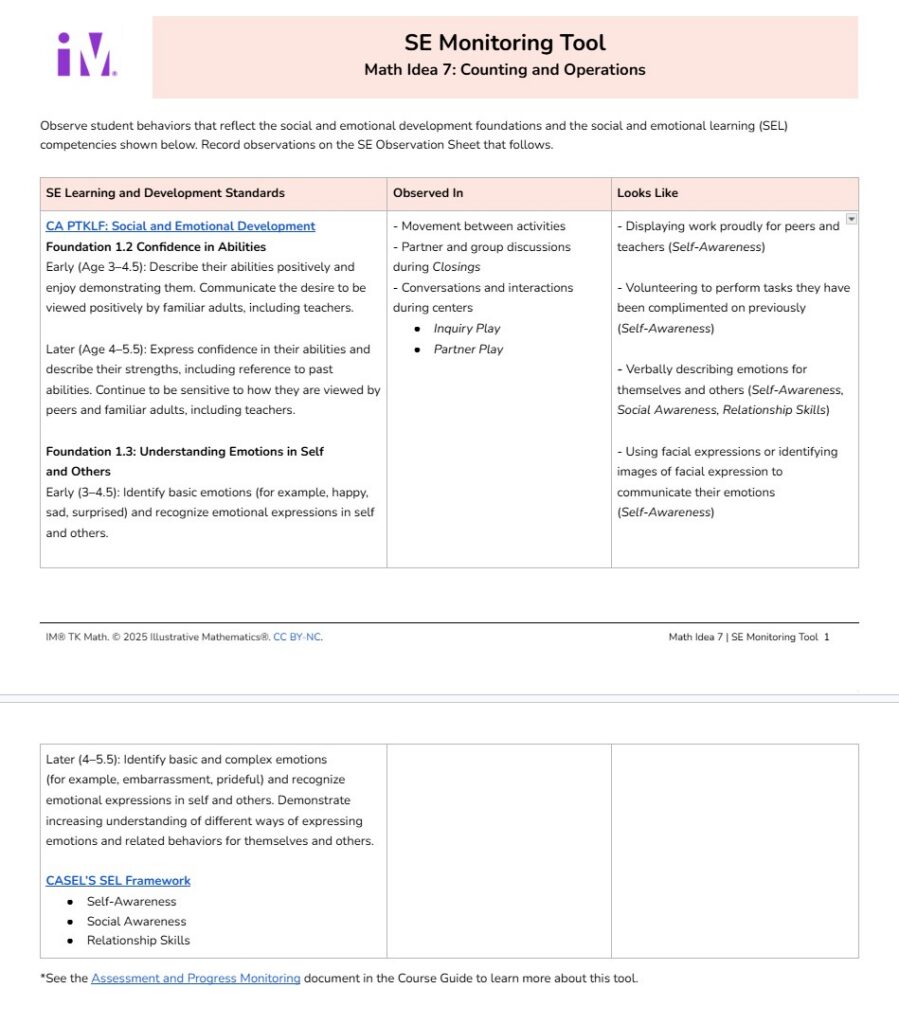
During Inquiry Play, teachers also attend to and observe student behaviors that reflect the social and emotional development foundations and the social and emotional learning (SEL) competencies highlighted on the curriculum’s SE Monitoring Tool for each Math Idea, or unit.
Teacher-Led Play: Intentional Guidance
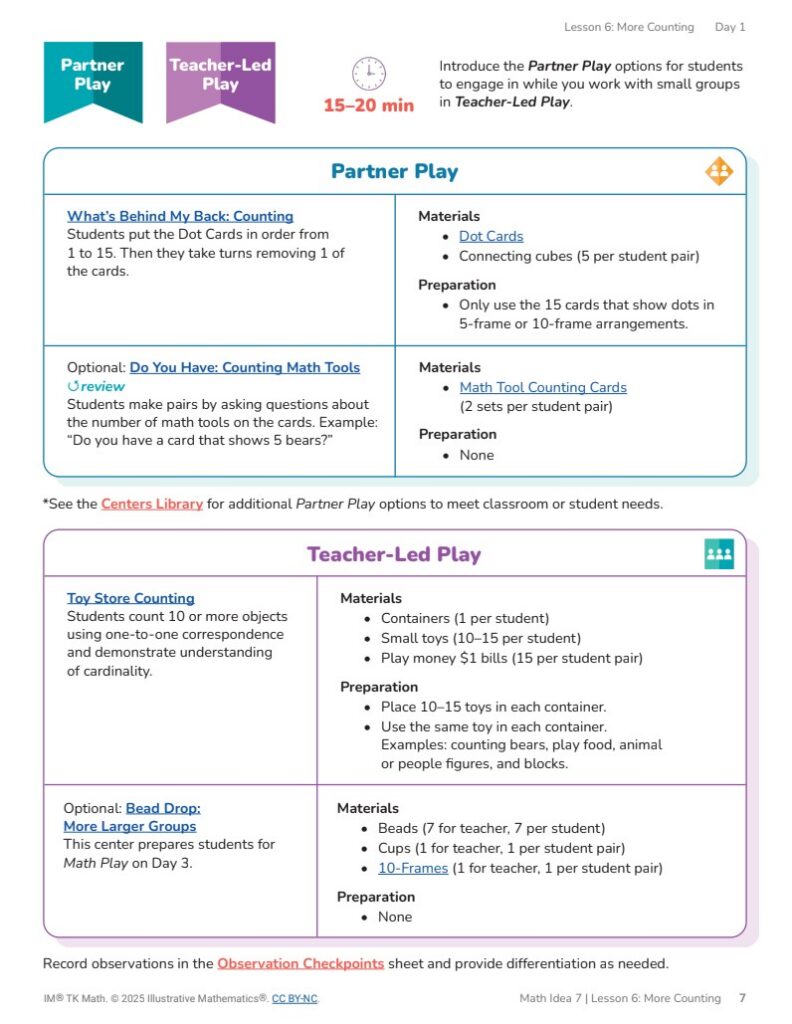
Teacher-Led Play centers are small-group activities aligned to the lesson’s Preschool/Transitional Kindergarten Learning Foundations (PTKLF)—the framework that guides early learning in California—and research-based learning trajectories.
In Teacher-Led Play, structure doesn’t limit creativity—it supports it.
During our team’s virtual writing retreat, moments of guided building helped us focus our thinking, deepen collaboration, and connect ideas to a shared goal. In classrooms, Teacher-Led Play serves a similar function. Teachers have the opportunity to highlight, listen to, and extend student voice and thinking while supporting precision and mathematical language.
Teacher-Led Play is similar to building a LEGO set. There is a specific goal in mind. Students attend to precision, strengthen fine motor skills, demonstrate patience and perseverance, organize materials, and refine strategies. These experiences prepare them for their next “free build”—or their next Inquiry Play.
Guided by imagination and curiosity, IM TK Math students lean into the serious business of play, building mathematical understanding piece by piece.
Conclusion
As California expands access to Transitional Kindergarten, classrooms are increasingly embracing play-based approaches that support both joyful learning and strong academic foundations. In IM TK Math, Inquiry Play and Teacher-Led Play work together, allowing TK students to experience math as something they explore, make sense of, and enjoy—supported by thoughtful guidance every step of the way.
During our virtual writing retreat, the PK–6 content team experienced the power of this balanced play-based approach firsthand. By engaging in both free building and guided activities, we felt the dynamic between open exploration and structured guidance.
That same dynamic allows TK students to explore ideas actively, solve problems creatively, and learn joyfully.
In IM TK Math, the synergy between Inquiry Play and Teacher–Led Play helps create classrooms where students’ natural curiosity and creativity are extended—classrooms where students know, use, and enjoy mathematics.
Next Steps
For more information on IM’s Transitional Kindergarten math curriculum, visit knowim.org/TK.
Loved this peek into play-based learning? Keep the curiosity going with Staying Curious in Transitional Kindergarten: What Inquiry Play Reveals About How Students Think.
 Cherelle McKnight
Director, PK–6 Content
Cherelle McKnight is the director of PK–6 content at Illustrative Mathematics. Cherelle previously served as a mathematics teacher, coach, curriculum and instruction specialist, and consultant. She is passionate about supporting students, teachers, and parents, and helping them develop positive mathematical identities. As the director of PK–6 content at IM, Cherelle brings research and lived experiences to help create a world where students know, use, and enjoy mathematics.