
by Sarah Caban, Director, PK–12 Learning Experiences and Timesha Brooks, Sr Specialist, PL Design
Imagine you’re teaching Grade 6, Unit 1, Lesson 4. Students have spent the class investigating the area of parallelograms. As you circulate during activity 3, you notice students using the measurements and features of each parallelogram to decide how they might find its area.
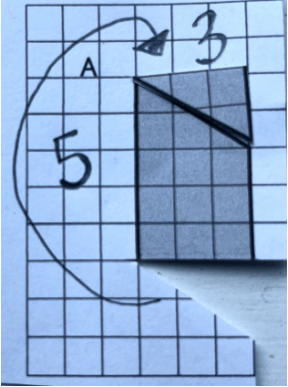
One pair cuts apart a parallelogram and rearranges it into a rectangle.
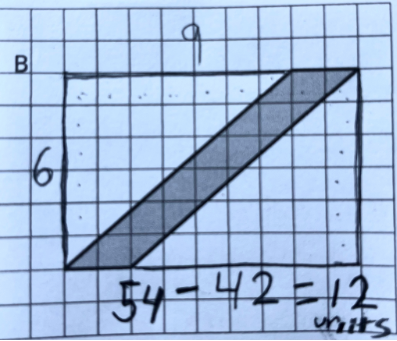
Another surrounds a parallelogram with a rectangle and subtracts the extra pieces.
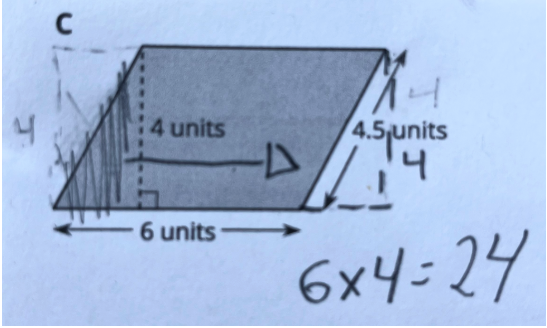
A third group tries several strategies and is convinced their final approach is different—until another student points out that they, too, have rearranged a parallelogram into a rectangle.
During the activity synthesis, you display student work and invite students to compare their approaches:
- “How are the strategies the same? How are they different?”
- “Which strategy—decomposing and rearranging, or enclosing and subtracting—seems more practical for finding the area of a shape similar to Parallelogram B? Why?”
- “Three measurements are shown for Parallelogram C. Which ones did you use? Which ones did you not use? Why and why not?”
Then you glance at the clock.
Five minutes.
You turn the page and see lesson synthesis.
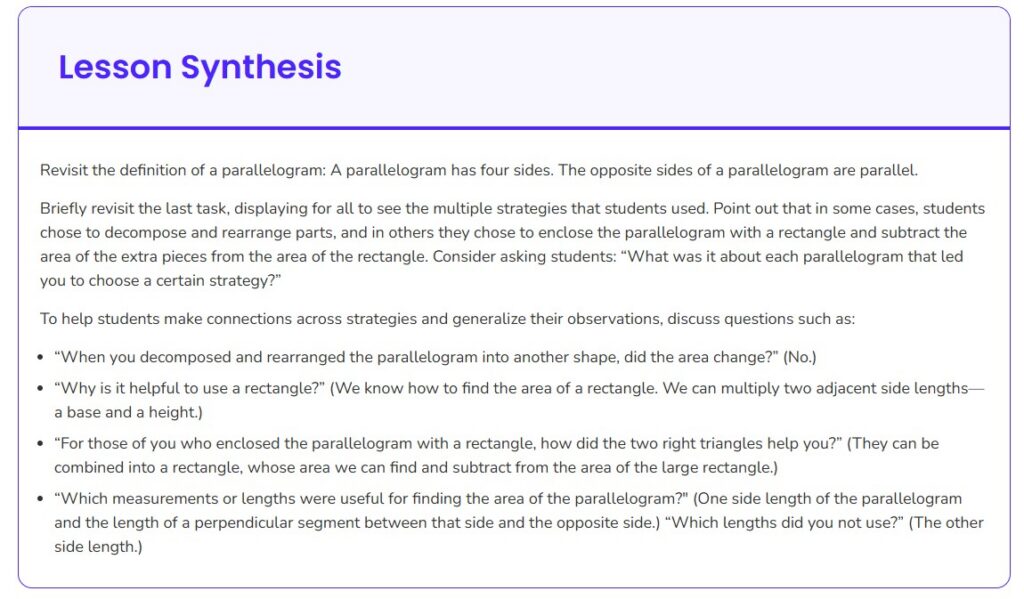
If you’ve ever looked at a lesson synthesis and wondered, Haven’t we already talked about this?, you’re not alone. But before deciding whether those final five minutes are necessary, consider a different question:
What would students miss if the lesson ended here?
Students have solved the problems. They’ve shared their thinking. They’ve learned from one another.
But have they considered:
What do all of these strategies reveal about the mathematics?
That question is the work of the lesson synthesis.
The Shift from Solving Problems to Making Sense of Mathematics
Throughout an IM Math lesson, students are doing mathematics. They make conjectures, test ideas, compare approaches, and revise their thinking. The classroom is intentionally filled with productive struggle and multiple ways of reasoning.
The lesson synthesis shifts the focus.
Instead of asking, “How did you solve it?” the conversation moves toward, “What can we learn from all of these ideas?”
That distinction matters.
An activity synthesis helps students make sense of the mathematical work they have just completed and connects that work to the purpose of the activity. The lesson synthesis widens the lens. Students have now experienced the arc of the lesson, and the class can consider what those experiences reveal when viewed together.
In the Grade 6 lesson, students discover several ways to find the area of a parallelogram. Each strategy is mathematically valid, and each reveals something important. The lesson is intentionally designed so that different parallelograms invite different approaches, helping students recognize a broader mathematical relationship rather than a single procedure.
Without the lesson synthesis, students may leave remembering only their strategy. With it, they begin to understand why the strategies work, grapple with efficiencies, and start becoming flexible in their mathematical thinking.
The goal isn’t simply to compare solutions. It’s to help students build a shared mathematical understanding they can carry into the next lesson.
The Lesson Synthesis Begins Long Before the End of the Lesson
One of the most important shifts teachers can make is recognizing that a lesson synthesis doesn’t begin in the last five minutes.
It begins during planning.
Before students ever encounter the task, teachers are already thinking about the mathematics they want students to uncover.
As you prepare for a lesson, consider asking yourself:
- What mathematical understanding do I hope every student leaves with?
- What strategies might students use?
- What misconceptions or unexpected ideas might emerge?
- Which student responses could help make the mathematics visible?
These questions aren’t about predicting exactly what students will say. They’re about preparing to recognize important mathematical ideas when they emerge.
Planning this way changes what you listen for as students work. Instead of searching for the “best” strategy, you begin collecting evidence of student thinking that can help the class make meaningful connections.
Listening for Connections
As students work through the parallelogram lesson, the lesson plan encourages us to listen carefully—not only for which strategy students use, but for why they chose it. Questions like, “Why did you decompose the parallelogram that way?” or “Why did you rearrange the pieces that way?” position students as authors of mathematical ideas, not simply answer-getters.
Those observations become the foundation of the lesson synthesis.
By the time students gather as a whole class, the teacher has been anticipating possible approaches, monitoring student thinking, and identifying examples and ideas that can help everyone make sense of the mathematics together.
Notice what changes.
The conversation is no longer about asking every student to share. It’s about intentionally connecting ideas.
The student who rearranged a parallelogram and the student who enclosed it in a rectangle may initially appear to have taken very different paths. The lesson synthesis creates an opportunity to ask what those paths have in common, and what that commonality tells us about parallelograms, rectangles, base, height, and area.
Responsive, Not Scripted
Teachers sometimes wonder whether they need to ask every lesson synthesis question exactly as written.
The lesson synthesis offers something more powerful than a script. It helps illuminate a mathematical destination.
Your students may notice an unexpected pattern. They may invent a strategy you didn’t anticipate. Those moments aren’t interruptions to the lesson synthesis. They can become part of it.
The teacher’s role during the lesson synthesis is not simply to steer students through a predetermined list of questions. It’s to use students’ thinking to help the class move toward the mathematical understanding of the lesson.
One helpful way to think about that work is as a progression:
- Elicit what students noticed.
- Compare strategies, representations, or ideas.
- Connect the mathematical relationships they reveal.
- Justify why those relationships hold true.
- Generalize an idea students can carry into future learning.
Not every lesson synthesis follows this exact path, but keeping these thinking moves in mind can help teachers remain responsive to students while keeping the discussion grounded in the mathematics.
More Than Sharing Strategies
One instructional routine that appears throughout IM Math is Compare and Connect. At first glance, it may look like students are simply sharing different ways to solve a problem.
Something deeper is happening. Students are learning to ask:
- What is the same?
- What is different?
- What does this strategy help us see?
Those questions move the conversation beyond individual solutions toward collective understanding. They help students recognize that different approaches can reveal the same mathematical relationship.
In the parallelogram lesson, students don’t just learn how to calculate area. They begin noticing a pattern that prepares them for future lessons: Every strategy depends on relating a parallelogram to a rectangle. The lesson synthesis gives the class an opportunity to make that connection explicit before students encounter the area formula in the next lesson.
That is what synthesis can do.
It becomes the moment where individual experiences become shared understanding—and where today’s work becomes the foundation for tomorrow’s mathematics.
Conclusion
The lesson synthesis is the final component of an IM Math lesson, but it isn’t the end of the learning. It’s the moment when students have enough experiences to begin making sense of them.
Over time, planning for lesson syntheses can change more than the final discussion. It can change the way teachers listen throughout the lesson. We begin paying closer attention to student thinking, looking for ideas worth connecting.
Students notice the shift, too. Instead of asking, “Which strategy is right?” they begin asking, “Why did they all work? How do we know when to use each strategy?”
Those are the moments that stay with students long after the lesson ends.
So, as you prepare for your next IM Math lesson, resist the urge to read the lesson synthesis only when you reach the end of the lesson.
Read it first. Identify one mathematical connection you want students to leave understanding. Then ask yourself: What mathematical understanding is this lesson inviting students to build together?
As you plan and teach, listen for the student ideas that could help the class make that connection. When you begin there, the lesson synthesis becomes more than the last five minutes of a lesson. It becomes a lens for the entire lesson.
And when you reach those final five minutes, you won’t be starting the lesson synthesis. You’ll be bringing together the thinking students have been building all along.
Are You Ready for More?
Connect with the Illustrative Mathematics team and ask about “Fostering Synthesis Through Discourse.” Schedule a call or email us at [email protected].
Looking for additional implementation support? Our free, self-paced on-demand training modules help teachers prepare lessons, understand instructional routines, build mathematical community, and confidently implement IM Math.
- classroom videos
- grade-specific examples
- companion guides
- available for every K–12 grade band
Explore the Anatomy of an IM® Math Lesson Series
This post is part of our Anatomy of an IM® Math Lesson series, which takes a closer look at the purposeful design of each part of an IM Math lesson, and how those components work together to support students in making sense of mathematics.
Continue exploring the series:
 Sarah Caban
Director, PK–12 Learning Experiences
Sarah Caban leads the creation of timely, relevant learning experiences that empower educators to teach with confidence and curiosity, fostering more equitable and joyful instruction with IM K–12 Math. Sarah was a lead writer for IM K–12 Math and brings over 15 years of experience as a math coach and teacher, including six years teaching in a one-room school on a small island off the coast of Maine.
 Timesha Brooks
Sr Specialist, PL Design
Timesha Brooks is a professional learning designer who specializes in mathematics pedagogy and teacher development. She designs practical, equity-centered professional learning that translates research into daily classroom moves. Driven by a passion to ensure all students have access to high-quality education, she helps teachers shift from being the math “doer” to being facilitators of learning so all students see themselves as capable, brilliant, and successful in mathematics.