By the Illustrative Mathematics team
Education Scorecard—a collaboration between Harvard University’s Center for Education Policy Research and Stanford University’s Educational Opportunity Project—recently named Dover School District in New Hampshire a District on the Rise. The data behind this recognition shows Dover students gaining ground in math faster than students in similar districts since 2022.
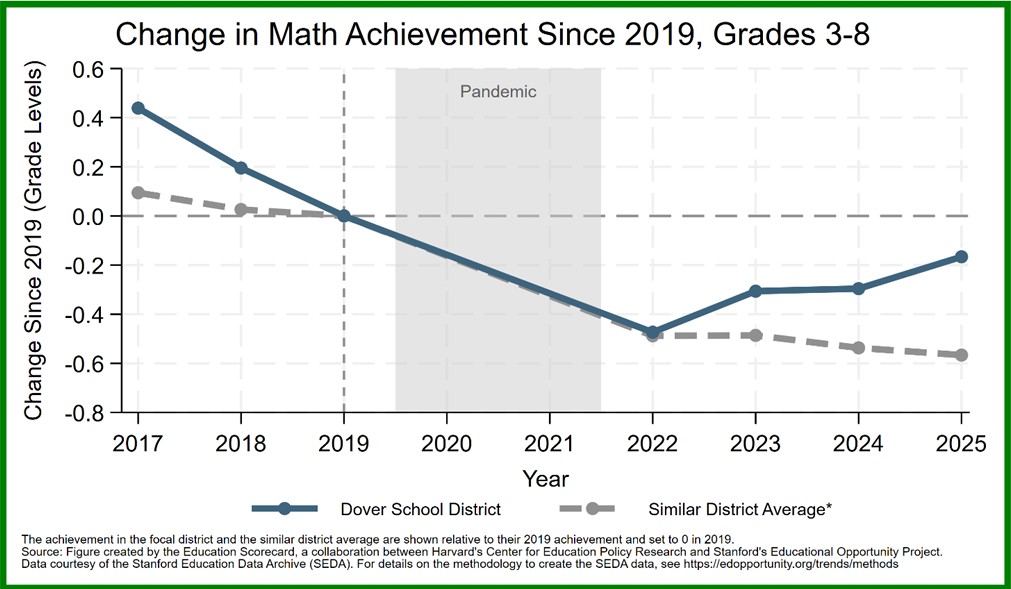
*Similar districts: Portsmouth School District, Hudson School District, Salem School District, Rochester School District, Derry Cooperative School District
Ask Dover educators what’s behind those trend lines, and you won’t hear about a single program or a silver bullet. You’ll hear about systems: evidence-based curriculum adoption, professional learning communities, district-level support, and using data to inform instruction rather than just measuring it.
“In Dover, our focus has been on building lasting systems that support both students and educators, not just responding to a moment in time,” said Superintendent Dr. Christine Boston in the district’s Education Scorecard profile.
In Dover Middle School math classrooms, one important piece of that system is IM® 6–8 Math. We spoke with Jen Krans, Dover’s Director of Curriculum, Instruction, and Assessment, about how the district chose the curriculum, what implementation has looked like, and why she believes honoring teacher expertise has made all the difference.
A Teacher-Led Adoption
When Dover’s curriculum review cycle signaled it was time to reexamine math programming, the district convened a committee of teachers to lead the adoption process—a decision Krans still points to as one of the wisest the district made.
“Including teachers in the decision-making makes it more likely that they’re committed to the implementation,” she said.
The committee set clear criteria for selection. Because standards alignment and all-green ratings across all three EdReports gateways were nonnegotiable, they sought a curriculum that delivered on both. IM Math is standards aligned and has earned all-green ratings from EdReports across every grade band, from kindergarten through high school.
Just as important was what Dover Middle School teachers wanted for their students. They had spent years building students’ capacity for mathematical discourse through trainings and coursework, and they were looking for materials designed around that same goal.
“Our teachers were really interested in building students’ ability to have mathematical discourse,” Krans said. “So IM Math was a natural fit.”
In 2021, Dover adopted IM Math for grades 6–8. Today, the district uses IM 6–8 Math v.360 through IM Certified® curriculum distribution partner Kendall Hunt.
Materials That Matched the Mindset
Dover’s teachers weren’t new to problem-based instruction when IM Math arrived. Many had been teaching that way for years. What they lacked was a curriculum built around that same instructional model.
“They had that mindset, and the materials allowed them to use that mindset in a more coherent way,” Krans explained. “We were able to look at the structure of a unit, a lesson, an assessment, and say: as you’re going through this, follow this progression.”
That coherence pays off for students, too. Because IM Math uses consistent structures and routines across lessons, units, and grade levels, students spend less energy figuring out how class works and more energy thinking mathematically.
“If you go into a Dover Middle School math classroom, you would see a lot of discourse. You would see collaborative work. You would see teachers using visual models,” Krans said. “You would see all of that because that is what they always did, but now it’s more coherent. A student’s not having to relearn every year what the structure is.”
Professional Learning That Drives Practice
Adopting during the pandemic meant Dover’s first curriculum training sessions were virtual. They helped teachers get started, Krans said, but the district didn’t stop there. Once in-person learning resumed, Dover ran what she calls a “hard reset”: foundational IM Math training for teachers, delivered when they could fully engage with it.
Ongoing district-level support comes from an instructional coach who helps teachers use the access and scaffolding resources built into the curriculum so every learner can enter an activity, and a Dean of Instruction who helps teachers understand the reasoning behind the curriculum’s design.
But Krans is quick to name who’s really leading the work. “Our teachers are driving this at our middle school. They’re driving student success.”
Dover Middle School’s math teachers meet in collaborative teams nearly every week, examining student evidence of learning and deciding what comes next. The curriculum has strengthened this work, Krans said, allowing educators to engage in ongoing analysis and conversations about instruction. Their planning starts with the end in mind. After reading a unit overview, the teams study the unit assessment and plan backward from there.
Department meetings connect the work across grade levels, helping teachers learn to trust the curriculum’s progression. When learning looks unfinished in the moment, a conversation with a colleague in another grade often reveals that the concept returns later in the sequence, by design, Krans said.
A Tool for Professionals, Not a Script
In Dover, trusting the curriculum’s progression is where teacher autonomy starts.
The progression is the part teachers don’t have to build or second-guess: the sequence of ideas, the way concepts return and deepen across units. That structure frees teachers to focus their expertise on the decisions no curriculum can make for them—how to respond to the thinking in the room, where a student needs another entry point, which ideas to draw out in discussion.
That’s why Krans believes IM Math earns teachers’ trust. It’s structured without being scripted.
“Teachers have the expertise. They need individual decision-making power, and they also need to be able to collaborate and work as a team,” Krans said. “IM Math gives them the framework to do that. We appreciate that it really is a tool for professionals.”
Measuring Progress in More Ways Than One
The Education Scorecard recognition is one signal that Dover is moving in the right direction, but the district doesn’t rely on a single measure. Dover monitors universal screening data three times a year, tracks performance on the New Hampshire state assessment, and uses the formative and summative assessments embedded in IM Math to see whether students are keeping pace with the curriculum’s learning progression.
And then there’s the evidence you can only gather in person.
“I gauge success when I go into a classroom and I hear students talking about math, persevering through difficult problems, and having a framework and a language to talk about it,” Krans explained. “When I see that our students are equitably accessing math, I know that’s a huge metric of success. And I do see that in our middle school.”
The district is building on that momentum. Two years ago, Dover launched an accelerated middle school math pathway using IM 6–8 Math Accelerated v.360, with the goal of growing the number of students ready for Algebra 1 in grade 8.
“We’re on track to do that,” Krans added.
Advice for Districts Considering IM Math
Krans’s advice for districts considering IM Math comes down to three commitments—the same ones she credits for Dover’s successful implementation.
- Include teachers in the adoption decision. Krans emphasizes that commitment to implementation starts with involving teachers in the decision.
- Invest in strong training up front, before teachers begin. She says educators should have a solid foundation because there is a learning curve.
- Build in regular, protected time for teachers to work together. Krans stresses that teachers need time to make sense of the change and develop their understanding together.
Conclusion
Dover’s recognition as a District on the Rise reflects years of deliberate work: systems built to last, data used to learn, and professional learning that never stopped after year one. Within that larger system, IM Math gave Dover Middle School teachers something they had been building toward for years—a coherent curriculum designed around the same beliefs they already brought to their classrooms.
For Krans, the destination is bigger than any assessment.
“I hope that students understand that math is for everyone,” she said. “Being able to think mathematically is being able to think. I tell students that, yes, reading is a superpower, but math is also a superpower because it’s a tool you use to be a critical thinker. No matter what you’re going to do, you need it.”
Next Steps
Want a closer look at the systems behind Dover’s rise? Read Dover School District’s Education Scorecard profile for the district’s full story, from professional learning communities to its MTSS framework.
Interested in bringing IM Math to your school or district? Access IM Math v.360 for free on AccessIM to experience the curriculum and implementation resources. Or explore enhanced digital and print versions of IM Math v.360 from IM Certified® partners, and find the option that’s right for your school or district.
Ready to talk about your goals? Connect with our team to learn about the support that can help you build a strong, sustainable IM Math implementation. Schedule a call or email us at [email protected].