By Hannah Herbert, PK–6 Content Specialist
In one corner of a transitional kindergarten classroom, a small group of children sorts a pile of buttons—some by size, some by color—while their teacher listens in and asks what they notice. Nearby, two students negotiate whose turn it is to roll the dice in a counting game. It looks like play. It is play. And it’s also the beginning of a mathematical life.
Scenes like these are easy to mislabel. To some, transitional kindergarten (TK) looks like a younger version of kindergarten. To others, it sounds like a new name for PreK. It’s neither.
TK is a distinct developmental year that serves children who aren’t yet age-eligible for kindergarten—typically four-year-olds turning five. It bridges the gap between PreK and kindergarten, not only academically but socially and emotionally. As more states invest in TK programs, it’s worth pausing on an important question:
What makes TK unique, and how does it set students up for success?
What Makes TK Unique?
Programs look different from state to state and school to school, but in broad strokes, TK sits in a meaningful middle ground.
PreK, which typically serves children ages three and four, is play-based and often child-led. The emphasis is on socialization, motor development, building relationships, and early introductions to ideas like numbers, letters, shapes, and colors.
TK is still play-based, but it introduces academic concepts—early math, reading, and writing—through learning experiences designed for how four- and five-year-olds actually learn, including play, small-group work, and short stretches of whole-group time. Along the way, children practice communicating their ideas, solving problems, and collaborating with classmates.
Kindergarten marks the start of more formal instruction, with greater independence and responsibility for students. In IM® K–5 Math, for example, kindergarten introduces structures like workbooks and a consistent lesson arc that carries through the elementary grades.
Just as important is what TK is not:
- TK is not teaching younger students kindergarten standards.
- TK is not a year to accelerate learning.
- TK is not PreK, repeated.
How TK Sets Students Up for Success
A student’s academic success begins long before they enter a kindergarten classroom. TK introduces academic concepts, yes, but it also helps young learners develop confidence, curiosity, independence, problem-solving, executive functioning, self-regulation, flexibility, and the ability to learn from mistakes.
Consider everything happening when a child participates in a 60-minute math lesson: taking turns, communicating their thinking, managing materials, following routines. TK students do all of these things every day. What makes TK special is that it’s the place where they learn how to do these things—with room to practice, make mistakes, and grow more confident each time:
- When students join a class discussion, they’re practicing how to listen and take turns.
- When they work on their own, they’re learning to follow routines and manage materials.
- When they stick with a challenging task, they’re strengthening self-regulation and building confidence in themselves as learners.
These skills aren’t happy accidents of the school day. Frameworks like California’s Preschool/Transitional Kindergarten Learning Foundations (PTKLF) and the SEL competencies from the Collaborative for Academic, Social, and Emotional Learning (CASEL) treat them as learning goals in their own right.
The PTKLF describe this stage as a period when “children engage in more conversations and shared activities with others, form relationships with peers, and learn to regulate emotions and behaviors with less adult support.” None of that shows up on a report card, but all of it shapes how a child experiences school for years to come.
A Curriculum Built for the TK Year
If TK isn’t kindergarten and isn’t PreK, then a TK curriculum can’t be kindergarten slowed down or PreK stretched out. It has to be built for this year, on its own terms.
That’s the thinking behind IM® TK Math. The curriculum is grounded in California’s PTKLF and research-based learning trajectories, so learning goals match where four- and five-year-olds actually are in their development—and not just mathematically. Because so much of TK is about learning how to learn, every lesson weaves in social and emotional learning opportunities, drawing on the PTKLF’s Social and Emotional Development foundations and CASEL’s SEL competencies.
And while the PTKLF come from California, the child development they describe doesn’t stop at the state line. Four- and five-year-olds grow the same way everywhere, which means the curriculum is at home in any TK classroom.
What “Built for TK” Looks Like
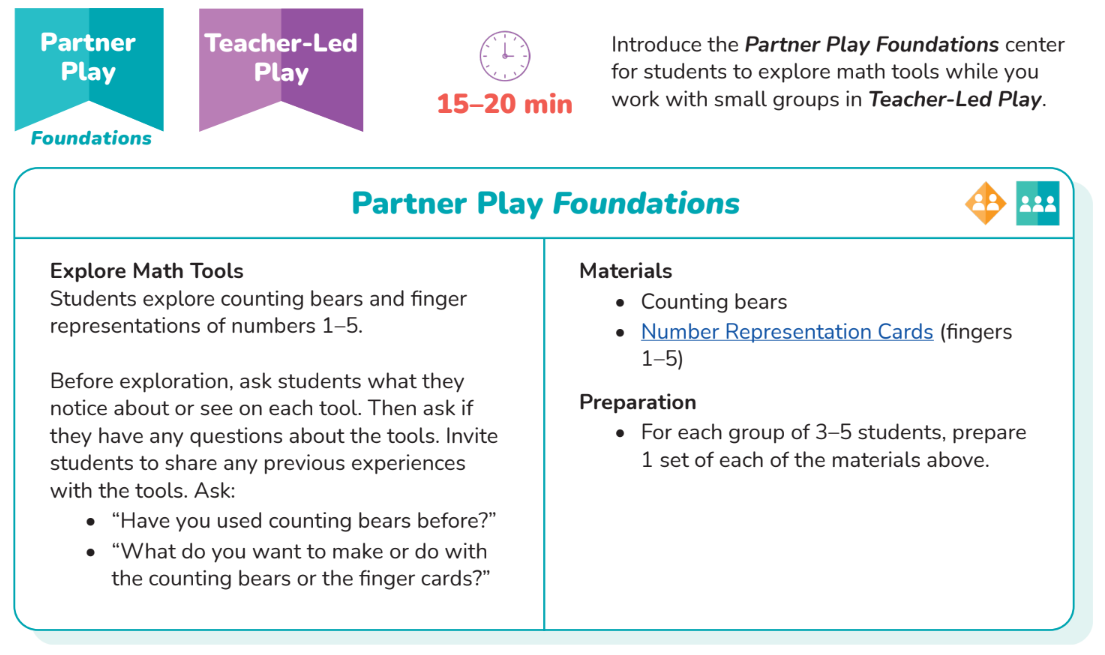
In IM TK Math, mathematical ideas show up the way they should at this age, through play, games, small-group experiences, and brief whole-group moments—not worksheets and seat time.
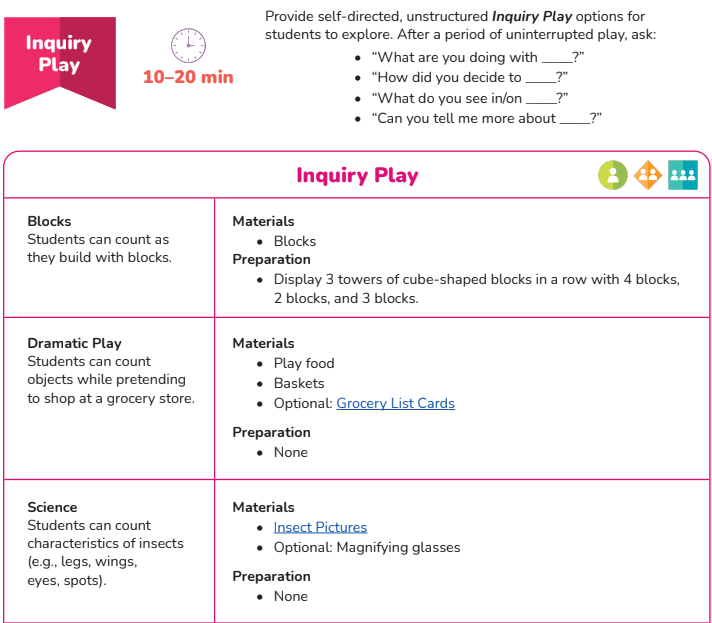
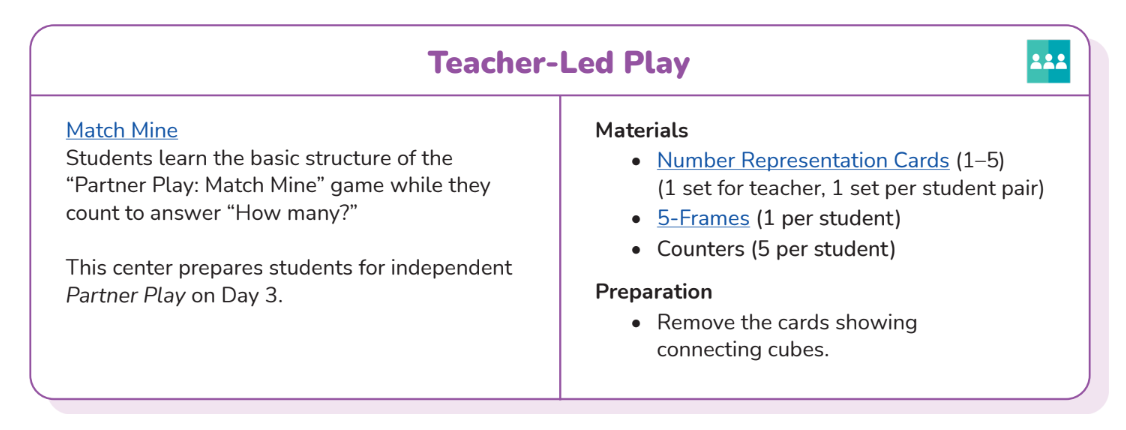
Math Idea 1, Lesson 4: Counting to Tell How Many
Just as important, the structure flexes. IM TK Math is designed so teachers can rearrange and adapt learning experiences in response to their students, following curiosity when it strikes, revisiting an idea when children need more time with it, and using moments of play to notice how students are thinking.
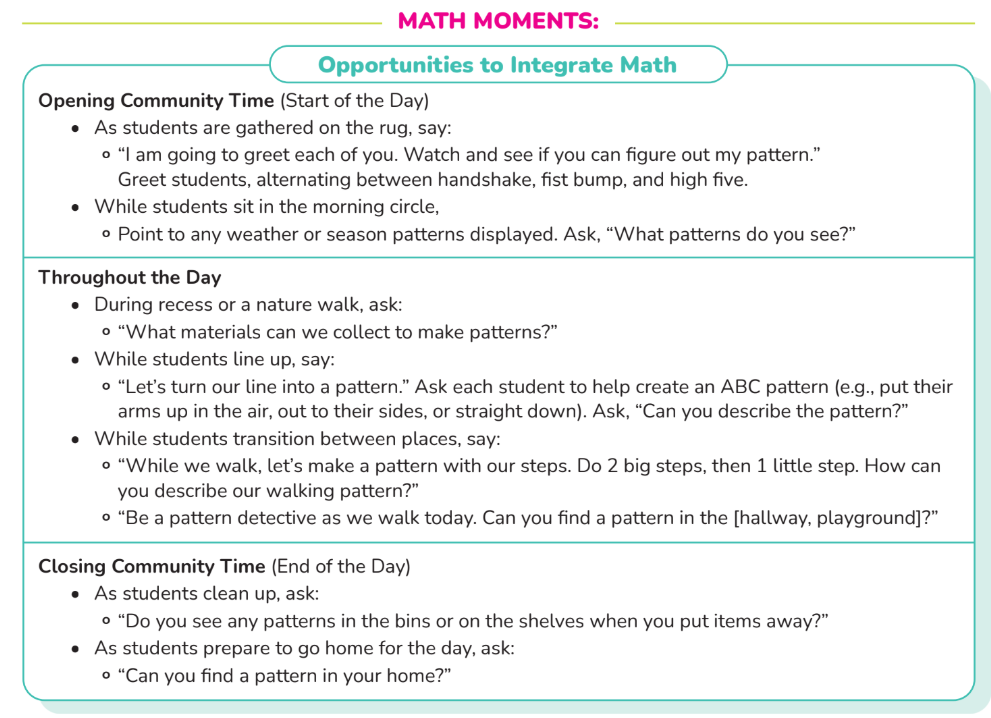
Math Idea 5, Lesson 1: Recognizing Patterns
The result is a year where children build early number sense, spatial reasoning, and pattern thinking while also building the confidence and curiosity that make them eager to keep going.
Conclusion
Back to those button sorters. They aren’t getting ready to do “real” math someday. They’re already doing it—comparing, classifying, counting, explaining their thinking to a friend. TK is where that mathematical life begins, and it deserves a curriculum, a classroom, and a set of expectations designed for exactly this moment.
When we treat TK as a year all its own, children get what the transition is meant to give them: a strong foundation for kindergarten and the beginnings of a positive mathematical identity that can carry them through school and beyond.
Next Steps
As you think about TK in your own school or classroom, consider the following:
For educators
- Take inventory of the experiences available in your classroom. How are opportunities for play, collaboration, and problem-solving balanced with opportunities to engage with academic concepts?
- How am I helping children build confidence in themselves as learners?
For leaders
- How is TK presented in our school—as a younger kindergarten, or as a unique developmental year for students?
- What should my expectations look like when walking into a TK classroom, knowing that play, movement, and flexibility are signs the year is working as designed?
Ready for More?
- Get to know IM TK Math and see how it supports the unique TK year: knowim.org/TK
- Connect with the Illustrative Mathematics team and ask about “TK Math Planning Guides.” Schedule a call or email us at [email protected].
More from This Series
This post kicks off our new series on transitional kindergarten, The TK Year, where we’ll take a closer look at what math looks like in a TK classroom, the role of play, supporting TK educators, and more. Subscribe to the IM Certified® blog so you never miss a post.

Hannah Herbert
PK–6 Content Specialist
Hannah Herbert holds a BA and an MA in Early Childhood Education and has over a decade of teaching experience in early childhood and elementary classrooms in Chicago and New Orleans. She has also served as an Elementary Curriculum Development Manager and an Early Childhood Pedagogical Coach.
As a PK–6 Content Specialist at Illustrative Mathematics, Hannah creates developmentally-appropriate learning experiences that empower students to see themselves as capable and confident math learners.