
By Hannah Herbert, PK–6 Content Specialist
Step into a transitional kindergarten (TK) classroom during student-led play, and you might see two students stacking blocks, a small group stringing beads in the makerspace, and a lively debate unfolding in the dramatic play corner about who gets which hat.
At first glance, it may not look like a math lesson. But look a little closer, and you’ll hear it: “Your tower is taller than mine.” “I need a longer string.” “One, two, three—there’s a hat for everyone!”
A common misconception in early childhood classrooms is that rigorous learning happens during lessons and pauses during play. But play is not a break from learning or something saved for extra time at the end of the day. In IM® TK Math, play is where much of the learning happens.
The learning is always there—it just takes knowing what to look for.
What Student-Led Play Looks Like in IM TK Math
IM TK Math includes two daily student-led play structures: inquiry play, where students pursue their own ideas within thoughtfully prepared centers, and partner play, a game structure students experience with a classmate.
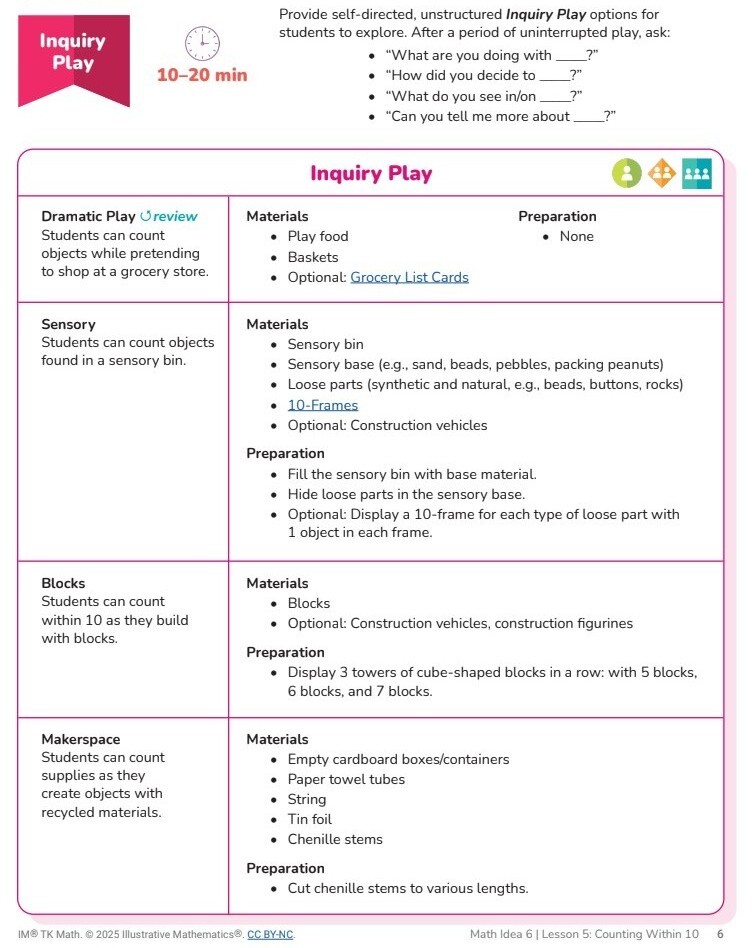
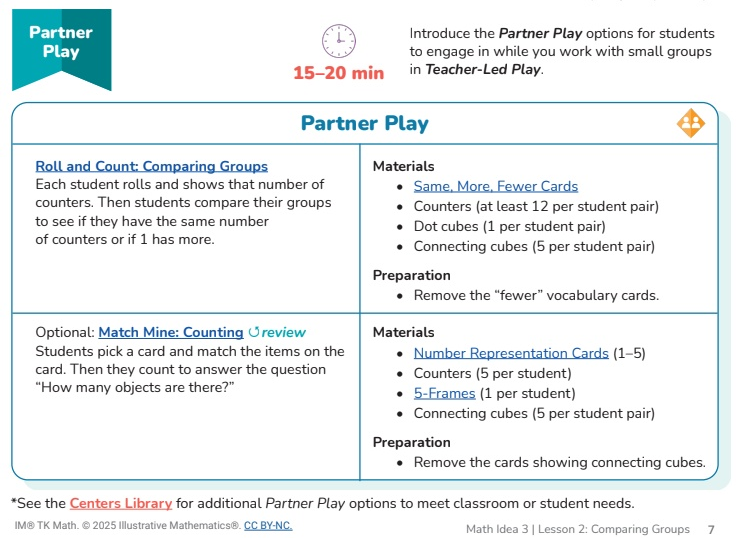
Student-led play in IM TK Math doesn’t mean a lack of structure or purpose. Each experience is designed around a learning standard and curated to give students room to both show what they know and build on it. Across both structures, play:
- invites students to test their own ideas
- encourages collaboration and conversation
- gives students meaningful decisions to make
- creates a safe space to take risks
- offers varied levels of structure, so students can enter the learning in different ways
Where’s the Rigor?
Rigor is sometimes mistaken for difficulty. But rigor isn’t about making tasks harder—it’s about meaningful thinking. During these play experiences, students create, analyze, compare, problem-solve, and reason. They explain their thinking, test strategies, revise their approach when something doesn’t work, and find compromises with classmates.
Those are exactly the kinds of thinking we hope to see in any strong mathematics classroom. And in TK, play is where they happen most naturally.
Where’s the Math?
Mathematical thinking shows up organically during play, often in students’ own words.
In a block center, students might:
- compare length and height: “Your tower is taller than my tower.”
- compose shapes: “I need a square tile and a triangle tile to make my castle.”
- count: “I made a tower with 3 red blocks and 1 blue block.”
- work with spatial relationships: “I put the doll inside the house.”
In the art center or makerspace, students might:
- compose and compare shapes: “This circle looks like a ball.”
- create patterns with beads, stamps, or paint
- notice attributes and sizes: “This is a big paper.” “I need a longer string.”
In dramatic play, students might:
- count objects: “One, two, three. There’s a hat for everyone!”
- sort: “Put the bananas over here and the apples over there.”
- compare quantities: “You have more beads than me.”
- solve real-world problems: “There’s not enough room. Let’s move the chair.”
Research supports what TK teachers see every day. As the California Department of Education notes in the California Preschool/Transitional Kindergarten Learning Foundations: Mathematics, “Children are born with a natural ability for and interest in exploring mathematical concepts. Through interactions with adults and their environment, children in the early years explore concepts such as quantity, shape, and size, and gain experience in counting, sorting, ordering, collecting data, and engaging in spatial thinking.”
That early foundation pays off. According to the introduction to the California Preschool/Transitional Kindergarten Learning Foundations (PTKLF), “Research shows that children who experience a rich mathematical environment at home and in an early education program perform better in mathematics in elementary school.”
Play Builds More Than Math
During play, students are also learning to communicate, listen to others, take turns, try new things, persist when something is challenging, and manage big feelings. These social-emotional skills develop alongside the mathematics—something a worksheet simply can’t offer.
The research echoes this, too. As the PTKLF’s introduction puts it, “Through child-led play, exploration, and interaction with adults and peers at home and in the early education environment, children develop skills that set the foundation for success in school and life.” So much happens in play, all at once.
The Teacher’s Role in Student-Led Play
Students lead the learning during inquiry and partner play, but teachers are far from passive. The teacher’s work begins before play starts, by:
- creating welcoming spaces
- choosing materials that invite mathematical thinking
- adjusting spaces and materials based on what they observe about student interest and need
Teachers also observe, listen, and document during play. They mediate when needed. And they ask questions that deepen student thinking, without giving students instructions on how to play. (Note: We’ll take a closer look at observation and questioning in upcoming posts in this series.)
Teachers can also help other adults see the learning in play. When a school leader or family member visits during play and wonders, “Why is it so loud?” or “Where’s the exit ticket?”, teachers can offer better questions to ask instead, such as:
- What problems are students solving?
- How are students communicating and collaborating?
Consider keeping a short list of questions visitors can ask students during play. There’s no better way to see the learning in action than to hear a four-year-old explain their thinking.
Conclusion
Student-led play is a powerful tool for learning—not a break from it. During play, TK students develop mathematical thinking, language, and social-emotional skills all at once, in ways that a worksheet or a long lesson on the rug can’t replicate. The learning is happening. We just have to look.
Next Steps
Educators:
- Reflect: When do I tend to step into play? Are there moments when I could step back and take in the learning that’s already happening?
- Observe student-led play this week and document one social-emotional skill you see students demonstrating. Share that success with the class.
- Draft two or three questions you can share with school leaders or visitors to ask students during play.
Leaders:
- Reflect: How is play positioned in our classrooms? Do we treat it as a meaningful time for learning?
- Reflect: How do our daily schedules protect time for play and inquiry for all students, so no one regularly misses play for pull-out groups?
- Visit a classroom during student-led play. What is one mathematical skill and one social-emotional skill you see students demonstrating?
Ready for More?
- Get to know IM TK Math and see how it supports the unique TK year: knowim.org/TK
- Connect with the Illustrative Mathematics team and ask about “TK Math Planning Guides.” Schedule a call or email us at [email protected].
More from This Series
What Makes Transitional Kindergarten Unique
Subscribe to the IM Certified® blog so you never miss a post.

Hannah Herbert
PK–6 Content Specialist
Hannah Herbert holds a BA and an MA in Early Childhood Education and has over a decade of teaching experience in early childhood and elementary classrooms in Chicago and New Orleans. She has also served as an Elementary Curriculum Development Manager and an Early Childhood Pedagogical Coach.
As a PK–6 Content Specialist at Illustrative Mathematics, Hannah creates developmentally-appropriate learning experiences that empower students to see themselves as capable and confident math learners.
