Establishing norms is critical to creating an environment where all students see themselves as knowers and doers of mathematics. Reflecting on the Illustrative Mathematics mission statement, Creating a world where learners know, use, and enjoy mathematics, how can we...
6–8 Math
Explicit Classroom Norms to Teach Kids How to Learn From Solving Problems
Jul 29, 2019
This blog post is the fourth in a series of four blog posts exploring the student experience of problem-based learning. The first three posts are available here: (1) “How Do Students Perceive Problem-Based Learning?” (2) “Inviting Students to the Mathematics” (3)...
Concrete Representations that Give Students a Way to Get Started
Jul 18, 2019
This blog post is the third in a series of four blog posts exploring the student experience of problem-based learning. The first two posts are available here: “How Do Students Perceive Problem-Based Learning?” and “Inviting Students to the Mathematics.” By Max...
Realizing the promise of open resources, part II
Jun 17, 2019
By William McCallum In my first post on the topic of realizing the promise of open educational resources, I described the IM Certified program. Our partners offer multiple versions, including a free online version and enhanced versions with different options for...
The Power of Small Ideas
May 21, 2019
By William McCallum, IM President Big ideas are popular in mathematics education, and you can find many lists of big ideas on the web. Some are more thoughtful than others, and I can see how some might be useful for organizing a curriculum. But few of the ideas I see...
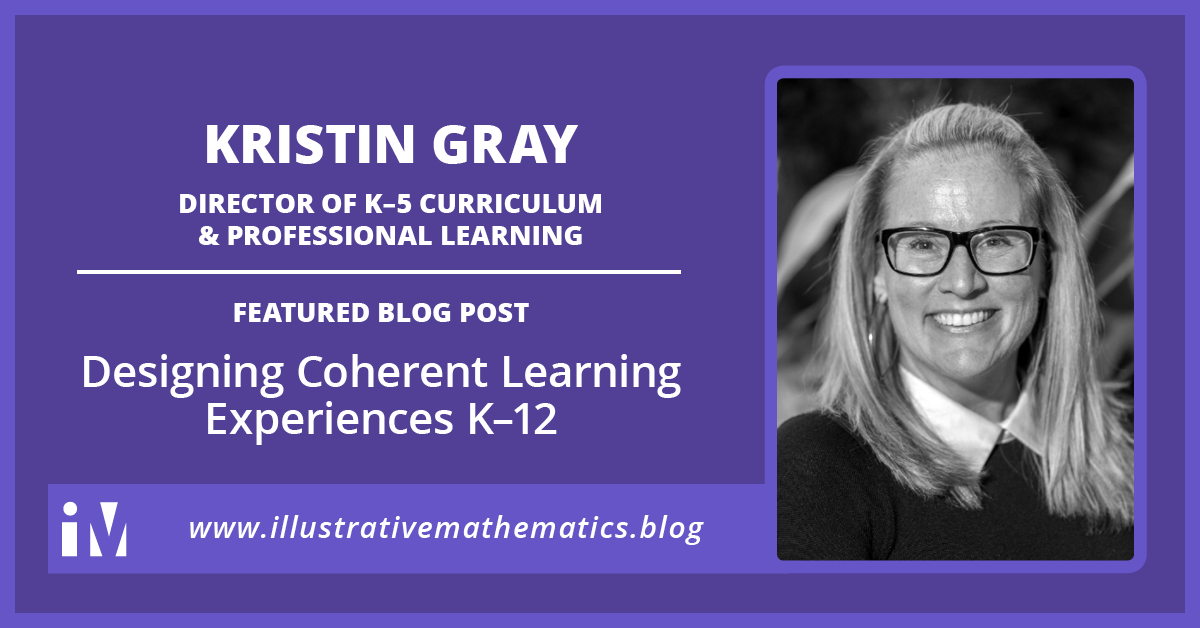
Designing Coherent Learning Experiences K-12
May 7, 2019
By Kristin Gray, Director of K–5 Curriculum & Professional Learning One challenge in curriculum design is considering all we know and believe to be true about math teaching and learning and translating that into realistic and actionable pieces for teachers and...
NCSM NCTM Recap
Apr 15, 2019
Illustrative Mathematics It was great to see so many of you at NCSM and NCTM in San Diego. If we missed you, or you weren’t able to attend, read our NCSM and NCTM round-up below. We enjoyed the conversations we had with those of you that are using the IM 6–8 Math...
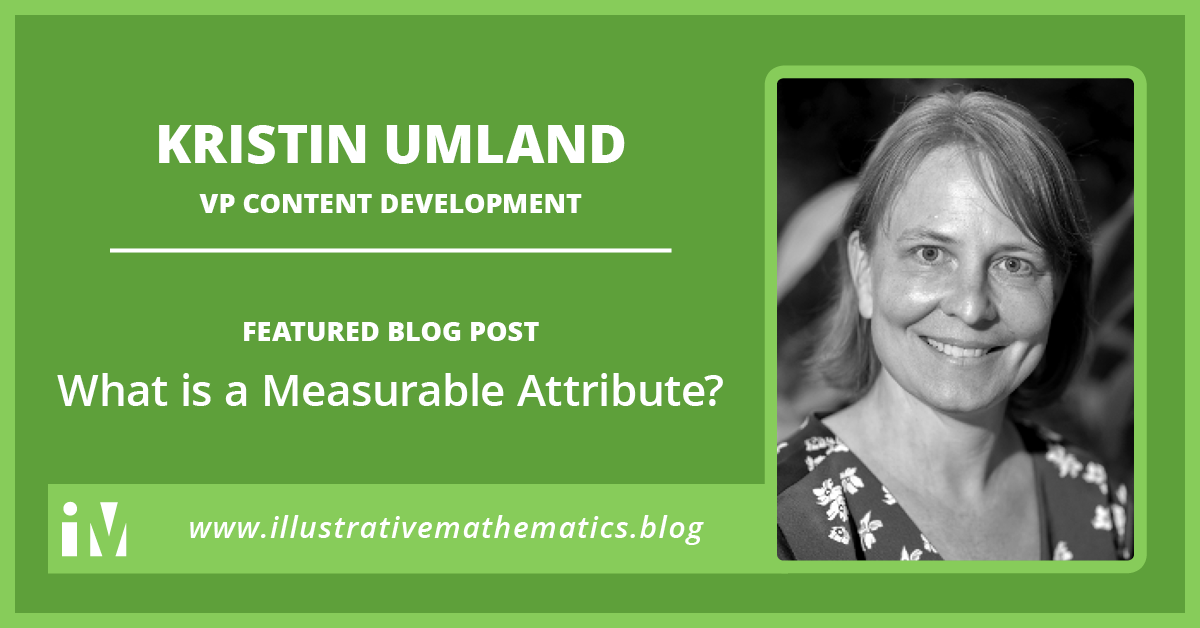
What is a Measurable Attribute?
Apr 8, 2019
By Kristin Umland,VP Content Development A great conversation I had with the IM elementary school curriculum writing team got me thinking: What is a measurable attribute? That is, when given an object, what can we measure about it? Before you jump in with your own...
Representing Subtraction of Signed Numbers: Can You Spot the Difference?
Mar 2, 2019
By Greta Anderson & Patti Drawdy, IM Certified Facilitator I read the lesson three times through, but was still unsure why the number line below shows $3 - 7$. My aha moment arrived courtesy of the grade 1 standards. Greta: Over the course of this past year,...
Planning Lessons for a Block Schedule
Feb 28, 2019
By Jennifer Wilson and Vanessa Cerrahoglu Update 2021 - August: IM has created block schedule guidance for IM 6-8 Math v.III and IM 9-12 Math v.I. Get unit guidance on how to customize the curriculum to fit your block schedule in the IM Community Hub. IM 6–8 Math...
to the IM Blog and Newsletter
RECENT POSTS
- What LEGO Taught Us About Play-Based Learning in Transitional Kindergarten Mar 18, 2026
- Staying Curious in Transitional Kindergarten: What Inquiry Play Reveals About How Students Think Mar 11, 2026
- Fluency Development Within and Across the Grades in IM® K–5 Math Part 4: Multiplication and Division Mar 10, 2026
- Fluency Development Within and Across the Grades in IM® K–5 Math Part 3: Multiplication and Division Mar 9, 2026
- Fluency Development Within and Across the Grades in IM® K-5 Math Part 2: Addition and Subtraction Mar 5, 2026
Categories
- 6–8 Math (143)
- 9–12 Math (114)
- Assessment (1)
- Back to School (7)
- Classroom Community (5)
- Classroom Discourse (6)
- Coaches Corner (10)
- Computational Fluency (2)
- Equity (5)
- Implementation (6)
- In the Classroom (9)
- Instructional Routines (5)
- K–5 Math (152)
- Lesson Planning (3)
- Math Content (3)
- Math Language Routines (3)
- Partners (5)
- Problem-Based Learning (5)
- Professional Learning (94)
- Recent Blog Posts (12)
- Research Studies (1)
- Supports for English Language Learners (1)
- Supports for Students with Disabilities (6)
- TK/PK Math (12)
- Uncategorized (2)
- Unfinished Learning (1)