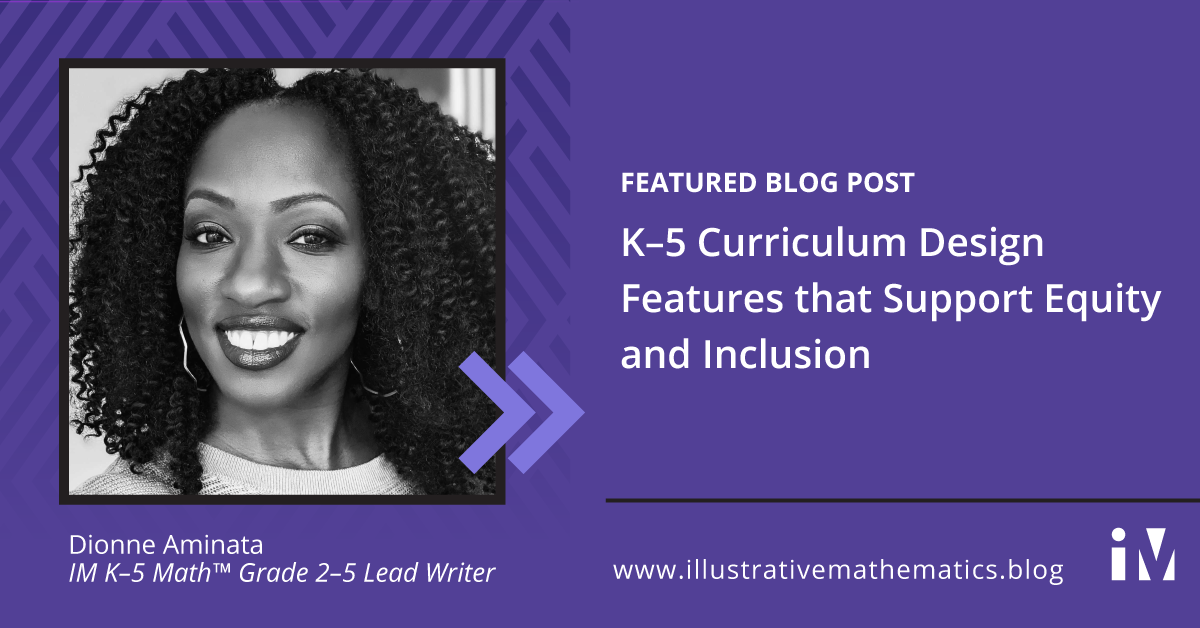
By Dionne Aminata Before I joined the K–5 curriculum writing team at IM, I was a K–8 regional math content specialist for a public charter organization that largely consisted of Title I schools, or schools receiving federal funding to support a large concentration of...
K–5 Math
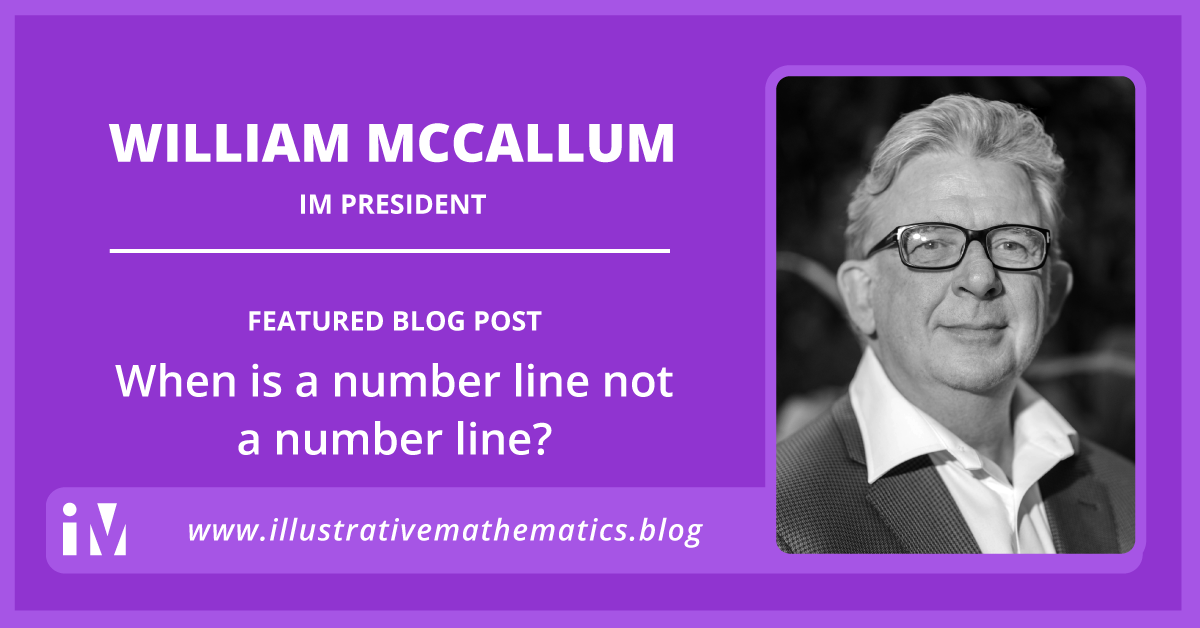
When is a number line not a number line?
Feb 15, 2020
By William McCallum The number line is a seemingly simple object: a straight line with two points marked 0 and 1. Those two points are the seeds of great complexity, however. Whole numbers are located at positions marked off by iterating the interval. Fractions are...
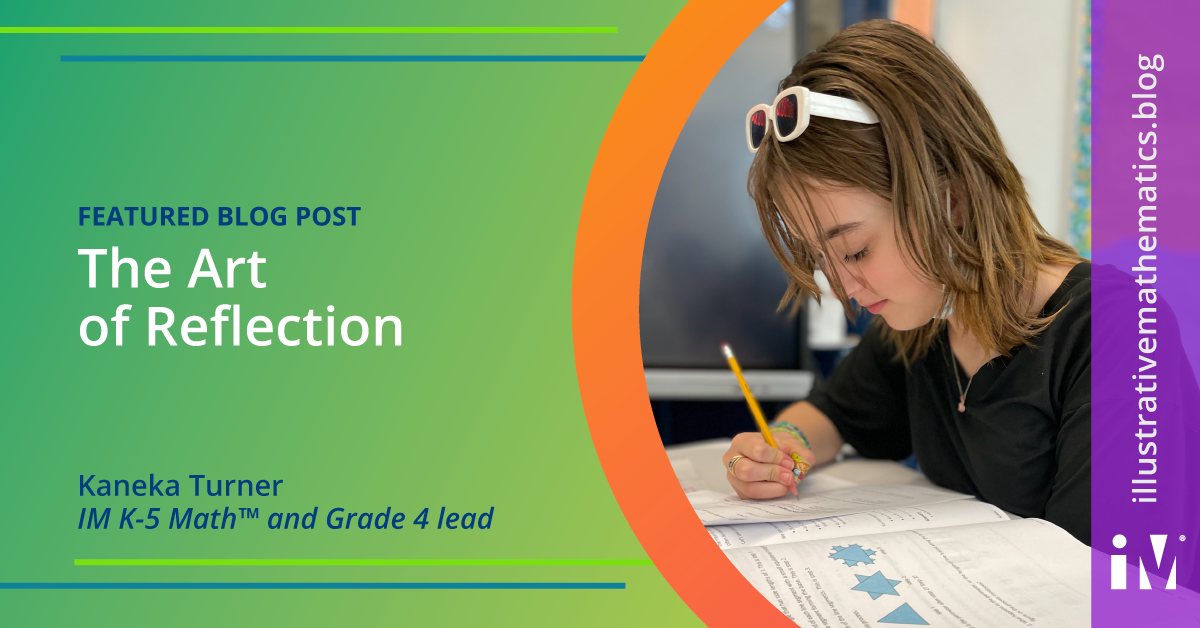
The Art of Reflection
Feb 3, 2020
“In times of stress, the best thing we can do for each other is to listen with our ears and our hearts and to be assured that our questions are just as important as our answers.” —Mr. (Fred) Rogers By Kaneka Turner We are never more “on” than when we are teaching a...
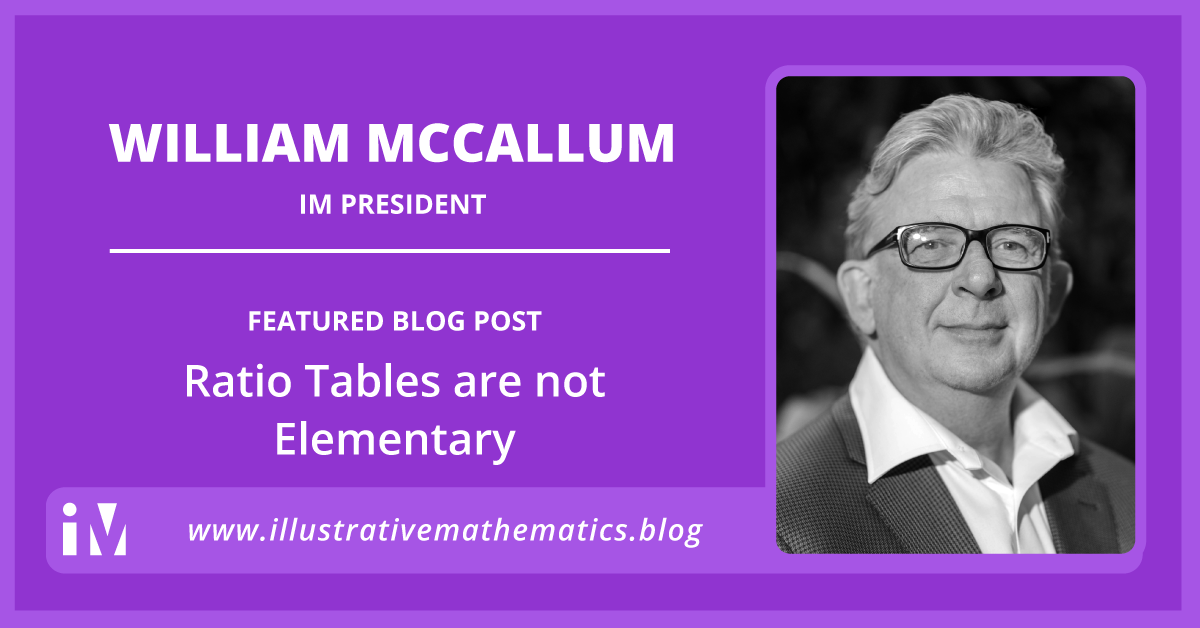
Ratio Tables are not Elementary
Jan 12, 2020
By William McCallum In grade 3, as students start to learn about multiplication, they think about products like 6 x 7 in terms of equal groups. 6 x 7 is the number of things when you have 6 groups with 7 things in each group. They might start out calculating that...
Using Diagrams to Build and Extend Student Understanding
Nov 25, 2019
When students notice things, we often ask, ‘Why is that happening?” but it can be challenging to explain why beyond the procedure one followed.
But fifth graders are brilliant.
Creating an Accessible Mathematical Community with IM K–5: the power of “yet” for students and adults
Oct 22, 2019
Does the perfect elementary math curriculum exist? Armed with a growth mindset and the Alpha IM K–5 curriculum, teachers in Ipswich Public Schools push their thinking to reach all mathematicians. By Maureen D. O’Connell I preach growth mindset daily. When my students...
Using Instructional Routines to Inspire Deep Thinking
Oct 13, 2019
We want students to think about math deeply. Creatively. Analytically. Instead, what often happens is that students race towards quick solutions. So what can we do to support this other kind of thinking in class—the slow, deep kind? By Jenna Laib One way is through...
Which Vertex is the Center of a Triangle?
Sep 23, 2019
By William McCallum I am sometimes asked what is the secret to the success of our curriculum, what is the special property that sets it apart from other curricula. That question is like the one in the title of this blog post, “Which vertex is the center of a...
First Impressions: The First Units in IM K–5 Math
Jul 23, 2019
“I've learned that people will forget what you said, people will forget what you did, but people will never forget how you made them feel.” Maya Angelou By Kristin Gray When I think back to my 8th grade math class, I cannot recall the exact problems I struggled with...
Realizing the promise of open resources, part II
Jun 17, 2019
By William McCallum In my first post on the topic of realizing the promise of open educational resources, I described the IM Certified program. Our partners offer multiple versions, including a free online version and enhanced versions with different options for...
to the IM Blog and Newsletter
RECENT POSTS
- How Do Students Go from Receiving Information to Belonging in a Classroom? Jun 16, 2026
- Pacing with Purpose in IM® Math Jun 8, 2026
- What Painting Rocks Can Teach Us About Math Identity Jun 2, 2026
- 10 Ways to Get Students Up and Moving in Math Class May 26, 2026
- From Fragmentation to Coherence: What NYC District 7 Shows About Sustaining Math Improvement May 18, 2026
Categories
- 6–8 Math (150)
- 9–12 Math (120)
- Assessment (1)
- Back to School (7)
- Classroom Community (8)
- Classroom Discourse (7)
- Coaches Corner (11)
- Computational Fluency (2)
- Equity (8)
- Implementation (9)
- In the Classroom (14)
- Instructional Routines (7)
- K–5 Math (159)
- Lesson Planning (5)
- Math Content (5)
- Math Language Routines (3)
- Partners (5)
- Problem-Based Learning (8)
- Professional Learning (96)
- Recent Blog Posts (12)
- Research Studies (2)
- Supports for English Language Learners (1)
- Supports for Students with Disabilities (6)
- TK/PK Math (12)
- Uncategorized (2)
- Unfinished Learning (1)