
By the Illustrative Mathematics team
East Hartford Public Schools didn’t start its math improvement journey by choosing a new curriculum. It started by asking a more fundamental question: What should mathematics instruction look like, and why?
That distinction matters. After adopting IM® Math at the middle school level in 2019 and the elementary level in 2021, the Connecticut district began seeing gains in math achievement in 2022. By 2025, achievement in grades 3–8 was approximately 0.6 grade levels above the district’s 2019 baseline, while similar districts remained well below their own 2019 baselines.
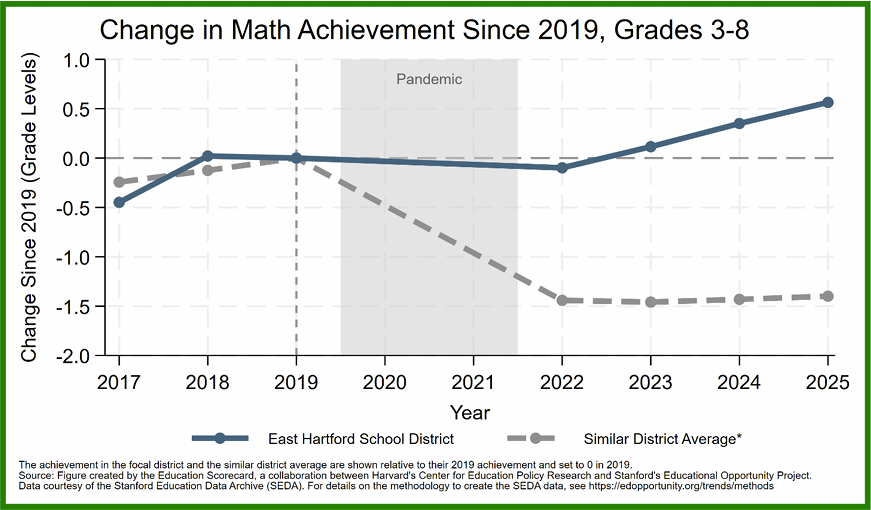
East Hartford’s math achievement rose steadily after 2022, while achievement in similar districts remained well below pre-pandemic levels. Source: Education Scorecard, using Stanford Educational Data Archive data.
A case study from Education Scorecard points to aligned curriculum and assessment, sustained professional learning, and a districtwide commitment to problem-based mathematics as factors supporting the district’s progress. East Hartford’s math leaders would add one more factor: the order in which they did things.
Before IM Math reached a single classroom, the district spent a full year building a shared understanding of what effective mathematics instruction should look like. Here’s how East Hartford laid that foundation, and what other districts can learn from its approach.
Starting with the Problem, Not the Product
East Hartford’s previous math curriculum didn’t give students the balance of procedural skill, conceptual understanding, and application the standards call for. So teachers filled the gaps themselves, creating their own resources and pulling from various online materials.
That effort was well-intentioned, but it came at a cost. “It led to some differences between grade levels, between classrooms, and between schools,” said Bob Janes, East Hartford’s secondary math curriculum supervisor. “Pacing varied, and some classrooms emphasized content that wasn’t the major work of the grade.”
The district began exploring deeper questions: How well did the curriculum support teachers in understanding the progression of the standards? Did the materials they were using provide a coherent, vertically aligned learning experience?
“Those questions set us on the path to examine what was the right approach and the right tool to make incremental change for our students, and then transformative change,” said Ellen Delgado, assistant superintendent of teaching and learning.
A Full Year to Build the Vision
Rather than roll out a new curriculum and hope buy-in would follow, the district spent the year before adopting IM Math engaged in professional learning focused on problem-based instruction. Educators explored the five practices for orchestrating productive mathematics discussions, how students build understanding, and why this approach can work for every student, including students with IEPs and multilingual learners.
“So when we brought in IM Math, it really was already motivated,” Janes said. “People were looking for something to support that new learning.”
That year of shared learning also connected to a broader vision for students. East Hartford’s Vision of the Graduate describes students as effective communicators, collaborative team members, self-motivated learners, and curious inquirers. “All of these things are embodied in IM Math,” Janes said.
Pacing as a Roadmap
With a vision for effective mathematics instruction in place, East Hartford made a decision that surprised some teachers: In year one, pacing would be tight, and everyone would stick to it.
“Before IM Math, we didn’t have something that was prioritizing the right things,” said Laura Corpora, East Hartford’s PreK–5 supervisor of math and science. “So now with a coherent curriculum, especially year one at the elementary level, we made sure we followed the pacing guidance and unit organization exactly as it was written.”
When teachers had concerns about the order and timing of units, Corpora’s answer was consistent: Let’s talk about it after you’ve taught a full year.
“After making it through year one, it made so much more sense,” she said. “Teachers had a better sense of it and could say, ‘Oh, I see why unit two comes after unit one, because it really builds on that content.’”
Support That Grew From the Inside
East Hartford’s professional learning didn’t stop when the curriculum arrived. Instructional coaches in every building anchored the work, and an IM Certified® facilitator from the district’s regional education service center, who was also a former East Hartford teacher, worked with the team to tailor professional learning to the district’s goals.
Rather than front-load an overview of the entire curriculum, the district’s PLCs (professional learning communities) started at the unit level, then moved to sections and individual lessons, so professional learning arrived when teachers could put it to use.
Over time, the district introduced learning walks, adapting IM’s IMplementation Reflection Tool to fit local needs, so that professional learning and planning could respond to what was actually happening in classrooms.
“It felt very aligned,” Janes said, “from the classroom to coaches to building leadership up through district leadership.”
The district also listened. After the first year, elementary teachers realized that existing math blocks didn’t leave enough time for IM K–5 Math centers, which they had come to see as essential for building fluency and foundational skills.
“The centers provide the foundation so that when students get into a lesson, they feel more confident and have the skills they need to attack grade-level work,” Corpora said.
So they added a block of time to the day. That block now provides centers or targeted small-group support based on students’ needs.
What Changed in Classrooms
Walk into an East Hartford math classroom today, and the first thing you notice is who’s talking.
“Typically in a math classroom, you would see the teacher talking and students listening,” Corpora said. “But a huge component of IM Math is that students are the doers of math, and that really has taken hold in East Hartford. At any given point during a lesson, students are talking to each other. They’re disagreeing, agreeing; they’re reasoning about things. Everyone is involved. That was the biggest shift.”
That shift has also expanded opportunities for students across the district. “Every subgroup is participating,” Corpora added. “The access is there. Lessons are built in a way that anyone can be part of the lesson and be successful.”
Corpora recalled one school with a large multilingual learner population, where students who might once have sat quietly are now standing at vertical boards, pointing, drawing, and explaining their thinking to their peers.
“That’s such a shift from how we were teaching math historically,” she said. “They wouldn’t have had those opportunities to speak and listen the same way.”
The more active role students play also gives teachers more opportunities to respond to their thinking. “Because of the way the IM Math lessons are built, teachers are able to assess and give feedback fluidly throughout a lesson,” Corpora explained. “You’re able to make a lot more instructional decisions in the moment, rather than waiting so long to act on things.”
Knowing It Was Working
East Hartford’s elementary and middle schools were in their first years of implementing IM Math as districts nationwide were seeing math proficiency decline in the wake of the COVID-19 pandemic.
“We knew this was going to be a journey,” Corpora said. “But right out of the gate, we started to see increases, and by the end of our second full year, proficiency in each grade from 3 through 6 had increased by 6 to 13 percentage points.”
Another sign of progress, which is harder to measure but just as telling, is the conversations teachers are having. Where they once questioned why units were ordered a certain way, they’re now explaining it to teammates.
“You’ll hear, ‘We have to do these lessons, because if we don’t, they’re not going to get this part,’” Corpora said.
Janes sees it in middle school planning meetings, too. When a teacher wants to adjust a lesson, the discussion starts with the district’s vision and the curriculum’s own resources.
“I have had teachers pull up a dependency diagram from the teacher resources as they’re talking about their units to each other,” he said. “We’re not making instructional decisions based on style or preference. We’re making decisions based on student data and the progression of the content itself.”
Advice for Other Districts
For Corpora, the advice is simple: “Stay the course, trust the process.” Five years into elementary implementation, she said, the district understands the curriculum in a way that simply wasn’t possible in year one, and that understanding came from teaching it as designed.
For Janes, it’s about establishing a clear vision before choosing a curriculum. “If you don’t have that vision and you use IM Math as the solution, then it’s not necessarily clear what the purpose of the curriculum is,” he said. “But if you have it, teachers understand the purpose of the curriculum, and they understand how it connects to student needs and the vision of the district.”
For Delgado, it’s about scope. “This was a district improvement initiative,” she explained. “It was tackled from all ends—curriculum, assessment, instruction, professional development—because implementation without a plan can become another failed program.”
Conclusion
High-quality instructional materials gave East Hartford a coherent foundation. But the district’s leaders started with a vision, supported teachers as they put it into practice, and gave the work time to take hold.
Last year, a teacher who had moved out of the district wrote Janes a letter. He described how excited he was to have learned about problem-based instruction and a classroom where students learn by doing and then consolidating their ideas together. He hoped to bring that approach to his new school.
That letter captures what East Hartford built—not just a curriculum adoption, but a shared belief about how students learn mathematics.
Next Steps
Interested in bringing IM Math to your school or district? East Hartford uses IM Math at the elementary level through IM Certified® partner Imagine Learning and at the middle school level through free access on AccessIM®. Discover the IM Math access options that best fit your school or district:
- Access IM Math v.360 for free on AccessIM, including full lessons, printable PDFs, and implementation resources.
- Explore enhanced digital and print versions of IM Math v.360 from IM Certified partners.
Looking for implementation support?
- Learn about IM Certified Professional Learning and implementation support designed to help educators deepen their understanding of IM Math and strengthen instruction over time.
- Start free, self-paced training modules, organized by grade band, with classroom videos and practical implementation guidance.
- Connect with our team to discuss the support that can help you build a strong, sustainable IM Math implementation.