
By the Illustrative Mathematics team
Every cohort of Los Angeles Unified School District (LAUSD) middle schools highlighted in a new case study saw gains in math proficiency after adopting IM® Math. Those gains ranged from 2.2 to 9.9 percentage points.
But the results are only part of the story.
The new case study from Columbia University’s Center for Public Research and Leadership (CPRL) shows what can happen when high-quality instructional materials are paired with professional learning, sustained support, and a deliberate strategy for building change from the ground up.
What started in 2019 as a voluntary pilot in eleven middle schools grew—cohort by cohort, over six years—until almost every LAUSD middle school was using a shared, high-quality math curriculum. Getting there required more than expanding access to the materials. It required building the structures and support needed for strong implementation to take hold.
From a Pilot to Districtwide Momentum
Before this work began, math instruction across LAUSD varied considerably from classroom to classroom. Teachers often made their own decisions about materials, pacing, and instructional approaches, and students did not consistently experience the same level of rigor or access to grade-level mathematics.
District leaders recognized the need for change.
In 2018, the Partnership for LA Schools introduced IM Math in the secondary grades of the 20 LAUSD schools it manages. Those schools became an early demonstration of what a different approach to mathematics instruction could look like—one that centered student thinking and gave students more opportunities to make sense of mathematics.
Other educators noticed.
District leaders visited classrooms. Teachers and school leaders heard from colleagues. And interest began to spread organically.
LAUSD then created an opportunity for middle schools to voluntarily opt into IM Math. Eleven schools joined the first pilot in 2019–20. The following year, another 100 schools followed. Over six school years, that opt-in approach expanded until almost every LAUSD middle school was using IM Math through IM Certified® partner Imagine Learning.
High-Quality Materials Were the Starting Point
The curriculum gave educators a shared foundation for rigorous, grade-level mathematics. Instead of asking individual teachers to create rigor from scratch, IM Math provided lessons designed around mathematical understanding, problem solving, and student thinking.
Math teacher Cristobal Garcia described the difference this way in the CPRL case study: “IM addresses the why.”
That shift changed what mathematics could look and sound like in classrooms. Students increasingly worked together, discussed their reasoning, grappled with problems, and made sense of mathematical ideas.
But LAUSD’s experience also reinforces an important lesson: High-quality instructional materials alone are not enough. The district had to build a system capable of supporting teachers as they changed their practice.
Investing Deeply in Professional Learning
As more schools opted in, LAUSD and its partners developed increasingly robust implementation supports. In the early years, facilitators from IM and Imagine Learning led coaching and professional learning, helping educators build a strong foundation in the curriculum and its instructional approach. The Partnership for LA Schools and Leading Educators, an external partner supporting implementation, also provided coaching and professional learning across the district’s regions.
Over time, LAUSD also built internal capacity, preparing regional math coordinators, coaches, teacher leaders, and other educators to facilitate professional learning. One particularly powerful structure was the lesson lab.
Teacher teams came together for six-hour sessions that combined professional learning, collaborative lesson planning, live teaching with students, and evidence-based reflection afterward. Rather than only talking about classroom-centered instruction, educators could see it in action, study how students responded, and reflect together on how to strengthen their practice.
The goal wasn’t simply to teach educators how to use a set of materials. It was to develop the people and practices needed to make strong instruction sustainable.
Using Data to Learn, Not to Judge
LAUSD made another consequential choice. It separated implementation monitoring from formal teacher evaluation. Educators and leaders used the IM-specific IMplementation Reflection Tool (IRT) to examine how lessons were being used, how teachers facilitated student discourse, and how instruction responded to student thinking.
Because the information was intended for improvement rather than evaluation, educators could be candid about where they were succeeding and where they needed support. That distinction helped create what Partnership for LA Schools’ Diana Mosha described as a culture where people could “feel safe to change.”
The district then used classroom observations, coaching, and regular data reviews to identify patterns and refine its approach. Over time, for example, the data showed that consistent participation in a single professional learning pathway across the year was associated with stronger gains in student outcomes than participation across multiple offerings.
Gains Across Every Cohort
The results documented by CPRL are encouraging. Despite entering the work at different times, every cohort highlighted in the case study showed gains in math proficiency on the California state assessment for grades 6–8:
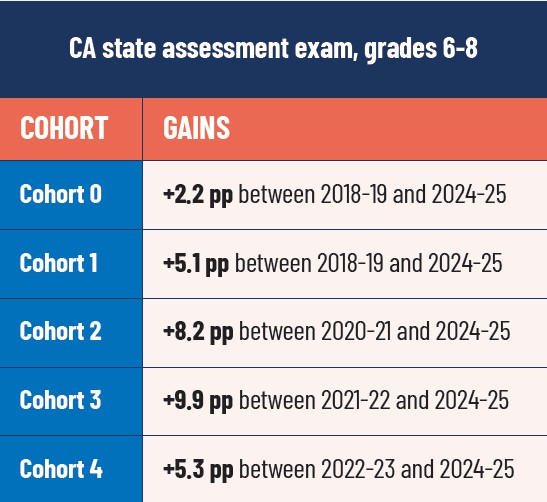
*Cohort 0 adopted IM Math in 2019-20; Cohort 1 in 2020-21; Cohort 2 in 2021-22; Cohort 3 in 2022-23; Cohort 4 in 2023-24. Note that Cohort 1’s baseline is 2018-19 because there was no outcome data available in 2019-20 due to COVID. Graphic from CPRL’s All Systems Go report (July 2026)
CPRL also reports early analysis from Leading Educators showing that students in schools identified as “strongly implementing” gained ground at three to five times the rate of comparison sites, with particularly notable progress among multilingual learners and students with disabilities.
And the change extends beyond test scores.
The case study describes classrooms where students who once primarily watched teachers demonstrate procedures are now working collaboratively, explaining their reasoning, asking questions, and making sense of mathematics together.
As LAUSD Region West Math Coordinator Mariana Kayichian observed, students are now “grappling and exploring and making sense of the mathematics.”
Building for Long-Term Sustainability
As implementation deepened, LAUSD focused on how to sustain the work over time and build the capacity to carry it forward. Teachers and coaches took on larger roles in professional learning. Schools built common planning time into schedules. Peer observation created opportunities for educators to learn from one another.
Shared classroom “look-fors” gave teachers and leaders a common language for high-quality, classroom-centered instruction.
LAUSD also extended that work beyond the classroom. Schools held workshops to help families understand student reports and see mathematics not simply as a grade, but as a process. That outreach reinforced the district’s broader vision of helping students see themselves as mathematicians and recognize the connections between mathematics and the world around them.
Together, these structures are helping LAUSD embed strong implementation into the day-to-day work of schools and the district. That foundation matters as LAUSD prepares for its next chapter. The district is moving toward a unified K–8 curriculum adoption beginning in the 2026–27 school year, with implementation beginning in 2027–28.
LAUSD enters this next phase with something it didn’t have six years ago: a shared instructional vision, experienced teacher leaders and coaches, stronger professional learning structures, and years of lessons about what it takes to implement a high-quality curriculum well.
Conclusion
LAUSD’s experience offers a powerful reminder for districts pursuing stronger math outcomes: Adopting high-quality instructional materials is an important step, but sustainable improvement depends on what districts build around them.
Over six years, LAUSD paired IM Math with professional learning, coaching, continuous improvement, and investment in educators. Those efforts helped strengthen classroom instruction while building greater coherence across a large and complex school system.
High-quality instructional materials can provide the foundation. When strong materials are paired with a shared instructional vision and the structures and support educators need to implement them well, that foundation can become something much bigger: a coherent system in which more students have the opportunity to see themselves as mathematicians.
Next Steps
Want to learn more about LAUSD’s implementation journey? Read the full CPRL case study for a closer look at how the district built greater coherence around mathematics instruction over time.
Interested in bringing IM Math to your school or district?
- Access IM Math v.360 for free on AccessIM to experience the curriculum and implementation resources.
- Explore enhanced digital and print versions of IM Math v.360 from IM Certified® partners, and find the option that’s right for your school or district.
- Explore California IM Math v.360 to learn more about the version designed specifically for California schools.
- Learn about IM Certified® professional learning and implementation support designed to help educators deepen their understanding of IM Math and strengthen instruction over time.
Want to learn more about bringing IM Math to your school or district or strengthening your implementation? Connect with our team to talk about your goals and the support that can help you build a strong, sustainable IM Math implementation.