
by Fattama Alkaysi, Content Specialist, PK–6
In this series of blog posts—The Anatomy of an IM® Math Lesson—we’ll take a closer look at each part of an IM Math lesson and how it contributes to meaningful student learning. After exploring the launch in our first post, we’re turning our attention to the warm-up and how it helps invite every student into the mathematics.
If you’re new to IM Math or looking for additional implementation support as you read, our free on-demand training modules provide classroom examples and practical guidance that complement the ideas explored throughout this series.
Typically, we like to have an idea of what’s coming and prepare ourselves for what we’re about to do. Think about how much better a workout feels when you’ve had a chance to warm up your body. Or how much easier it is to join a conversation when you already know the topic and have had a moment to gather your thoughts.
It can be harder and take longer to find our footing when we jump into something without context or a chance to get oriented. Math is no different. That’s why IM Math lessons begin with a warm-up.
What Is a Warm-up?
The warm-up is an instructional routine that begins every IM Math lesson. It serves as a low-stakes invitation for students to engage in the math while reinforcing number sense, fluency, and mathematical thinking. 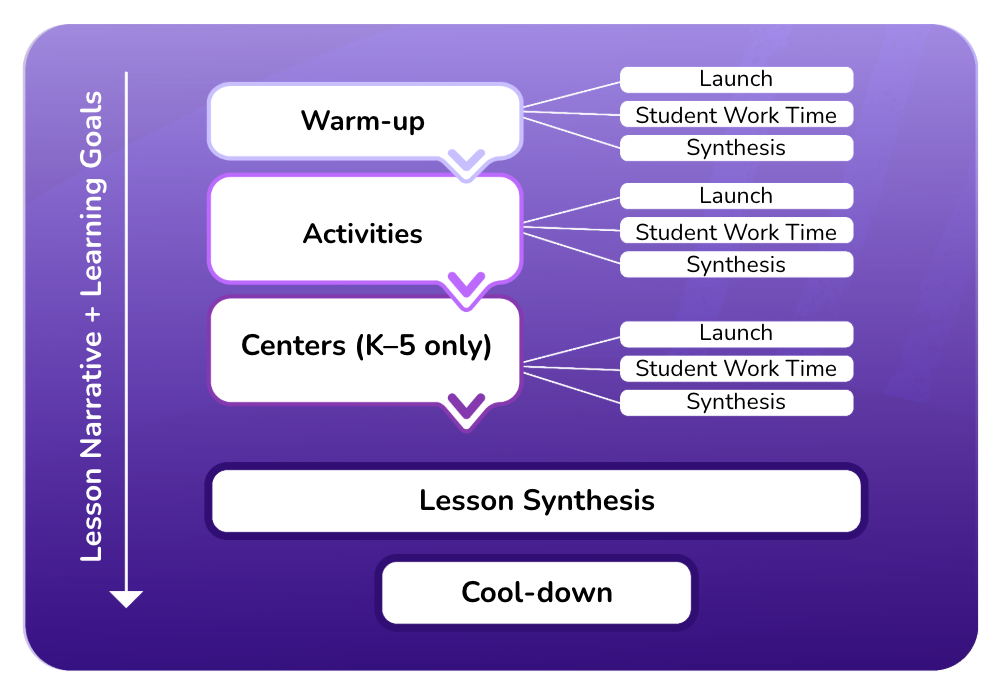
One thing that makes IM Math warm-ups unique is that many of the routines appear throughout the grade level progression. For instance, there are ten different warm-up routines repeated throughout the K–5 curriculum, each designed to provide an opportunity for students to bring their own thinking, experience, and knowledge to the lesson.
“What Do You Know about ____?” invites students to examine representations and discuss what they may already know, giving them an opportunity to build on each other’s knowledge and share their familiarity with a topic.
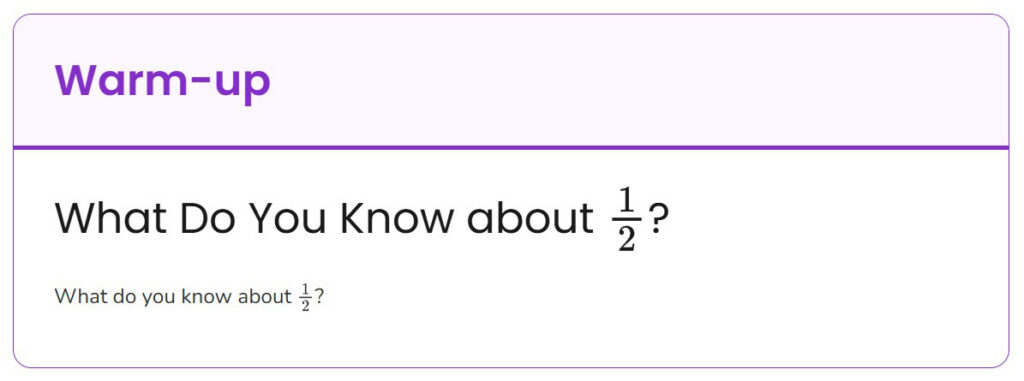 Grade 4, Unit 2, Lesson 1
Another warm-up routine, “Notice and Wonder,” is an open-ended invitation for students to share what they notice or wonder about an image or representation. This routine continues all the way through Grade 12.
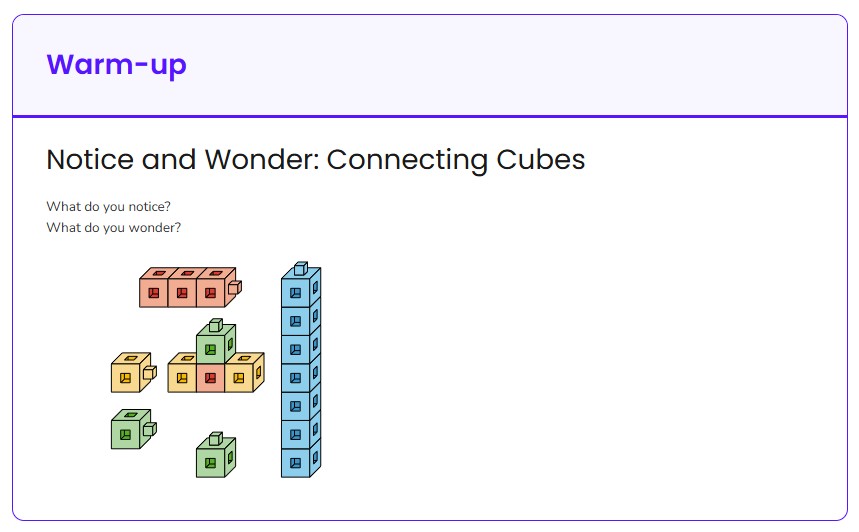 Grade K, Unit 1, Lesson 1
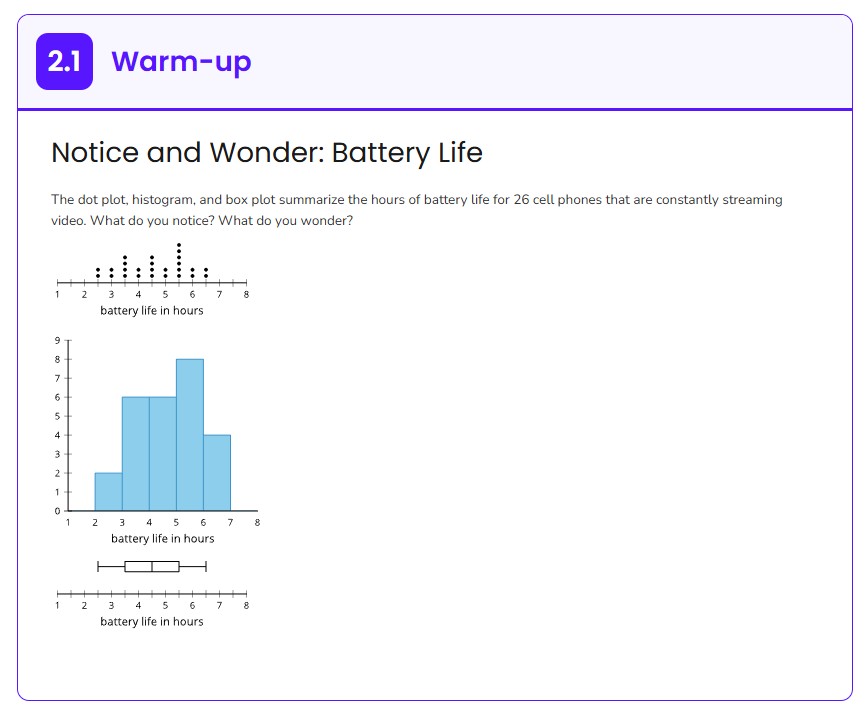 Algebra 1, Unit 1, Lesson 2
Two Ways Warm-ups Support Student Learning
Warm-ups generally serve one of two instructional purposes.
1. Introducing New Learning
Sometimes the warm-up prepares students for the day’s lesson by reconnecting them to familiar ideas, revisiting a previous lesson, or introducing a context they’ll encounter later.
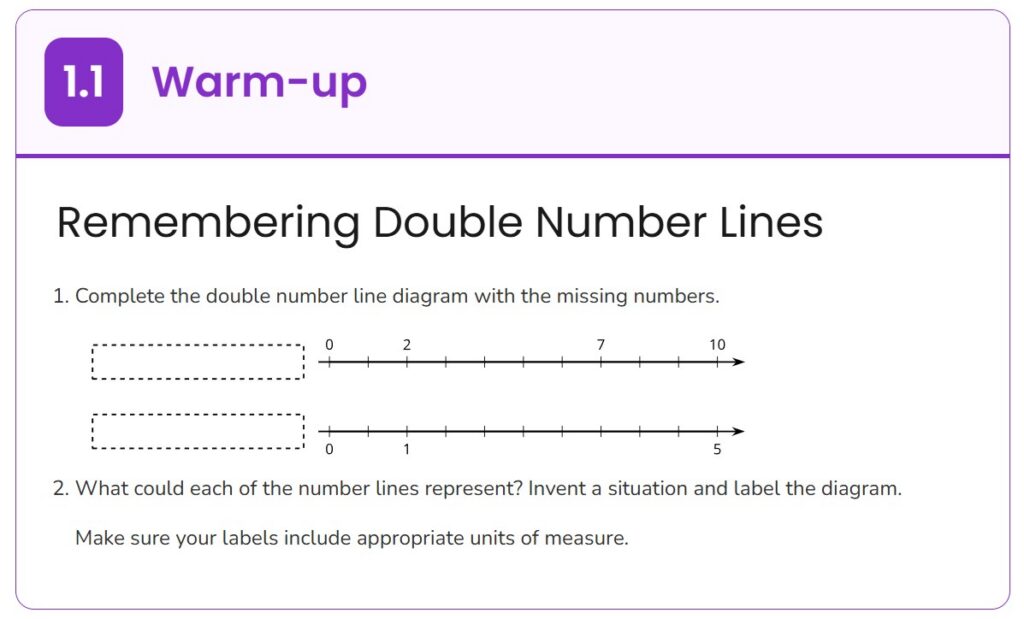 Grade 7, Unit 2, Lesson 1
When serving as an introduction to the lesson, the warm-up may remind students of a familiar context, revisit where a previous lesson left off, or review an idea that may appear later in the lesson so that new mathematical learning is not hindered by unfamiliar context.
2. Strengthening Mathematical Thinking
Other warm-ups, such as “Number Talk” and “Math Talk”, are designed to strengthen number sense, procedural fluency, and mathematical reasoning.
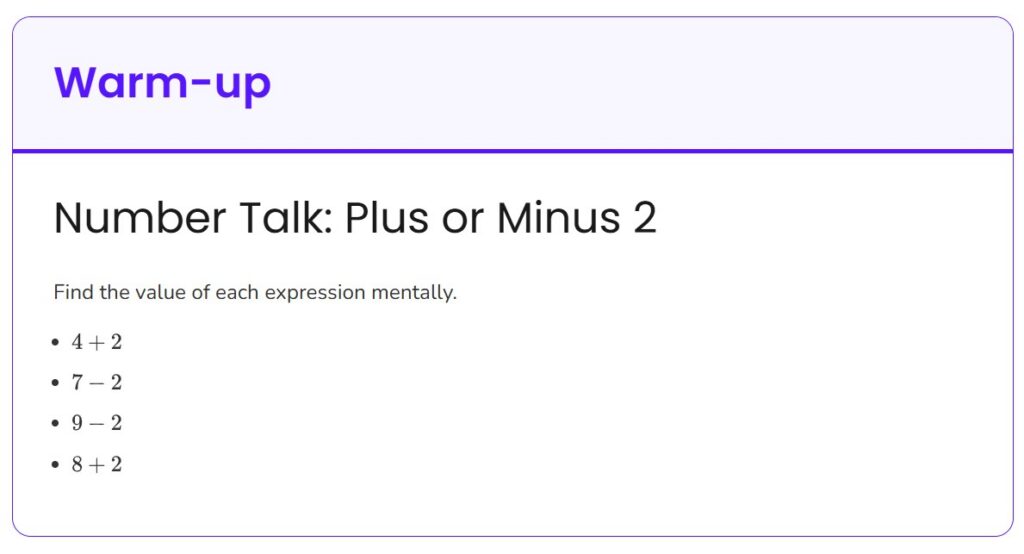 Grade 1, Unit 1, Lesson 14
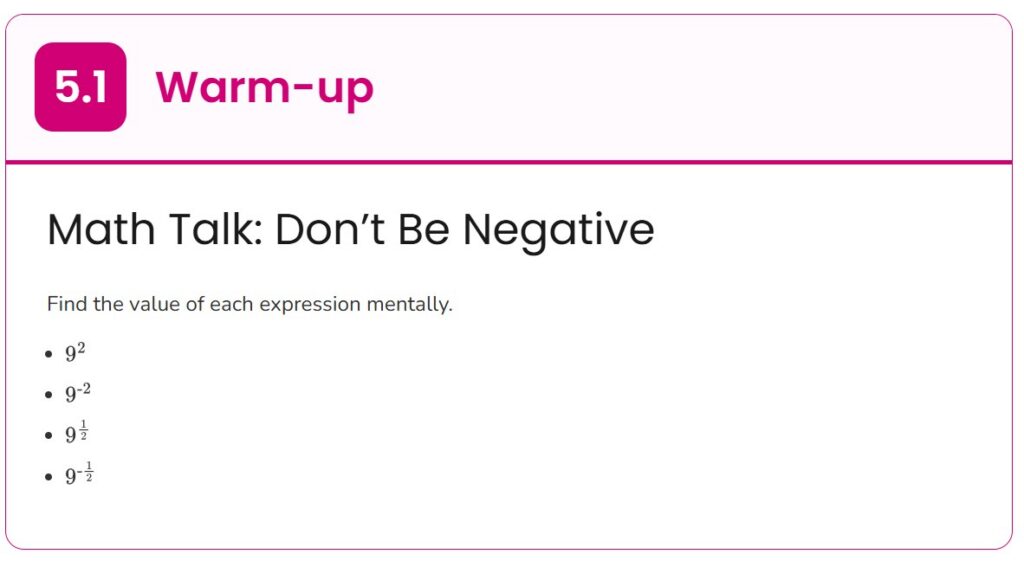 Algebra 2, Unit 4, Lesson 5
Students engage in mental math, recognize patterns, compare strategies, and make connections between mathematical ideas. Over time, these repeated opportunities help students become increasingly flexible and efficient mathematical thinkers.
Keeping Warm-ups Focused and Manageable
One of the most common questions teachers ask is:
“What if my warm-up takes too long?”
Warm-ups are intentionally discussion-based and invitational. Rich conversations are a sign that students are thinking mathematically. At the same time, the warm-up is just one part of a coherent lesson.
Once students are familiar with a routine, the goal is typically to spend about five to ten minutes before moving into the day’s activities. Students don’t need to completely master every idea during the warm-up. They’ll revisit and deepen those ideas throughout the lesson and across future lessons.
Protecting time for the remainder of the lesson—including the synthesis—is just as important as protecting time for the warm-up. (For more pacing guidance, please read Pacing with Purpose in IM® Math.)
Benefits of Warm-up Routines
Warm-ups don’t just prepare students for today’s lesson. They help build the mathematical community that supports learning all year long.
Warm-ups can help teachers show students that their thinking is valuable by making student thinking visible within classroom discourse. They promote the use of multiple strategies, encourage students to build connections between ideas, and help students see their ideas as formal mathematical symbols and representations.
One of the greatest strengths of IM Math warm-ups is their consistency. As warm-up routines become familiar, they become even more invitational. Students know what to expect and may feel more comfortable engaging with the math. The familiarity of a warm-up routine can free up cognitive space, allowing students to focus more fully on the learning itself rather than the method of learning.
“Consistently using a small set of carefully chosen routines is just one way to lower the cognitive load for teachers. Refocus the energy—previously used on structuring an activity—on other objectives, such as understanding students’ thinking and how mathematical ideas are playing out.” — IM® K–5 Math v.360 Course Guide
How a Warm-up Supports the Learning Goal and Lesson
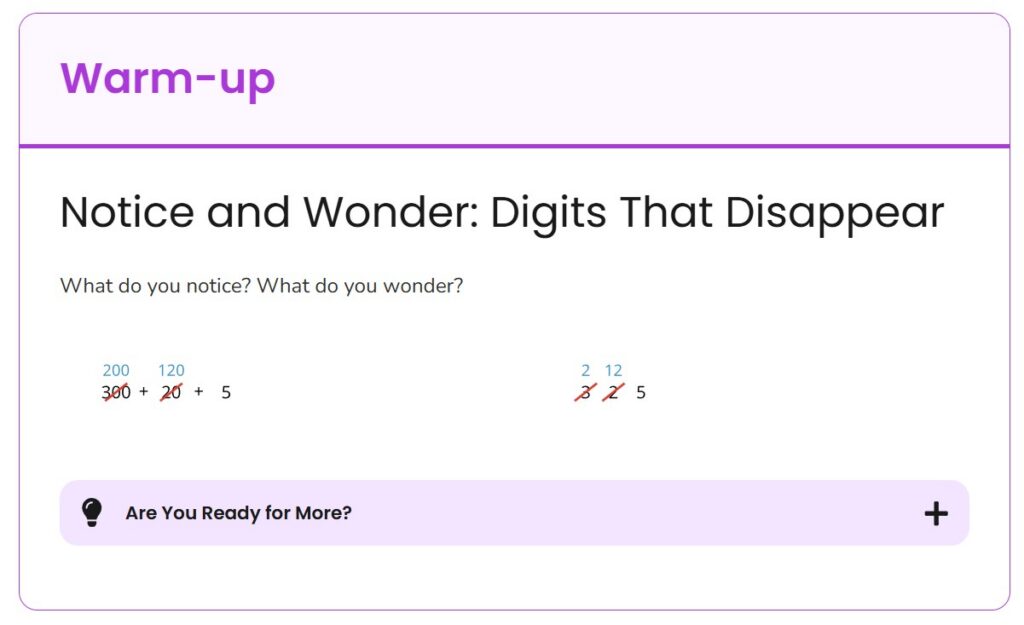
Let’s take a closer look at a Grade 3 Notice and Wonder warm-up from Unit 3, Lesson 10.
The warm-up, “Notice and Wonder: Digits that Disappear” is an invitational warm-up that introduces the lesson goal: “Let’s learn another algorithm to subtract.” Its purpose is to help students notice how a decomposed number can be recorded, preparing them to apply that understanding later in the lesson activities.
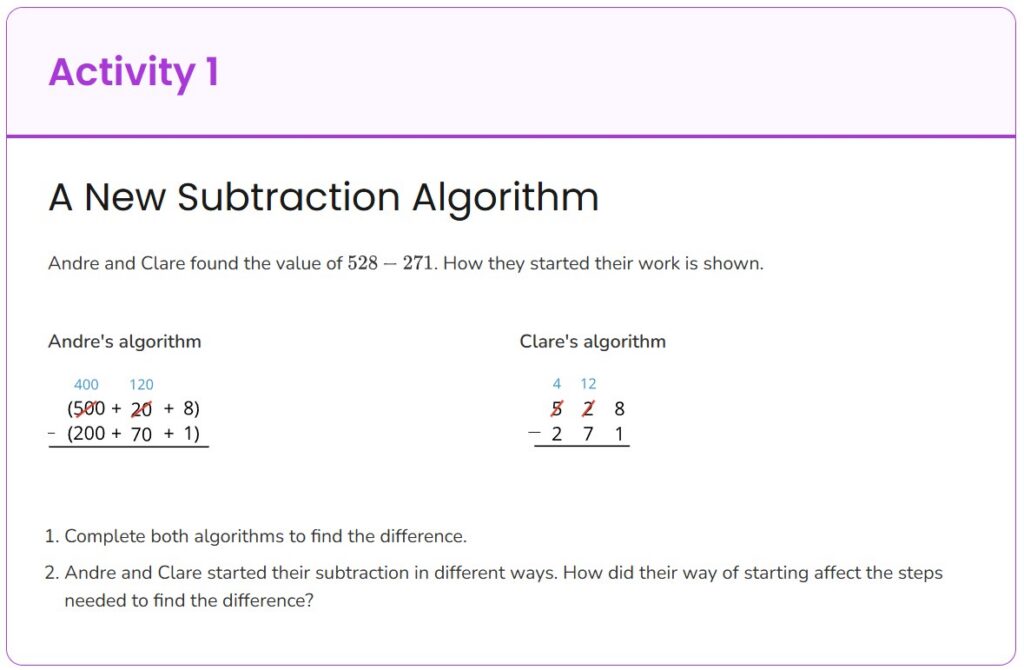
In the first lesson activity, students take a closer look at two different algorithms that mirror what was introduced in the warm-up.
In Activity 2, students use Clare’s algorithm to solve several subtraction problems independently before sharing with a partner.
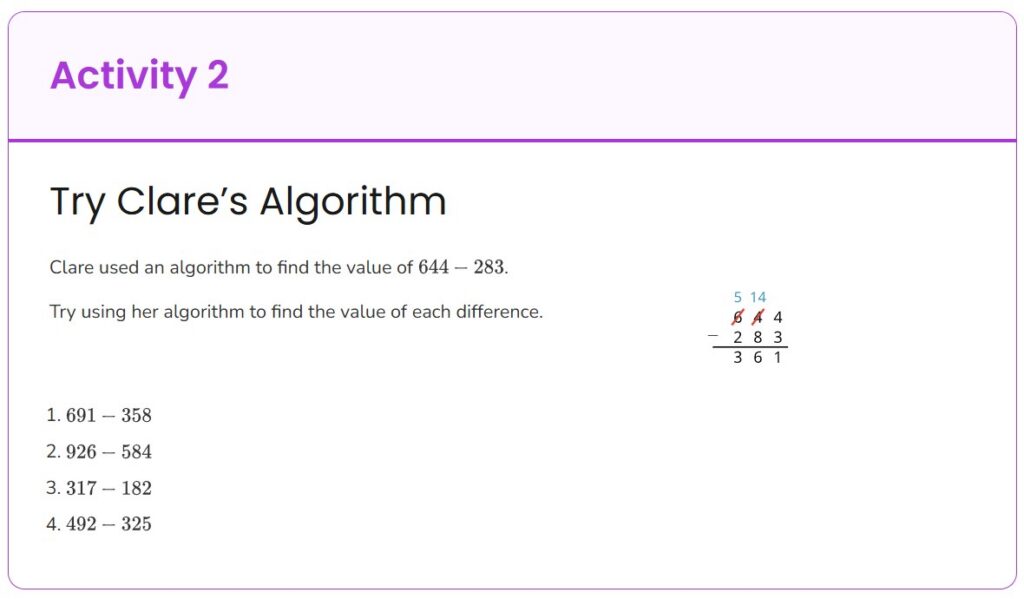
The warm-up naturally introduces the lesson in a low-stakes, invitational manner that allows all students to engage with the learning. From there, the lesson activities build progressively from examining a decomposed notation to solving subtraction problems using algorithms that record the difference in each place-value position.
A warm-up isn’t simply the first activity in an IM Math lesson. It’s every student’s first opportunity to engage with the mathematics, contribute ideas, and begin building connections that will deepen throughout the lesson. By easing students into mathematical thinking, the warm-up creates an inviting transition into the day’s learning.
Conclusion
Giving students time to orient themselves before diving into a new task matters. Jumping directly into lesson activities can unintentionally leave some students behind before the learning has even begun. A thoughtfully facilitated warm-up helps ensure that every student has an accessible entry point into the mathematics.
Warm-ups also provide opportunities for students to share their own experiences and ideas while building on the thinking of their classmates. As routines become familiar, students know what to expect, grow more comfortable contributing to discussions, and develop habits of mathematical discourse that extend far beyond the first few minutes of class.
As you prepare your next lesson, consider:
- What is the purpose of today’s warm-up?
- How does it connect to the lesson’s learning goal?
- What opportunities will students have to share their thinking?
- How will the routine invite every student into the mathematics?
Are You Ready for More?
Connect with the Illustrative Mathematics team and ask about “Establishing Instructional Routines.” Schedule a call or email us at [email protected].
Looking for additional implementation support? Our free, self-paced on-demand training modules help teachers prepare lessons, understand instructional routines, build mathematical community, and confidently implement IM Math.
- classroom videos
- grade-specific examples
- companion guides
- available for every K–12 grade band
 Fattama Alkaysi
Content Specialist, PK–6
Fattama is a PK–6 content specialist and former classroom teacher with seven years of experience helping students develop confidence and understanding in mathematics. Guided by her passion for equitable and engaging learning, she designs instructional materials with the content team that promote curiosity, joy, and champion student voice.