
By Elisa Smith, Senior Specialist, 5–12 Content
My family likes to take road trips. Driving gives us the freedom to make our own schedule, stop along the way, and take in the varied landscapes of our country.
Each night we talk about what’s ahead the next day: how far we’re going, what we hope to see, and whether we have time to linger or need to keep moving. We’ve learned that the trip goes more smoothly when we understand the route ahead.
The lesson narrative in an IM® Math lesson can serve a similar purpose. It gives teachers more than a preview of what will happen in the lesson. It helps them see the mathematical story: where students have been, what they are currently navigating, and what today’s work is preparing them to do next.
That larger view can make lesson preparation more purposeful. It can also help answer an important planning question:
What do my students need to make sense of today, and what can I trust they will have more time to develop later?
Let’s look at some ways teachers, coaches, and administrators can leverage the information found in the lesson narratives, along with the learning goals, to improve planning and time management, and contribute to overall teacher understanding.
What is the Lesson Narrative?
The lesson narrative provides an overview of the mathematical purpose and progression of a lesson. Depending on the lesson, it may explain:
- the mathematical content students will work with and how it connects to prior and future learning
- the meaning of any new terms introduced in the lesson
- how the mathematical practices come into play, as appropriate
- how the activities work together to develop an idea
- technology or other considerations that may affect lesson preparation
IM Math Lesson Structure
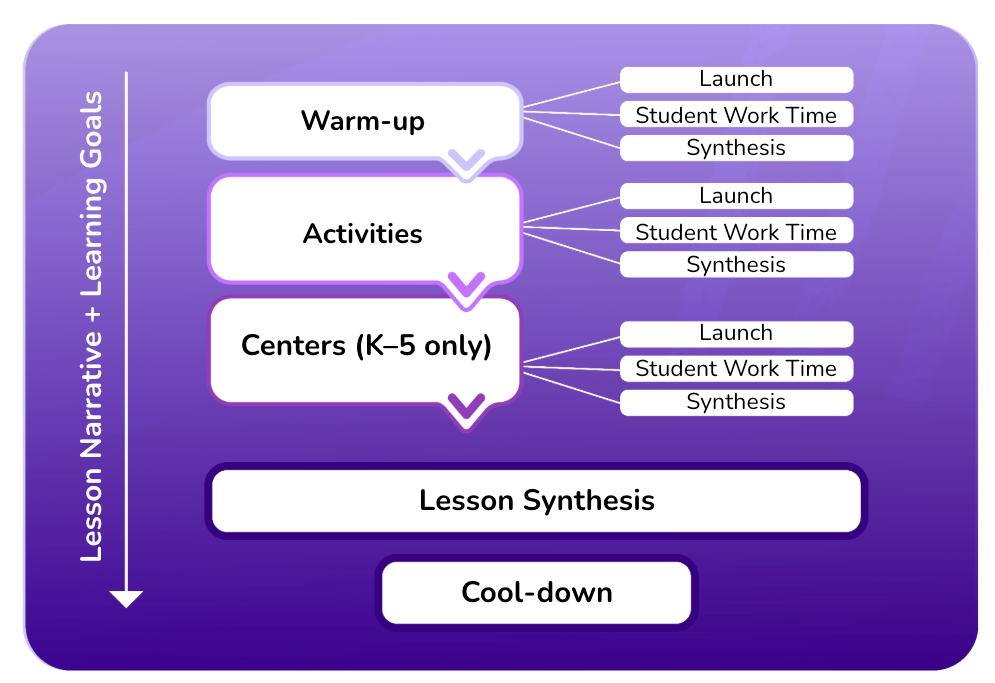
IM Math v.360 also includes narratives at the course, unit, section, and activity levels. Each helps to orient teachers to the mathematical purpose of the instruction ahead. The lesson narrative sits in an especially useful place. It is broad enough to show how the lesson fits into the larger sequence, but specific enough to support decisions about the day ahead.
Seeing the Mathematical Story of a Lesson
Consider the lesson narrative for an eighth-grade lesson early in a unit on the Pythagorean Theorem and irrational numbers.
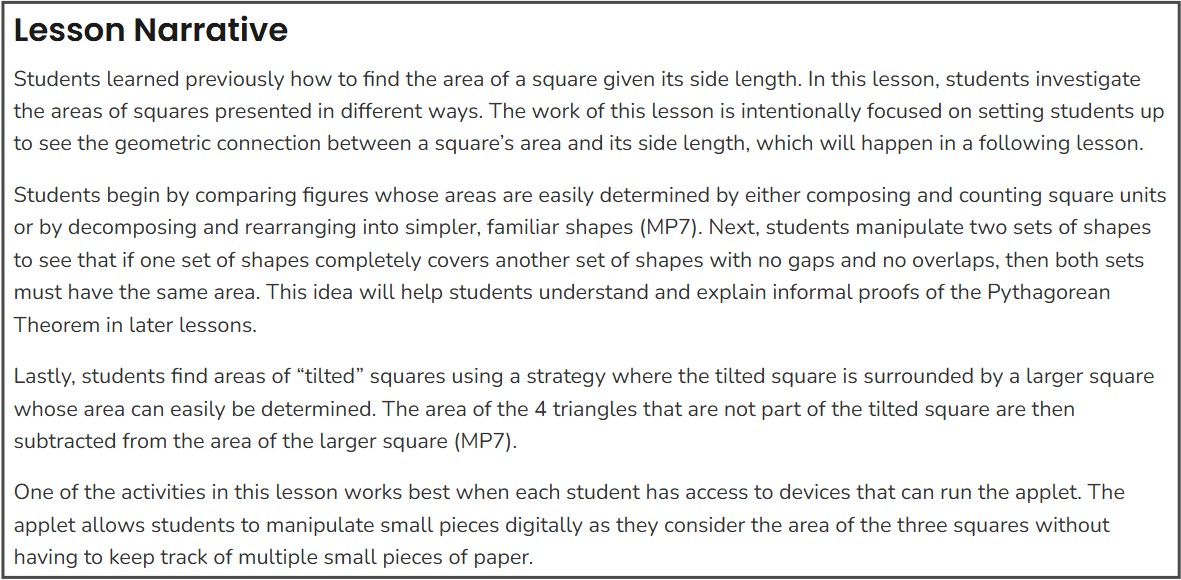
Notice . . .
- The opening paragraph connects students’ prior learning to the main idea of the day and explains how the lesson will set students up for future learning.
- The next two paragraphs give a brief overview of how the activities unfold.
- Math Practice 7 (look for and make use of structure) is highlighted twice.
- The last paragraph details technology considerations.
Reading the narrative before diving into individual activities gives a teacher a lens for the lesson.
Wonder . . .
- What is the main idea students are developing?
- Why are these particular activities sequenced this way?
- What kinds of student thinking are especially important today?
- How does this lesson prepare students for what comes next?
Now consider the narrative for the very next lesson.
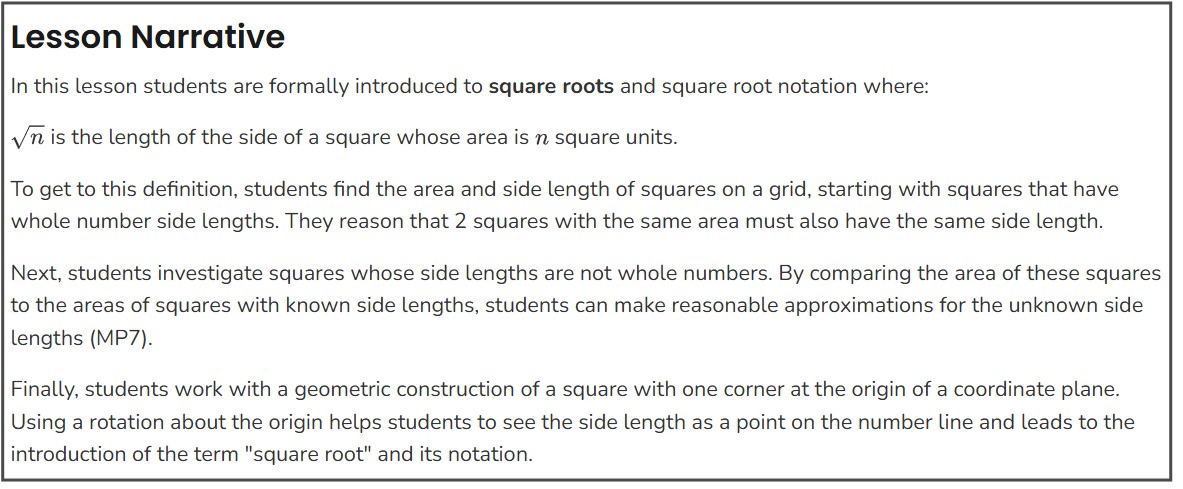
Notice . . .
- The new term “square root” is described.
- This narrative follows a similar structure, with the next paragraphs offering a sense of how the activities build on each other.
- Math Practice 7 is again highlighted.
Wonder . . .
- How will this geometric way of thinking about squares and square roots impact student understanding of the Pythagorean Theorem in a later lesson?
- What is the main focus of each lesson, and what is its purpose in the learning sequence?
Taken on its own, each narrative helps a teacher prepare for that lesson. But reading the two narratives together reveals the beginning of a larger arc: Students are not expected to encounter the term square root and immediately master everything associated with it. The concept is developing across a sequence of lessons.
That matters for instruction.
A teacher who sees the larger arc can introduce the new language in the context of the day’s mathematics without feeling pressure to stop and teach everything students will eventually need to know about square roots.
Reading Across Lessons to See the Arc
The value becomes even clearer when teachers read several lesson narratives in sequence.
Across the first four lessons of this unit, the mathematical progression begins with geometric connections between the areas of squares and their side lengths. The term “square root” and related notation appear in the second lesson, but subsequent lessons give students additional opportunities to work with and make sense of the concepts. By the fourth lesson, the narrative lets us know that this work is leading to an understanding of irrational numbers.
That can help teachers make more informed choices from the beginning. Rather than treating every new idea as something students must fully understand the moment it appears, teachers can ask:
What understanding is this lesson responsible for developing, and what will continue to grow over time?
The lesson narratives also reveal shifts in the kinds of mathematical thinking emphasized across the sequence. In this example, Math Practice 7 (look for and make use of structure) is emphasized in the first two lessons, while Math Practice 2 (reason abstractly and quantitatively) is emphasized in the next two lessons.
While other Math Practices are incorporated into the activities of each lesson, seeing that pattern can help teachers notice a purposeful shift: Students move from recognizing patterns to making sense of an abstract idea in the face of concrete representations.
The narratives are not simply describing four separate lessons. Read together, they reveal the mathematical journey students are taking.
The Lesson Narrative as a Unit Planning Tool
Unit planning is a lot like making the itinerary for a trip. Where will we stop each day, and what will we see along the way? When planning for an upcoming unit of instruction, consider reading the lesson narratives for each lesson in order before looking closely at every activity.
As you read, ask:
- Which ideas are introduced and then revisited or deepened later?
- Which mathematical practices are emphasized across the unit?
- Can you see the roadmap of conceptual understanding?
- How do the lesson narratives, learning goals, and unit assessments work together to clarify what students are building toward?
This view of the unit can also help teachers resist the urge to over-teach. Knowing what comes next can help teachers preserve the intended progression rather than adding explanations, procedures, or terminology before students have had a chance to make sense of the mathematics themselves.
The Lesson Narrative as a Daily Planning Tool
When it comes to lesson planning, everyone does it a little differently. Some teachers plan one day at a time, while others may look a few days to a week ahead.
Whatever your planning approach, consider rereading the applicable lesson narrative(s) for upcoming instruction, keeping in mind the lesson’s place in the mathematical arc of the unit. Then, read each activity narrative within the lesson and compare it with the learning goals as you think about the flow of the day.
Ask yourself:
- What do I understand now that can help me with time management?
- What new terms are being introduced, and how can I best prepare my students for the new language?
- What do I NOT have to teach in this lesson because I now know it is coming up in a later lesson?
Conclusion
Even with the best-laid plans, every road trip has its twists, turns, and unexpected detours. But understanding the terrain, knowing when to slow down or speed up, and recognizing the must-see stops helps us make more informed decisions about what students need to make sense of today and what they will have opportunities to develop later.
The lesson narrative can be a valuable part of that roadmap, allowing us to focus more on the joy of the journey.
Next Steps
As you plan your next few lessons or next unit of study, consider:
- How does knowing the overall trajectory of the lessons help me plan what to teach and what not to teach on any given day?
- How can I pair the lesson narrative and the learning goals to understand what is most important?
- Which math practices are emphasized in each activity, and how can I support that type of thinking?
Ready for More?
Connect with the Illustrative Mathematics team and ask about “Understanding Math Content Progressions Across Grades” (K–5 educators) or “Collaborative Unit and Lesson Planning PLC” (6–12 educators). Schedule a call or email us at [email protected].
Looking for additional implementation support? Our free, self-paced on-demand training modules help teachers prepare lessons, understand instructional routines, build mathematical community, and confidently implement IM K–12 Math.
Explore the Anatomy of an IM® Math Lesson Series
This post is part of our Anatomy of an IM® Math Lesson series, which takes a closer look at the purposeful design of each part of an IM Math lesson, and how those components work together to support students in making sense of mathematics.
Continue exploring the series:
- Making the Launch Work for You
- Setting Up Students for Success with the Warm-up
- Why Centers Matter
- Making Meaning in the Lesson Synthesis
- Making Instructional Decisions with the Cool-down
 Elisa Smith
Senior Specialist, 5–12 Content
Elisa Smith is an accomplished educator with over 20 years of classroom experience and a master’s degree in teaching. She has earned and renewed National Board Certification and is passionate about helping teachers create classrooms where every learner and every idea is valued.
As a Senior Content Specialist at Illustrative Mathematics, Elisa leverages her expertise in building conceptual understanding to create coherent and engaging experiences for teachers and students.